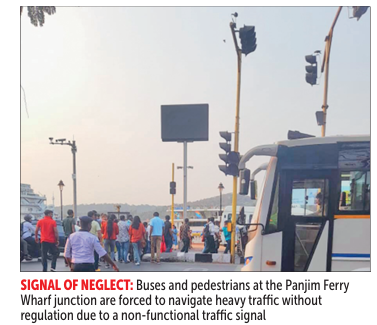
In a smart city where AI-enabled cameras are quick to flash for traffic vi olations, the very signals they monitor have largely disap peared or ceased to function. Panjim’s infrastructure pre sents a stark contradiction: high-tech surveillance paired with non-functional basics. Frustrated by this imbalance, citizens are no longer just complaining; they have been staging symbolic “begging’ protests to fund their repairs which they claim the govern ment cannot afford. Most of non-functional traf fic signals in the city reflect a troubling apathy toward ba sic infrastructure essential for smooth traffic flow. Frustrated by the lack of response to repeated com plaints, residents of Merces recently staged a protest at the Merces junction to draw the authorities’ attention. Like several other locations, this junction has become a major safety hotspot due to prolonged signal failure. The issue gained further public attention when the Santa Cruz Congress Block Committee organised a unique protest at the same site, highlighting the risks faced by commuters and pedestrians.
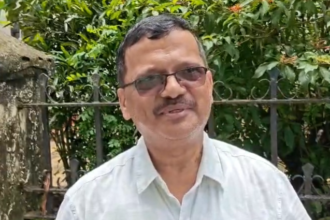
Protesters alleged that their repeated appeals to the au thorities have gone unaddressed. As part of the demonstration, party workers symbolical ly begged for alms from motorists, claiming the collected funds would be used to “help the government” repair the faulty traffic signals. The act was intended to underscore what they described as administrative apathy toward a critical public safety concern. Reports indicate that key junctions, including Merc es—a major intersection connecting NH-66 and NH-748 — have had non-functional signals for over a year, raising serious safety concerns. The situation has been further ex acerbated by Smart City road works, during which certain signals, including those near the Vivanta junction, were removed, resulting in unregulated traffic flow. Although AI-enabled CCTV cameras have been installed across Panjim and Porvorim to issue challans for viola tions such as signal jumping and over-speeding, traffic signals themselves have either disappeared or remain non-functional. In the absence of working signals, motorists are forced to navigate heavy traffic without regulation, significantly increasing the risk of accidents and near-miss incidents, especially during peak hours. Protesters have warned that unless immediate cor rective measures are taken, the junction could witness serious accidents. They have demanded urgent repair or replacement of the signal system, along with improved traffic management. Road safety experts have also highlighted sys temic issues in traffic in frastructure planning. Speaking to O Heraldo, Dilip Naik, founder of the Goa Road Safety Forum, said, “First and foremost there must be a separate dept dedicated for road safety engineering works, like proper junction de signs (Rotary, roundabout, T-junction), thermoplastic road marking, signboards, and other road safety fur niture. It is seen that traffic signals are not holistically designed, meaning one person erects traffic sig nals, someone else does maintenance, and often maintenance periods are shorter. Signboards per taining to the junction where traffic signals are erected are done by some one and road marking by a third agency. PWD engi neers are supposed to be experts of all three works but unfortunately they are experts of none of the three works and they are supposed to make a holistic design which is never done.” Anant Agni, Member Secretary, Movement for Amity to wards Roads in Goa (MARG), said, “Government is not at all serious about traffic management across Goa. Traffic signals are a must in every city and town considering the heavy flow of vehicles. These signals could be managed even by outsourcing to some agencies through CSR initia tives. To minimise traffic congestion, the government and the CCP should take immediate initiative and install sig nals at all important points in the city.” John Nazareth, Block President of the Santa Cruz Con gress Block Committee, said, “Some years ago, Panjim had several functioning traffic signals, but over time they have gradually disappeared. With a significant increase in vehicular movement compared to earlier years, cross ing roads has become increasingly risky for pedestrians. At present, barring the signal near Kala Academy, there are virtually no operational traffic lights in the city. With Panjim witnessing a steady influx of tourists—many of whom use rented vehicles and are unfamiliar with local roads—the absence of traffic signals makes it even more challenging to regulate speeding vehicles and ensure road safety.” Sources in the Corporation of the City of Panaji (CCP) as well as the Traffic Cell of Goa Police said that the signals are to be maintained by the Imagine Panaji Smart City De velopment Limited (IPSCDL). “The signals are to be maintained by the IPSCDL. How ever, many are not being maintained. Some modifications are also required in the roads so that traffic signals could be repositioned. For example at D B Road if signals are made operational, congestion is experienced instead of easing traffic,” an official of the Traffic Department said. The issue has once again brought the spotlight on urban traffic infrastructure in Panjim, with growing calls for au thorities to act swiftly, restore normalcy, and ensure com muter safety.