We possess the land for over a century: Railways
The Railways have disputed claims by Velsao residents that ongoing dou ble-tracking has blocked the traditional access to more than 20 houses, maintaining that the pathway was nev er legally established as a right-of-way. Replying to queries from the media, South Western Railway (SWR) Chief PRO Dr Manjunath Kanamadi said the Railways maintained that the pathway was only a casual and permissive use of railway land that had been tolerated during single-track operations. The response comes amid a dis pute over ownership and survey records. Villagers and local activ ists have maintained that the dis puted land belongs to local families and have relied on Portuguese-era title documents in support of their claim.

They have also alleged that SWR has failed to produce valid ti tle or land-acquisition documents for the stretch. Kanamadi, however, said RVNL/ SWR maintained that the land had been in the legal possession of the Railways for over a century. He said the ongoing process before the Inspector of Survey and Land Re cords (ISLR) was aimed at verifying and confirming the position and assigning formal survey numbers. “The outcome of the ISLR pro cess regarding the survey numbers is awaited,” he said. On the residents’ claim that dou ble-tracking had destroyed the only traditional access route to more than 20 homes and left families landlocked, Kanamadi said RVNL maintained that the pathway was never a legally established right-of way, but rather a casual and permis sive use of railway land tolerated during single-track operations.
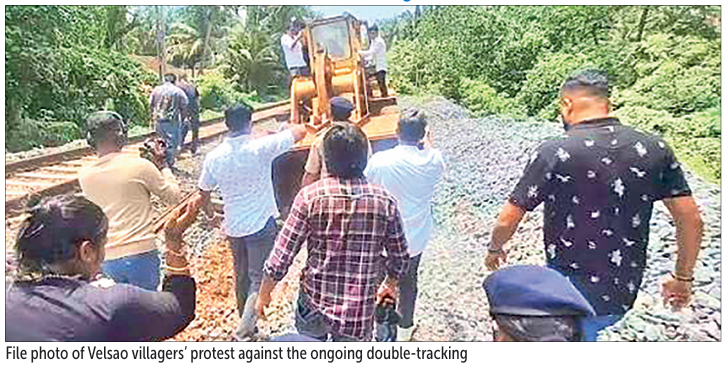
Kanamadi also sought to counter allegations that the authorities had violated administrative directions issued during a June 19 meeting by allowing work to resume be fore the joint ISLR site survey was completed or title documents were produced. He said RVNL maintained that the dis trict administration had withdrawn those directions after learning that the matter was sub judice before the ISLR Court, and that there were no active instructions to halt the work. On the demand that the Railways ensure an access road to the affected houses, Kan amadi said Town Planning and local bod ies, including municipalities and corpo rations, along with the State Government, were responsible for ensuring citizen ac cess through road acquisition. He maintained that railway land dedicat ed to national infrastructure could not be diverted for public access. The Railways’ response comes in ad dition to comments made by SWR in Goa during Monday’s protest in Velsao.
It’s our land, we have right of way: Velsao villagers
Goencho Ekvott (GE), on behalf of Velsao vil lagers, has mounted a de tailed rebuttal to South West ern Railway’s (SWR) position on the disputed stretch of land in the village, challeng ing the Railways’ claim to the property and alleging that its recent actions have vio lated directions intended to protect residents’ access to their homes. GE president Orville Doura do Rodrigues said the villagers’ position was that the disputed stretch had been used “openly, peacefully and continuously” as a public motorable village road from before the exist ing railway track was laid in 1890. He questioned the basis on which SWR was claiming ownership of the land. GE has invoked Section 14(1) of the Goa Land Revenue Code, 1968, which states that lands, public roads, lanes and paths that are not the property of any person are government property, subject to rights of way and other legally subsist ing public or individual rights. Rodrigues said the provision was relevant to the dispute and questioned SWR Chief PRO Dr Manjunath Kanamadi’s posi tion on the land. The villagers have also dis puted SWR’s description of their use of the land as “casual, permissive occupation”. GE pointed out that the disputed land had not been assigned a Survey Number and argued that, consequently, it was the property of the local gov ernment, namely the Village Panchayat. It also maintained that SWR had offered no ba sis for claiming ownership of the land. GE has rejected the claim that the Railways have been in legal possession of the land for more than a century. Rodrigues pointed out that Goa remained under Portuguese rule until 1961 and questioned how the claim of legal railway posses sion for over a century could be sustained.
The villagers have further questioned why the disputed land in Velsao has not been mutated in the name of SWR, while, according to GE, numer ous properties across Goa, in cluding in adjoining Cansaulim and Sancoale, have been mu tated and partitioned in the Railways’ name. Another issue raised by GE concerns proceedings before the Inspector of Sur vey and Land Records (ISLR) in the Right of Way (ROW) matter. Rodrigues said replies to objections raised by villagers had not been filed by SWR for several months, result ing in ISLR (ROW) giving the Railways a “last and final op portunity” to file its reply by August 27.
GE has also questioned SWR’s refer ence to administrative instructions con tained in a June 19 letter. Rodrigues said Kanamadi had not provided details of the claimed withdrawal and appeared to be confusing administrative instructions concerning the Right of Way with the separate title proceedings pending be fore ISLR (ROW). The villagers maintain that the admin istrative instructions specifically required that no action be taken that would result in the complete blockage of residents’ ac cess without a suitable alternative arrange ment. GE has alleged that this direction has been “blatantly violated” by SWR. The dispute has meanwhile acquired a fresh dimension following the detention of two persons working with a wheel load er at the site. According to Rodrigues, the wheel-loader driver and his assistant were detained by Goa Police at Verna at around 1.40 pm and handed over to the Railway Protection Force (RPF) at Vasco da Gama at around 3 pm. Rodrigues said the RPF had no jurisdic tion over the land abutting the existing rail way track and that the matter should have been handled by the Goa Police.
According to locals, at around 9 pm on Monday, Congress leader Amit Patkar, who was at the forefront of the protest, got the two men released after offering himself in their place. An FIR was subsequently filed against him, while the two workers were let off. The matter took another turn when the wheel loader subsequently went missing. Rodrigues said Patkar was filing a vehi cle-missing complaint with Verna Police Station. At the same time, two affected villagers were in the process of filing an FIR against SWR, Rail Vikas Nigam Ltd (RVNL) and Surya Construction for alleged criminal trespass. The villagers have also raised con cerns over possible alternatives being considered to create a Right of Way. Rodrigues said the local administra tion, comprising the Deputy Collector and Mamlatdar, had spoken to Velsao Sarpanch Maria Diana Gouveia and in formed her of three probable options for creating the Right of Way. GE contends that the proposed options could have a severe impact on residents. According to Rodrigues, more than 25 her itage houses situated three and four rows deep could effectively be left with access only through their kitchens. The villagers have also raised safety and quality-of-life concerns arising from the proximity of the railway line. Rodrigues said the living rooms and bedrooms of these residences would be barely 3-4 me tres from the coal rakes passing the hous es, with trains moving past the residences throughout the day and night. The dispute is now headed towards fur ther proceedings before both ISLR (ROW) and the District Court. Rodrigues said the next ISLR (ROW) hearing is scheduled for August 20. The previous District Court hearing was held on August 10, which he described as the day of the protest, while the next hearing has been fixed for Septem ber 18. The villagers’ stand is that the dispute is not merely about access, but also concerns the ownership and legal status of the dis puted land, the pending title proceedings and the manner in which any proposed Right of Way can be created without effec tively cutting off established access to Vel sao homes.