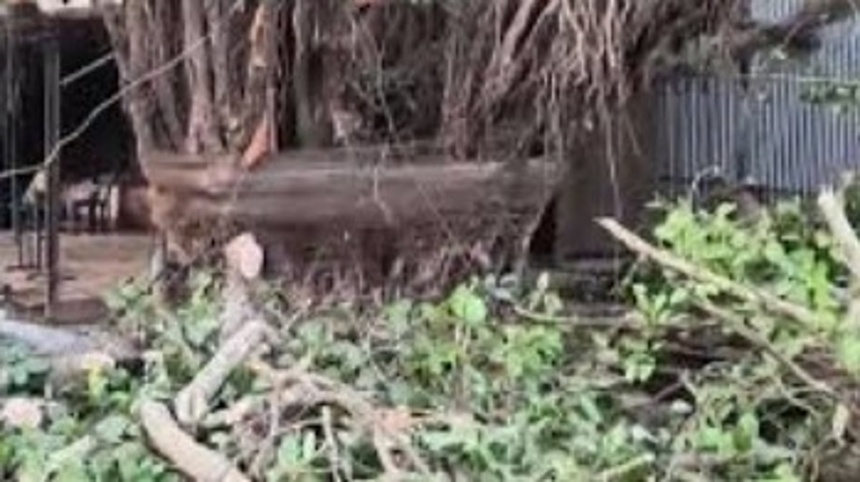
The demolition of a centuries-old banyan tree and the adjacent Khapareshwar temple in Porvorim marks yet another chapter in the ongoing conflict between development and heritage preservation. In the eyes of the government, these structures were mere obstacles hindering the construction of a flyover, a project deemed essential for urban expansion. However, for the thousands who revered this ancient tree and temple, their removal represents not just environmental and cultural loss, but also a deep wound to collective sentiment.
The government, armed with a High Court order, proceeded with the clearance, albeit without meaningful dialogue with the local community, environmentalists, or religious leaders. The opposition to this move was predictable and intense. Protesters gathered in large numbers, expressing their anguish over the removal of a sacred site and a tree that had stood as a living monument for generations. Yet, despite their resistance, the administration, backed by heavy police deployment, executed its plan with brute force.

The question that lingers is—was this conflict inevitable? The issue of the banyan tree and the temple was not an unforeseen roadblock that suddenly emerged. For months, activists and environmentalists had been voicing their concerns, staging peaceful demonstrations, and even appealing to Union Road Transport and Highways Minister Nitin Gadkari to reconsider the project’s impact on the tree. Their efforts, however, proved futile as the High Court directed the authorities to relocate the tree under expert supervision. This directive, while legally sound, raises doubts about the practicality of transplanting such an old tree and ensuring its
survival.
Transplantation, in theory, is an eco-friendly compromise, but its success rate is alarmingly low. Past experiences have shown that large, old trees rarely thrive in new environments after being uprooted. Of the five trees previously relocated in a similar manner, none survived. This grim reality suggests that the banyan tree’s relocation might only be a symbolic gesture, rather than a genuine attempt at conservation.
Equally troubling is the handling of the Khapareshwar temple. Unlike the banyan tree, the temple’s removal was not sanctioned by judicial order but was carried out in what appears to be administrative high-handedness. The government neither consulted the locals nor provided a clear plan for the temple’s reconstruction. Such disregard for religious sentiment was bound to fuel public outrage, leading to the prolonged standoff that unfolded over the weekend. It was not merely about relocating an idol; it was about eroding the trust of a community that saw its place of worship being dismantled without prior consent or clarity on its future.
While development is crucial, the manner in which it is pursued matters immensely. No society can expect to progress while entirely preserving its natural and cultural heritage. Some compromises are inevitable. However, the key lies in minimizing damage and ensuring that those affected are taken into confidence. In this case, the government failed on both fronts—by neither safeguarding the banyan tree effectively nor handling the temple’s removal with the sensitivity it deserved.
It is ironic that whenever a Union minister visits Goa for inaugurations or foundation-laying ceremonies, they emphasize the importance of environmental conservation. Yet, on the ground, these words appear to be little more than lip service, with little genuine commitment to sustainable development. The Porvorim incident starkly reveals this hypocrisy, where a tree that provided oxygen for generations was sacrificed in the name of progress, with no guarantees of its survival.
The opposition parties have wasted no time in politicizing this issue, accusing the ruling government of betraying the very community it claims to protect. While their criticism may have a political motive, it does raise valid concerns about the government’s handling of sensitive issues. Public faith in governance erodes when decisions are imposed rather than discussed, when heritage is discarded rather than preserved, and when promises of environmental responsibility remain unfulfilled.