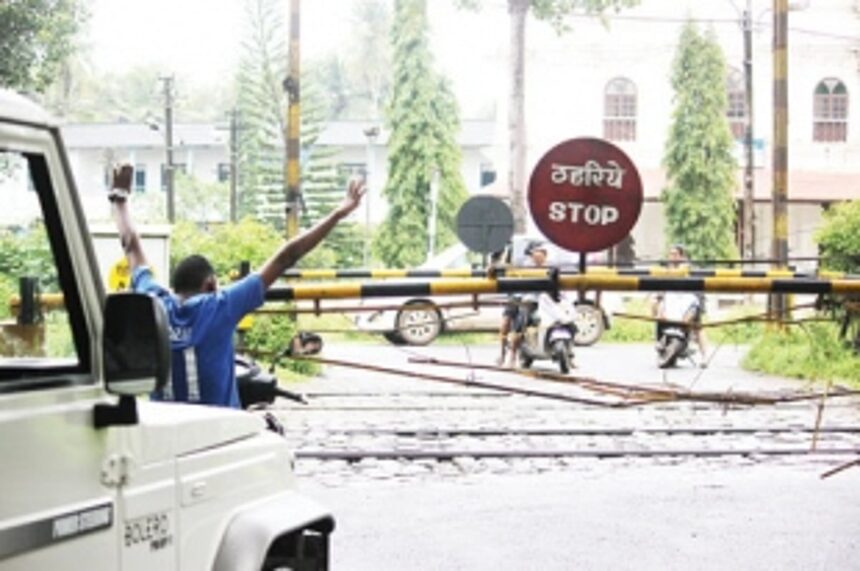
Everyday hundreds of locals from the coastal belt that enter Margao via the Seraulim railway track are faced with unpredictable delays when the railway gate shuts for a train to pass. On top of this, the government’s plans of track expansion by implementing a double lining has only met with opposition from the locals.
These are parents taking their children to school; the local fish vendors who need to get to the wholesale fish-market. These are business people and people who have jobs in the city. And every day they are either forced to take a U-turn and try a longer route or are invariably stuck in the daily traffic jams and have to wait for the train to pass.
While the road to the railway crossing from Margao is narrow and in need of repairs, on the other side of the track is the Seraulim church. “There are traffic jams on both sides of the railway gate when the train passes and sometimes the gate shuts for more than 15-20 minutes even if takes the train only a minute or so to pass. The gates are shut manually as per the signal the gatemen receive and they are not able to tell us how much time the train will take to pass. In peak hours this is an agonising wait, especially for those in a rush,” said Marius Da Costa from Margao.
There are others from Margao who wish to go to Seraulim, Betalbatim, Utorda, Majorda, etc and are also delayed by the railway gate. People prefer to take this route to avoid the traffic jam and rush at the Margao Colva junction and that road via Mungul only to get delayed at the gate.
Incidentally, the locals of Seraulim and the panchayat have discussed this issue several times for years now and have heavily opposed the Union Railway Ministry’s decision for double lining.
The Panchayat has already written to the Union Railway Minister, Suresh Prabhu, and submitted their resolutions to the government. It is to be noted that the Konkan Railway has plans to build a flyover and there have been discussions about suitable sites for the flyover in the village.
Suravle Gaunkarancho Ekvott from Seraulim has also submitted memorandums to the Union Railway Minister, South Goa MP Narendra Sawaikar, former Environment Minister Alina Saldanha where the people of her Cortalim constituency have also opposed double lining. It is to be noted that in addition to Seraulim, the people of Collem, Kalay, Santona, Sanvordem, Curchorem, Xelvona, Assolda, Chandor, Guirdolim, Sao Jose de Areal, Davorlim, Majorda, Pale, Velsao, Cansaulim, Arossim, Issorcim, Dabolim, Chicalim and Vasco are also opposing the double line proposal.
“When will the Railways build a flyover in Seraulim…the people are suffering,” said Seraulim resident Rodney Almeida.
“We believe in a decision making that is for the people, of the people and by the people — not one that is trusted on us against our will. Plans for development that are arrogant and deliberately ignore taking the villagers — the most important stakeholders –into confidence as active participants in the planning process is a pre-meditated hoax on the people of the State of Goa,” read the memorandum of the Ekvott.
“We wish to inform you that Seraulim already has two railway tracks passing through the village, i.e. South Western Railway and Konkan Railway. Double tracking of South Western Railway and then double tracking of Konkan Railway will cause hardships and problems to all the villagers of an unimaginable magnitude,” read the memorandum of the panchayat to the Union Railway Minister.
The Seraulim Gram Sabha also moved a resolution not to have any more railway tracks in the village and the panchayat body has also ratified the same and forwarded to the concerned authorities.
The villagers have out-rightly refused the Double Tracking of the South Western Railway line and also that of the Konkan Railway and have vowed to resist the Government’s decision and have termed it akin to forcing the Railway Project down the throats of the villagers.
“Nowhere in the country are three tracks passing through any village. Then, why only through our village? As we are already victims of the existing two tracks of the SWR and the KR, many of our farmers are prevented from carting agricultural machinery to the paddy fields. Our cattle have lost access to century-old grazing grounds. Hundreds of cattle are killed annually on the railway tracks,” said Seraulim Sarpanch Leslie Dourado.