KARSTEN MIRANDA
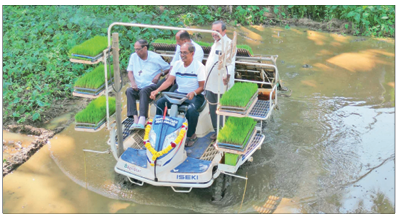
Fr George Quadros, a Salesian priest from Don Bosco, widely known as the ‘Paddy Man of Goa’, has taken his mechanised farming model beyond State bor ders, bringing paddy cultivation back to life in Kindla, a small vil lage on the banks of the Tiracol River in Sindhudurg district. Recently, Fr George and his team from Goencho Xetkar mechanical ly transplanted paddy in Kindla for the first time, marking a major shift for a farming community that has struggled with labour shortag es and rising costs for years. Fr George has spent over a decade championing mecha nised paddy cultivation in Goa. Along with Goencho Xetkar — a collective of three profession als-turned-farmers — he has helped revive large stretches of fallow land across the State by introducing affordable agri-tech solutions. The Maharashtra connection came through an unexpected route. Fr Raymond Lisboa, par ish priest of Kindla Church and a former classmate of Fr George, reached out after witnessing the steady decline of farming in his parish. Explaining the thinking behind the initia tive, Fr George said the effort was rooted in a promise to demonstrate that mechanised farming could work even in remote regions. He described Kindla as a mission station in interior Sindhudurg and said that was precisely why it was chosen for the pro ject. He said the idea was to take mechanised farming out of Goa and demonstrate its full potential — from transplanting machinery to drone technology — in collaboration with Goencho Xetkar and Don Bosco, keep ing the initiative open to farmers and resi dents from surrounding areas. Kindla’s story mirrors that of many rural farming regions. Young people moved to cit ies for better prospects, labour costs went up, and farmers were left with very limited options. Once spread across over one lakh acres, paddy cultivation in the region had shrunk drastically. In recent years, farmers were able to cultivate barely 20,000 acres — entirely through manual labour. Since January last year, Fr George and his team have made multiple trips to the village to prepare the ground for the inter vention. Farmers in Kindla initially raised practical questions about whether mech anised farming could work on their fields — from the suitability of the terrain and narrow access roads to costs, labour sav ings and long-term viability. “We didn’t arrive with machines and in structions,” said Stanley Fernandes of Go encho Xetkar, a telecom professional who left behind his corporate job for farming. “We had to first speak to the farmers, un derstand their limitations, study the ter rain and access roads, which are extremely narrow and rough. Only then could we plan the right approach.” That groundwork paid off last week. Using one ride-on transplanter and one walk-behind transplanter, the team cul tivated approximately 40,000 square metres of paddy fields within seven hours. “Manually, this would have taken at least 10 days with 10 people working in the fields every day. We finished the work and returned home the same night,” said Ken neth Lopes, a former aircraft engineer who now uses his skills to fly agri-tech drones. Three varieties of rice — Subhangi, Silky and Jyothi, a traditional Goan red rice grown at the farmers’ request — were transplanted. The planting was formally inaugurated with a short prayer by Bishop Alwyn Barre to of Sindhudurg, followed by a traditional puja performed by Kindla Sarpanch Dipak Naik. A brief felicitation ceremony was lat er organised by the parish and farmers to honour Fr George and his team. Kenneth said the project was about more than speed or scale. “Our goal is to make agrarian communities self-sustaining again. Mechanised farming allows them to cover more land and grow more food, but it also gives young people a reason to return. They can take a couple of days off from their jobs, cultivate the fields, and go back. Farming doesn’t have to mean giving up everything else.” The initiative also drew attention from the Maharashtra government. A Krishi Adhikari from Sindhudurg district visited the fields during the transplanting and ex pressed interest in promoting the model more widely. Sarpanch Dipak Naik committed panchayat support to expand cultivation next season. “We want to increase the cul tivated area from 40,000 to 90,000 square metres,” he said. Fr George described the project as a private effort driven by farmers’ needs rather than institutional backing. He said he was willing to travel anywhere if it helped agriculture and enterprise, and in vited young people from any State to train in mechanised farming, receive a stipend and replicate the model in their own vil lages. As Fr George and his team drove back to Goa that night, they left behind more than freshly transplanted fields — they left a working example of how technology, trust and local collaboration can help revive rural farming communities.