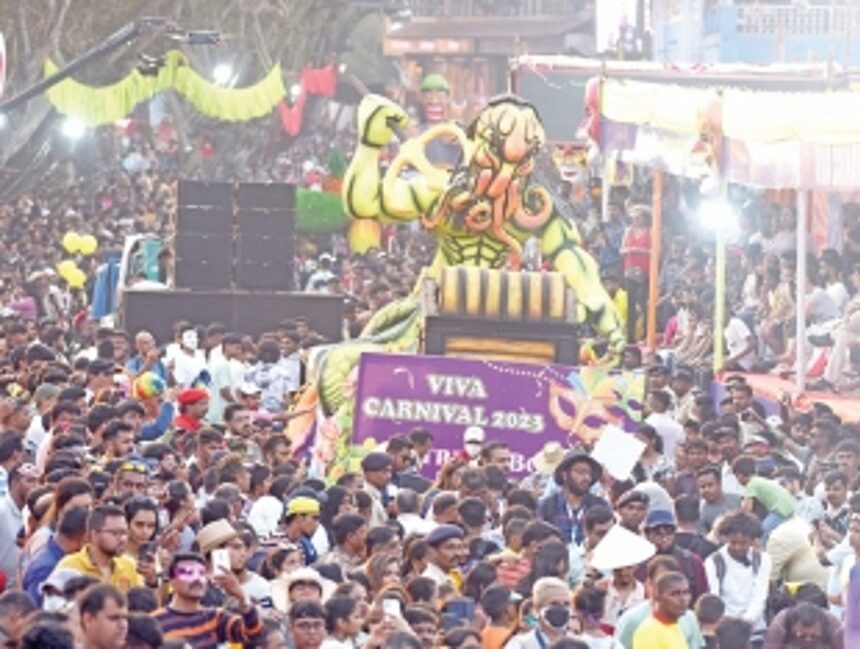
Carnival in Goa is the time when not just one city, but an entire civilization comes together to celebrate life. It is believed that we draw inspiration from carnivals in Brazil and other parts of Latin America. But, the inspiration may have come from outside, but Goa Carnival is not just an occasion for festivities, but it has also become a cultural identification tag, which is proudly worn by Goans. It acts as a magnet for tourism.
But above all this, deep down, the Goa Carnival is actually a very simple festival, where people celebrate with a lot of community spirit, which is away from the glitz and glitter caused by the commercialisation happening now. This is what makes Goa so beautiful.
In 1963, musician Timoteo Fernandes in his mid-twenties gathered in the heart of Panjim dressed up as King Momo and walked towards the Panjim garden with people following him in the spirit of revelry and merry-making. Fernandes happened to see pictures of the carnival in Brazil in a magazine in Panjim which inspired him to replicate that spirit in his own town the very next week.
That spirit still beats in the hearts of most genuine Ponjekars, for the Carnival imbibes the same spirit of belonging, kinghip and community affection. But those who pretend to have it but hobnob with those who make crores “gambling” with the spirit of people, are killing that spirit at the altar of greed.
The carnival of, by and for the people has faced an intrusion and infusion of money and power and crass commercialisation, where the business of carnival has overtaken the spirit of the carnival.
Carnival was as simple as the first King Momo Timoteo Fernandes dressing up and walking the streets with simple people and having fun; why is that simplicity and fun being robbed now?
A people’s carnival, lovingly called Carnaval do Povo, planned simply by locals on the streets of Sao Tome and Fontainhas was given an NOC by the Mayor but blocked along the way.
Since the last decade, the whole spirit is wavering into something which is very commercial and one could even go to an extent of calling it crass.
The question therefore arises, is this premise correct? Can we really say that the carnival of today’s Goa is no longer celebrated in the same spirit, as it used to be done till some years ago? Has it become a money spinning exercise, where ego and one-upmanship come into play, due to which people’s spirit is getting killed? Have the colours of money become more ‘valuable’ than the colours of people’s carnival?
These are some of the questions that need to be answered.
Tracing the journey of Goa Carnival since 1963, Timoteo Fernandes, who was the first King Momo, reminisced, “Carnival was spontaneous. People dressed up in different ways, visiting houses, and families. Before I used to dress as a woman, selling fruits to my neighbours. People were very happy. I used to keep changing my dress and many didn’t recognise me. Even my brother Lawrence and I used to dress up as Gonsaboil (bull). Every year, we used to change
our attire.”
“I had a musical group with a guitarist and a violinist. My brother Tome used to sing. People used to ‘hire’ us for birthdays free of cost. One day, Mr Vasco Alvares invited us to play for his son’s birthday. There I saw a magazine from Rio, Brazil. I read the full magazine dedicated to the carnival and decided to organise exactly the same as I read, the next Saturday,” he said.
He then arranged a bullock cart from Merces and purchased Re 1 scrap paper of different colours, tore them into long strips and decorated a bullock cart.
“I called all my friends, neighbours, and relatives and gathered them at Fountains. I dressed as King Momo and sat in the bullock cart and sang all the way we went to Jardim Garcia de Orta,”
Fernandes said.
While moving around then, people didn’t know what was happening. Everyone was just staring at them.
“Near the (old) secretariat, the bull got excited because of all the noise the people were making. The cartman got down and hugged the cows and calmed them down. We proceeded towards the Jardim Garcia de Orta. This was in 1965. I paid the cartman Rs 5, making my cost a total of Rs 6,” he said.
Next year, he asked the municipality to lend him their open jeep and they obliged.
“This time I organised a small procession and called some small groups also to join in and in this way, it became a bit bigger. And with all this, the procession we went on the same route and reached Jardim Garcia de Orta. For that, I paid Rs 5 for five musicians and Rs 20 for the entire setup,” the first ‘King Momo’ of Goa Carnival said.
In 1967, the chief minister decided to do it in a bigger way. Mr Mayekar was the minister of tourism at that time. So they formed a committee and from then on in 1967, the carnival has been going on in the way it is seen today.
When asked about his feelings regarding the changes that have happened with the way Carnival used to be celebrated earlier and now, Arnaldo Costa, actor, Khell Tiatr and Tiatr said, “At village level in the South, especially in Salcete, we used to have ‘Zomni voile Khell’, which is now called ‘Khell Tiatr’. They used to go and perform in each and every village. They would perform by forming a circle unlike now where the stages are put up.”
Costa said that most of the plays would be based on Bhatkars and Mundkars. There would be a song and then comedy dialogues. The one playing Bhatkar would ask his worker to send his wife to his house for house work in a humorous tone and the worker would obey by saying, “I will send her, since you are the Bhatkar, what else can I do?”.
And then there would be another song break and so on it would go. The songs would highlight a social issue.
“For example, there used to be songs with lyrics, ‘where the person is leaving for Mumbai in search of better opportunities as surviving in Goa has become difficult.’ In those days, we would walk and perform and now the artists travel by buses,” he said.
Simplicity was the hallmark of Goa Carnival, when it started. People were much happier, although money spent on revelry was miniscule. But now, the perception is there is political interference, power and money have also been infused into this auspicious event. Does it take away the basic spirit with which the carnival was started?
Trajano D’ Mello, President, Lokacho Aadhar, said, “I used to be part of the ethnic carnival that used to be organised in the villages. People used to buy fruits and snacks that were being sold during the carnival, just to encourage those who were selling it. Earlier there was very little money put into the carnival. Today, the political leaders make money out of the carnival itself. It has become an absolute commercial game. It has lost its ethnicity.”
He lamented that the ethnicity of the carnival is not even seen in the villages of Goa today.
“People want to celebrate the carnival on the streets of our villages, where families can come together and have fun, without having any profit-making motive. This does not disturb the main carnival. Yet, the government seems to be not in a mood to grant permission. The greed of money is such that not just carnival, entire Goa is getting finished,” he said.
He alleged that the government has denied permission for people’s carnival at Sao Tome because it knows very well that the crowd that comes to see the event, especially the tourists, will not go to see the main carnival, rather walk in the streets of Sao Tome.
“This is because they will get to see the real Goan architecture and culture. Today, in the name of carnival, a lot of money is collected in the form of sponsorships from the casinos,” D’ Mello said.
Since this is a people’s festival, should the government leave it to the villages and wards to celebrate the way they want to, instead of acting like a big brother or a permission giving
institution?
Responding to the question, Jack Sukhija, Vice-president, Travel and Tourism Association of Goa (TTAG), said, “The essence of carnival is the people’s enthusiasm. Carnival started with celebrations in villages. Today, unfortunately, it has become so much associated with ‘Brand Goa’; big money has got in this event. Once that happens, the true spirit of carnival is getting killed.”
According to him, the best thing the government could do is let the people celebrate in their own way and it could ensure that the law and order is
maintained.
When asked about the concept behind the ‘Carnaval do Povo’ and its current status, Sukhija said that since the last two years, people have been making documentaries on the traditional carnival.
“Seeing this, it was decided that it should be revived again to show the community spirit, on an experimental basis. With this thought, people of Sao Tome, Fontainhas and Ribandar decided to hold the ‘Carnaval do Povo’, where the people would open their kitchen, come on to the streets, local bands would perform, there would be ‘King Momo’ and a small float. This was planned and still in the pipeline,” Sukhija said.
“Unfortunately, somewhere down the line, some people with vested interests, have tried to sabotage it, thinking that it may become more popular and the money, which is concentrated at one point, where money could be easily made, would get disbursed to various people. So, right now we are struggling for approval. We are still hopeful of getting the permission from the Collector’s office,” he said.
“Hopefully the Panjim MLA, who seems to be very busy nowadays and not meeting people, takes up this issues in the people interest and gives us the necessary permissions,” he added.
It now boils down to one serious question, which needs to be asked. Should festivals like this, which are occasions of joy, be handed over to the people to celebrate the way they want, while the administration steps back, having its presence only where needed like traffic management?
“This would be an ideal thing to do for reviving the ethnic carnival celebrations. But the way governance is progressing, the political leadership is not interested in reviving the ‘cart age’. They are only interested in making some fast money. The greed has taken over to such an extent that nobody is interested to see people enjoying themselves. We have ruined everything,” D’Mello said.
“To get the traditional carnival back on its feet, we need to ask some pertinent questions. Firstly, are we interested in saving what is left? This question does pertain only to carnival, but a lot of other things,” the senior political analyst said.
He said the problem lay with the mindset, which instead of preserving the old, is always thinking about how to make quick money.
“If that is the mindset, then it won’t be possible to restore the old ‘cart age’ carnival back. The demography of Goa’s villages has totally changed. Sao Tome is a village in the city. The architecture, the people are the real Goans. This is something which is not there even in the rural areas of Goa. But the administration is not giving them the permission to hold the carnival,” the president of Lokancho Aadhar said.
He alleged that the government wants to “divide and rule”. It doesn’t want the people to unite for any cause.
When asked about how the traditional Khell Tiatr and how it has been preserved, Arnaldo Costa said, “Earlier, carnivals used to be organised as part of our tradition. But, the government is treating carnival and Khell tiar as a commercial activity.”
Khell-Tiatr is a musical drama of Konkani stage. It has one story running from the beginning to the end with many songs which are related to the theme of the play. It is just like an opera with songs and dialogues-based on the story line. Such dramatic forms are found practically in all languages.
A quintessentially Goan art form, the Khell Tiatr makes an appearance only during Carnival, adding to the fun and frolic that engulfs the tiny state.
According to Costa, one Khell consists of three plays. Each play is of 30 minutes to one hour. There are cantos, which are songs within the play. First there is the opening chorus and then there are cantos.
“But, there has been no support from the government to promote Khell Tiatr. I am the president of the Konkani Non-stop Tiatrtistanchi Saunstha. We have formed a committee and on behalf of all the tiatrists, especially in South Goa, have sent a letter to the president of Tiatr Academy of Goa (TAG) requesting him to sponsor at least two to three places for staging Khell Tiatr. But there is no response to it,” the Khell Tiatr actor said.
Every year, the Khell Tiatrists perform at five different places for three days. The artistes travel in a bus, which costs Rs 25,000. This year, from Curtorim in Salcete, the performers will be travelling to Canacona.
“Although we get some money from the show organisers, we don’t have any institutional support. We perform with a brass band, which is very costly. Some of the play directors have left because it has become economically unviable for them. But there are groups which are still performing because of the passion for this art form,” he said.
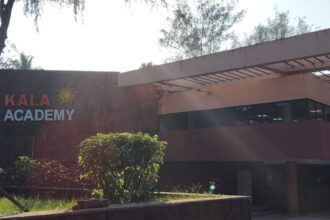
Cota added that for the last 12 years, TAG has been organising Khell Tiartr in Panjim. Every year it used to be staged at Kala Academy. This year, it will be held at Azad maidan.
“We have to perform one play, with duration of not more than 45 minutes. They pay around Rs 35,000 for the show,”
he said.
Revisiting the first official Goa Carnival held in 1967, Fernandes said that the government had no clue on how to organize the carnival.
“I showed them how to take out a float. I had an old Vauxhall Victor car, which I had bought for Rs 5,000 from Porvorim. I used that car to make the first float by spending my money. Afterwards, I wanted to dismantle the float structure installed on my car. Afterwards, the government started bringing floats from Mumbai,” he said.
In the initial years, there weren’t any floats. There used to be only one float on which the King Momo arrived, and the other participants followed him. In 1974, children of Clube Nacional’s members made a float. From then onwards, many groups started joining.
“Once, there was competition between numerous groups. One of the groups had soft drink laced with gin. Not knowing the contents of this drink, some female participants drank it and then after the parade was over, the girls were found dozing off. This caused a lot of problems. Due to this, for quite some time, the girls were not allowed by their parents to participate in the carnival parade,” he said.
Gradually, as the carnival festivities gained popularity, the need was felt to organise carnival parades at many other places in Goa.
“After some time, I thought to myself why the carnival was being held only in Panjim? So, I decided to organise it in North and South Goa. Once again, the organising committee requested me to become King Momo. I officially became King Momo thrice. Then after some time, the Chief Officer of Mapusa municipality, who was known to me, requested me to organise the carnival in Mapusa and become the King Momo there also,” he said.
Now, we know that the whole system has been taken hostage in a way. So, what is the way out? Where will the solution come from? What is the role people have to deal with this issue?
“While the carnival has grown over the years, getting bigger doesn’t necessarily mean becoming better. I think the time has come to disperse it to bring back the community spirit because the Goan ethos is receding. Carnival is something which is unique to Goa. Rest of the country doesn’t have it,” Jack Sukhija said.
The V-P of TTAG said that people should ask where is the money going and what is the outcome we are getting and what is our involvement in it?
“It is supposed to be our festival and we should be allowed to celebrate it our way. The elected representatives should take a firm stand and support it, because it is good for the community. A happy community is good for the government,” he said.
One of the key elements of democracy is decentralisation. Considering that carnival is a people’s festival, the government should decentralise the celebrations so that more people are able to participate and live their culture. Power and politics should take a back seat here.