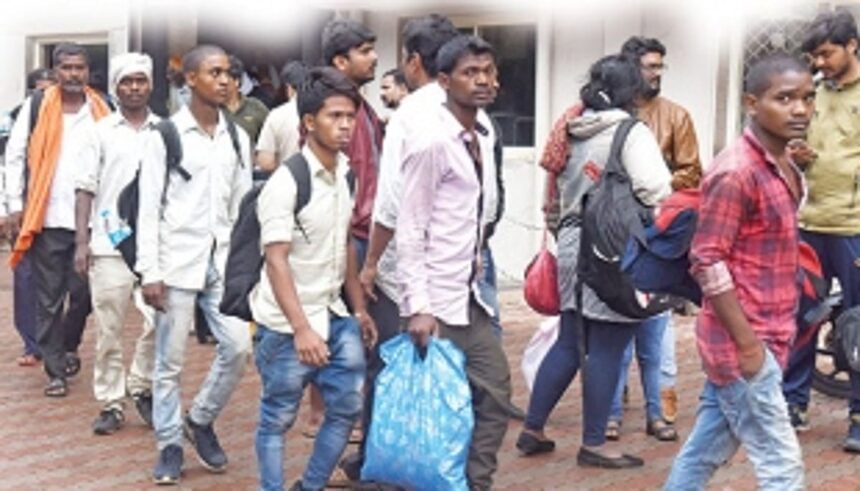
The ongoing State legislative Assembly recently witnessed uproar over a train that arrived at the Tivim Railway station. What made this train so troublesome to the legislators and social media commentators alike, was that the train was filled with migrant labourers, sparking fears that they were here to take over jobs meant for Goans. However, it is just the tip of the iceberg as migrants are landing into Goa from almost all sides.
Not only are Goa’s prime businesses being taken over by non-Goans, but even traditional occupations like farming, bakery, fishing are today no-longer the monopoly of Goans
But the main reason for the influx of migrants into Goa is the demand for the same.
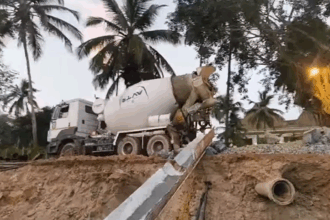
Goa is taking up a huge amount of development works worth almost Rs 20,000 cr, which have been sanctioned by the Centre.
While the locals are really uninterested in the type of jobs that are required, it is the migrants, who are filling the void.
A top contractor reveals that not many Goans are interested in masonry, plumbing, tile-fitting or electrical jobs and hence they have to bring in outside labourers to get the work completed in time.
A manager of M Venkat Rao, who does not want to be named, says “Well, we are taking up the work of NH17 from Patradevi to Bambolim and we are in need of labourers in thousands.
“However, as the labour force isn’t available in Goa, and even if it is they demand huge rates. We have to look elsewhere as these projects have a deadline and we have to work within the budget also.
Development Everywhere!
Currently even though the monsoon is in full swing, the development works in Goa are in full swing and a huge labour force of nearly 25,000 are working everyday to complete the job.
A PWD Engineer says, currently the work of NH17 is underway from Patradevi to Bambolim; Siridao to Verna – Zuari bridge and flyover; widening of NH17 B from Cortalim to Vasco; Western bypass; Eastern bypass; Talpona; Galgibaga bridges; Completion of arms of Mandovi bridge; and that the work on NH4A from Anmod to Panjim will also begin shortly.
Also the 3000-odd cr Mopa airport work is also on the verge of recommencing. Besides several sewerage and pipeline works, above all work is on in the Panjim Smart City project, he said.
“Where will we get the labourers? It is the contractors, who through their agents get the people,” he adds.
However, he had no answer when asked where the people leave when the project is completed.
“It is for the contractor to look out,” he replies.
MIGRANTS IN EVERY BUSINESS
There are several issues that Goans would like the government to mark as priority and solve as soon as possible, be it garbage disposal, pollution control, uncontrolled construction, threat to ecosystem, lack of basic infrastructure for the massive flow of tourists etc.
Against this backdrop, the challenge before the government is to figure out how they can effectively control the unabated migrant influx, which now equals the population of Goa and related issues that threaten the very identity of Goans.
Migrants, who are locally termed as ‘outsiders,’ have already taken over the business of the State from the hands of locals. To make matters worse, they have not only taken over the mainstream trades from Goans but have also made their presence felt strongly in traditional businesses like bakery, fishing etc.
The outsiders have already taken over the traditional trades such as that of selling bread, fish, vegetables etc. Moreover, they are not only seen in cities and coastal belts, which were initially operated by Goans, but are also engaged in agricultural activities in villages after having worked for several years as labourers in the fields and farms of Goans.
The majority of the business at the entire coast of Goa is now being handled by outsiders, right from selling of tender coconuts to operating restaurants, shacks, tea shops and even taxis.
Anjuna-Caisua panchayat Sarpanch, Patrick Savio Almeida, was quick to point that “over 70 per cent of the businesses on Goa’s coast is run by the outsiders and you cannot deny any permission for trade if everything is transparent.”
The taxi union too acknowledged that almost 30 per cent of taxis were being operated by migrants and same per cent of drivers are also present in Goa’s lucrative taxi business.
“You cannot call a driver or taxi operator, an outsider because they all have election cards, tourist taxi permits and taxis in their name. They are now competing with the Goan taxi operators,” a member of the union laments.
The issue of outsiders taking over various businesses in Goa has become a serious topic of discussion. It has also featured in several debates on various platforms, even reaching the floor of the ongoing State Legislatives Assembly. Foreigners too are now involved in operating restaurants, cafes, guest houses, crèches, juice centres, money exchange centres and what have you! And this can be seen especially in the northern-most coastal belt of Morjim, Ashwem, and Arambol.
Goa for Goans was the battle cry of the leaders and foot soldiers who opposed the merger of Goa with Maharashtra and championed the cause of having a separate State. The promise was to save Goan land for Goans and also to preserve its unique identity and culture.
The cases booked by police against prostitution rackets are mainly operated by the outsiders and as per Goa police records, the accused are either from Karnataka, MP, UP, Haryana, Delhi and other States.
It is pertinent to note that a maximum number of cases relating to drugs and prostitution are booked by the Calangute police station for the past six months, as it is a tourism hub for the tourists that arrive in the State.
Police Inspector of a coastal police station, adds “It is a challengeable job but police are trying to completely stop these activities in view of better tourism and retaining Goa’s identity for clean tourism.”