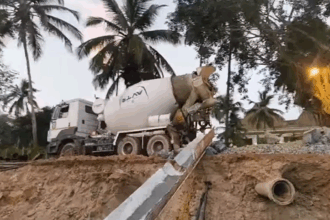
et ready to welcome the Goa of the Future. Tall skyscrapers, crumbling civic infrastructure, more concrete fewer humans; thanks to a builder and real estate lobby inspired amendments to the Town & Country Planning Act. As most of Goans have no clue as to what these revolutionary amendments to the TCP Act will beget, it is worthwhile to understand what they would actually do to Amchem Goem.
Transfer of Development rights &
Accommodation reservation
The TDR Policy is introduced as an incentive for people who want to conserve and preserve their eco- sensitive areas, salt pans, mangroves, and even heritage homes. Interestingly, the policy has been puzzling many citizens since according to the Goa Land Development and Building Construction Regulations, 2010, many of these areas such as private forests, salt pans, land under CRZ, waterbody etc have no FAR and the agricultural zones have a FAR of just 5%.
Another policy which is likely to be introduced along with the TDR policy is the Accommodation Reservation Policy (ACP) which allows individuals and builders to purchase cheap land in the hinterlands, built a low-cost park, hand it over to the local body in exchange for the FAR development rights. This FAR can be added to the FAR of a property in the urban area to construct taller buildings with higher built-up areas.
Although this policy reduces the financial burden on local bodies (land acquisition and construction costs), the potential for abuse is far greater, especially in a State which has a poor vigilance track record. There are several other fundamental issues plaguing these policies. Besides the lack of a clear title to properties and an overwhelming opposition to the Regional Plan, the other fundamental issue is the lack of knowledge of ground realities.
The TCP department does not have a record of the authorised and unauthorised structures across Goa. Without knowing the existing built-up areas on each plot, any transfer of development rights will lead to more unauthorised structures and extensions. The government has to prepare a land use register according to the TCP Act, to record the buildup area of all existing structures. However, none of the PDA areas (cities) has prepared this register.
Sources have informed that the amendments in the TCP Act which were mean to implement the TDR policy also may include clauses that allow the government to change zones in the Regional Plan 2021 arbitrarily on a case-to-case base. Also, Herald has also been informed that there is no penalty clause for abuse of TDR and ACP
Ownership of Land before TDR
It is unclear how the TDR policy and ACP will guarantee the title of the development rights in a State that cannot guarantee an ownership title to citizens, it is unclear how the TDR policy will guarantee the title of the development rights. Under the TCP Act an “owner” is a person who for the time being who is receiving or entitled to receive rents or profits of such property. Experts question whether this definition of “owner” is sufficient to permit an individual from transferring development rights which may be worth crores of rupees.
The Goa Government has not implemented any law that grants the conclusive title of ownership to the properties. Form 1 & 14 and Form B establish only prima facie title. Goans have to prove their title using deeds of conveyance, succession, sale etc and Portuguese era documents. People who buy these properties are always at risk of a previously unknown co-owner or heir returning to claim their share. If the heir files a suit and wins the case, all successive deeds of transfer can be rendered null and void. If a builder constructs apartments on such properties and sells flats to unsuspecting customers, the customers stand to lose their apartment along with their entire investment.
In such a scenario, experts wonder how will the government be able to keep track of the development rights which may pass from the owner through several middlemen and investors till it reaches the final real estate developer. There may even a possibility where a single TRD right is used fraudulently at several places across Goa.
The State Law commission under the chairmanship of Ramakant Khalap had prepared the “Goa Land Titling Bill” in 2012 in order to establish clear titles of landowners. However, the bill is yet to be introduced in the assembly.
What is TDR?
Under the TDR Policy, the government can transfer the potential built-up area of a plot, calculated on the basis Floor Area Ratio allowable for that plot, to the owner to construct for himself or by way of transfer/sale by him to someone else from the present location to some other location in the city, village or State. This potential built up area can be added to the over and above the permissible limit of any other plot. The Government can grant this buildup space via a TDR certificate which can use used by the owner or sold at any given time in the future.
Although the Government is planning to introduce the TDR policy by amending the TCP Act, the policy has been in existence in Goa since 2010. Under Section 25(A) of the Goa Land Development And Building Construction Regulations, 2010, the development potential of private properties marked as Recreational zones, road widening and Conservation zones can be made available to the owner. However, the government did not make any regulations that allowed the owner to transfer the rights to any other person.
What is the Accommodation Reservation?
Under this policy, an owner can build a public amenity such as garden or swimming pool and then hand it over to the State Government or the local body free of cost in exchange for the permissible built up area(FAR) in the form development rights (TDR Certificate). This policy is ideal where the cost of the land is far greater than the cost of the amenity.
Requisition and Acquisition Bill not in the interest of Goa : Ramakant Khalap
The select committee report for the R&A Bill, which was introduced last year , had been tabled on Friday. The bill had been criticized by citizens and political parties for bypassing the Right to Fair Compensation and Transparency in Land Acquisition, Rehabilitation and Resettlement Act, 2013, particularly regarding the compensation which is 3 to 4 times the market value.
Under this Act, the Collector can enter any property for inspection without giving prior notice and then issue summons to the landlord for requisition of the property. The property can be taken on requisition (rent) for a period of upto 15 years. The compensation (monthly rent) for the land is decided by an arbitrator.
Interestingly, the owner get only 30 days period to file any appeal. If the owner is living abroad and returns after a year, he will have to approach the High Court if he wants to challenge the requisition.
Former Union Law Minister Ramakant Khalap informed Herald that the provisions for compensation in the R&A Bill goes against the principles laid down in the 2013 land acquisition Act. “It gives arbitrary powers to the government to requisition the land. Knowing the vindictive attitude of the government, they may use this bill as a weapon against political opponent under the guise of requisition”, he said. He concluded by saying that that the Bill is not in the interest of Goa.
Case to Case Basis Zone conversion will open a pandoras Box : Khalap
Speaking on the possibility of the government amending the TCP Act to allow zone changes on case to case basis, Khalap categorically stated that this will lead to corruption. “There has to be a study, inquiry and investigation on the TDR, the Requisition & Acquisition Bill and what impact these policies had on States which already have these laws”, he said.
Pointing out that the TDR policy in other States had been limited to metropolitan areas, he questioned whether Goa will remain as clean as possible, whether high rise building will be beneficial to Goa and whether out Goan identity, will be maintained. “If we construct building above the height of Coconut trees, we will lose the character of Goa”
He expressed his concern that if the case-to-case zone change police is implemented, there will be a flood of application for zone changes and that will go against the purpose of having a regional plan. “It will open a pandoras box and the purpose of planned development of a town will be defeated”, he said.