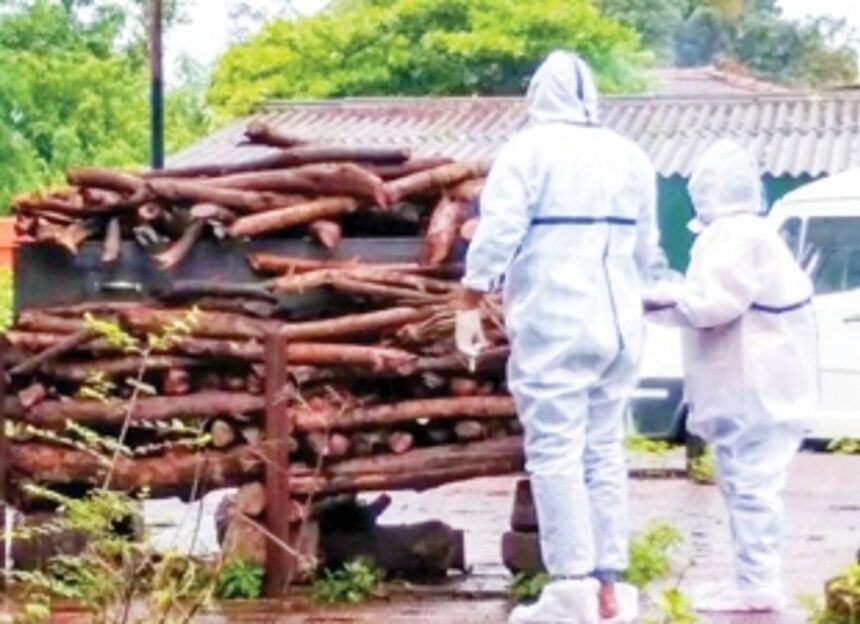
Every time the phone rings of these group of four young men, living in South Goa (identity and place of residence not revealed intentionally) they get jitters as they feel there is a COVID-19 death somewhere and there is a call for duty.
The young boys of South Goa, initially – prior to COVID-19 also worked as helpers to many ambulances and undertakers; but this time their job is different. There is an invisible risk every time they handle a dead body now.
A smallest of mistake, and they could be the next to contract the virus. Who knows, they too could be in the grave and someone else would be performing their final rights, said one of the youth.
The youth further points out, that though they handled the dead bodies in the past, it is much more different this time.
“Besides the element of extra risk, we have to also hide our identities, not even our families know that we are involved in handling of COVID-19 patients. Also we have to be extra cautious as any mistake can get put lives of our families at risk too,” they said.
They have been living their worst nightmare since the outbreak of the pandemic, spending hours alongside dead bodies while carrying out their high-risk job of transporting bodies from the morgue to wherever they are disposed of.
For these brave-hearts in the COVID Dead Body Disposal team, who have so far accomplished their mission despite the odds, learning to wear a Personal Protection Equipment (PPE) was the first huge task.
“We had no idea of what PPE is and had to learn about it from medical professionals; and that too with the level of concentration, which we never showed in schools,” one of them said jokingly.
He further added, “All along, we wear PPE kits and masks while the ambulance that is used to transport the bodies is sanitised several times a day. However, with the heat, sometimes it gets unbearable (wearing the kits) as it’s too hot,” he added.
Currently, Goa has just four boys who handle the COVID dead bodies and they have so far disposed-off five bodies.
“We have no issues, you can call us anytime, we are ready, even at night,” said one youth.
When asked whether they are not scared of handling the bodies, one of them replied philosophically, “One has to die some day. Plus we were always in this profession but just that it is different now. Now with this work, we will get more blessings and maybe with the blessings of the families, we too may become doctors or big people in the next life.”
Talking about the challenges they face, they explained that the heavy monsoon rains is one such big challenge, which makes their already tough job even tougher.
”The rain sometimes dampens the wooden pyre, making it difficult for the body to burn and the wet surface is another hassle. Performing last rites in open areas without a shed could be a nightmare,” they point out.
Speaking further, one boy said it is disheartening to see people get scared to come near the bodies of closed ones.
“They should be given PPEs and have a last look. But a few don’t even have a last look also, which is very shocking. This gives us just one lesson that there is nobody of yours in this world – mother, father, son daughter, sister brother everything is fake, finally you have to go all alone,” he said.
They said they all belong to different religions and on that note; Herald deliberately did not bother to ask them about their religions, as what’s important here is that the service they are doing for humanity.
“We have no issues, we are from different religions and do the final rites of everyone, be it Hindu, Christian, Muslim or anybody else. Religions do not matter,” they unanimously stated.
Speaking about the process, after the cremation or burial, the body disposal team sprays and sanitises an area up to 40 feet around the place where the last rites are performed.
While officials refuse to say what payments are paid to the team, it is learnt that they are paid between Rs 2,500 – Rs 3000 per person/ per body.
Asked why they are taking such high risks, they promptly said, “Well, we are not well educated and for our families, we have to do whatever job we get. Besides, in the lockdown that was imposed for COVID-19, we were badly hit from a financial point of view, as we ran out of cash and had to depend on others to provide us with food.”
These unsung heroes of Goa need much more than just showering of petals and clapping.
Not enough body handlers
Dr Madhu Ghodkirekar, who is an Associate Professor at Goa Medical College and Hospital (GMC), Bambolim; and is now posted in Hospicio in public interest, says though there is a shortage of body handlers and requisite teams, the present body disposal team is doing a wonderful job.
Speaking to Herald, Dr Madhu says during the first cremations at Ponda – of two bodies (one from Morlem and one from Vasco), our people from Forensic department, Covid-19 Hospital and EMRI staffers were used.
“Though we managed to carry on the cremations well, one thing we realised was that it was not a permanent solution; as body handling is a difficult task and we need specialised people. So, I spoke to private undertakers and they refused to take the responsibility and also refused their ambulances. However, they gave me some contacts, who they hire as labourers,” he explained.
Hence, he added, he called them – the group of four and they agreed to come for the third funeral.
“Then we had to train them in using the PPEs, as it has procedures for wearing, removing and disposing it off. After that, right from the third body to the tenth, this group of four youth of South Goa has handled the dead bodies professionally,” Dr Madhu informed.
Dr Madhu further adds that, right from lowering the coffin in the grave, to putting wood on the pyre, this group does everything.
“Even to light the pyre, there is a technique like how much kerosene has to be used; how much wood is required; and what to do in case of rain etc. These boys know everything,” he disclosed. He added that some payments on case-to-case basis have been agreed upon by the administration and the group.
“In some cases, the families have paid and in the cases where the family cannot afford, the collector has paid from the Disaster Management Fund,” he disclosed.
Talking about shortage, Dr Madhu said that till these body handlers came in the picture, they did not know who they should have taken as the ICMR guidelines were not clear.
“In Goa, we have just four youth and God forbid, the cases rise, then just four of them not going to be enough. Dead bodies may come from everywhere,” he narrated, while adding “We need such teams as part of disaster management.”
He suggested the family members must also help at least till the body handlers take over, if a death occurs at their homes.
“In Vasco the family shifted the body to mortuary after PPEs were provided by the Health department. Body handlers were used only while disposing the body at the Hindu crematorium in Vasco,” he pointed out.