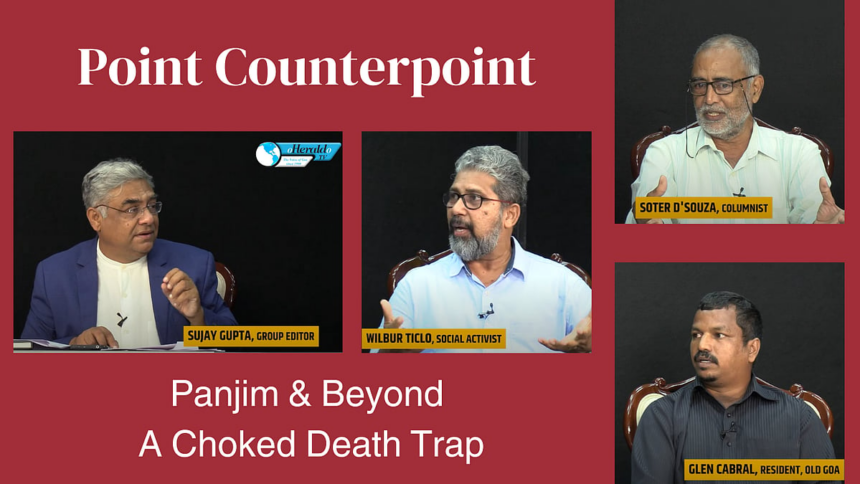
The discussion hosted by Sujay Gupta, Group Editor of Herald Publications, in Herald Tv Show Point Counterpoint brought to the forefront Goa’s deepening crises in infrastructure, governance, and heritage preservation.
Centered on the challenges exacerbated by marquee events such as the International Film Festival of India (IFFI) and the exposition of St. Francis Xavier’s relics, the panel featured activist and columnist Soter D’Souza, heritage advocate Glenn Cabral, and social activist Wilber Ticlo.

Their dialogue painted a grim picture of the state’s current trajectory.
Key Discussion Points:
Soter D’Souza highlighted the toll taken by haphazard urban development, calling it a direct consequence of normalized corruption and poor governance.
He cited incomplete roadworks, unsafe construction practices, and mismanagement of sewage systems as glaring examples of administrative neglect, leading to accidents and, tragically, loss of life. D’Souza emphasized the role of voters in perpetuating this cycle by electing corrupt leaders and tolerating systemic mismanagement.
Wilber Ticlo elaborated on the chaotic state of Porvorim, where ongoing flyover construction has resulted in unbearable traffic congestion, dust pollution, and prolonged delays for residents.
Despite repeated warnings to authorities, there has been minimal accountability or mitigation efforts. Ticlo advocated for judicial interventions and stricter accountability mechanisms for contractors and local authorities.
Glenn Cabral focused on the plight of Old Goa, warning that unregulated construction poses an existential threat to the region’s heritage precinct. Despite experts like Edgar Ribeiro advocating for a heritage-centric master plan, no concrete action has been taken. Illegal zoning changes and construction activities within protected areas, facilitated by regulatory loopholes, have left Old Goa at risk of losing its UNESCO World Heritage status. Cabral warned that this loss would devastate both cultural pride and the local economy. He called for the immediate restoration of local bodies’ decision-making powers and stringent enforcement of heritage protection laws.
Wilber Ticlo traced the root of many modern issues to the tourism boom of the 1980s. Initially, tourism directly benefitted local communities, who rented out rooms and provided services. However, this organic model has since been overtaken by outsiders pouring black money into the state, buying properties, and engaging in illegal development. Ticlo lamented that this influx has marginalized locals and eroded their financial and cultural ties to the tourism economy.
Soter D’Souza echoed these concerns, pointing out that the unchecked influx of outsider developers has commodified Goa, transforming it into a hub of exploitative tourism that disregards the state’s cultural and environmental integrity.
The panel unanimously agreed that civic apathy and political corruption are interlinked problems exacerbating Goa’s decline. They noted a growing disconnect between citizens and governance, fueled by a lack of awareness about democratic rights and responsibilities.
D’Souza critiqued the over-reliance on judicial activism, such as filing Public Interest Litigations (PILs), which he believes has weakened grassroots movements. He called for a revival of the “People’s Court” model, where collective action drives accountability.
Ticlo lamented the misplaced priorities of modern society, with more attention given to festivals and social events than to critical issues like heritage preservation, resource management, and sustainable development. Glenn Cabral further criticized the public’s passive acceptance of political malpractice, which emboldens leaders to ignore long-term consequences in favor of short-term gains.