Garbage has long since been a topic of much dispute in the
little state of Goa. Tourism, which is one of the state’s main sources of
income, has taken a hit with many potential visitors criticising the affair of
the destination in terms of hygiene and sanitation. The government has long
since promised to set up a series of waste management and treatment plants in
various parts of the state, which, for the most part, has proven to be just
paper talk. In an effort to circumvent this, a series of individuals that
clearly believe in the expression ‘love thy neighbour’ have taken the matter
into their own hands, and taken it upon themselves to resolve the issue.
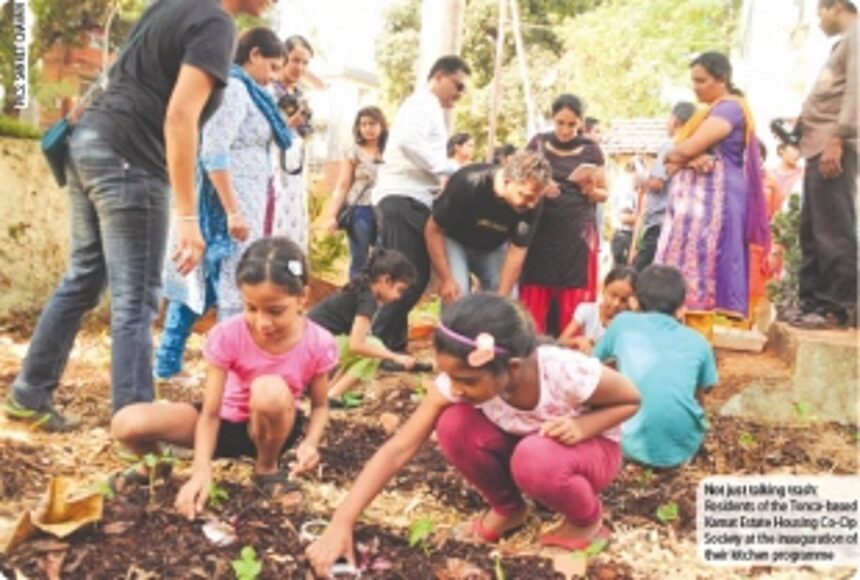
In an unprecedented move, the Kamat Estate Housing Co-Op
Society in Tonca has become the only housing colony in the state that has
successfully managed to treat 100% of its own waste. The Organic Project of
converting kitchen waste to compost and using the compost to grow a kitchen
garden was completed yesterday at the hands of Siddharth Kunkolienkar, MLA Panjim,
Shubam Chodankar, Mayor of the city of Panjim and Sanjit Rodrigues,
Commissioner of the CCP.

Pointing out the aim of the project, Darryl Pereira, the
Secretary of Kamat Estate Housing Co-Op Society, said, “Concerned about the
stress on Panjim city, one of our residents, Richard Dias, came to us in the
belief that the solution lay in moving away from consolidated garbage dumping
grounds. Waste was already being segregated at a household level into wet and
dry bins. Thus, the next step forward shouldn’t have been too difficult. While
we might have faced a few sceptics as the programme kicked off, we are now
fully-fledged in our functioning.”
To begin this project, the society’s existent composting
station was repaired and enhanced. The society decided to manage its
compostable waste in-house and went on to only hand over its dry waste to the
CCP, who in turn offered assurances that if help was required in managing wet
waste, they would gladly step in. To begin with, the housekeeping staff of the
complex was charged with the responsibility of manning the station before a
permanent team was put in place. Within a span of merely three months, the
society managed to have their operations running in a smooth flow.
Today, the compost being generated is used to cultivate a
kitchen garden. Yogita Mehra of Green Essentials, who is involved in the
promotion of organic farming, has designed the kitchen garden for this unique
project. “I personally believe that this will be an activity that will bring
residents together, especially children who can look at this as their baby,”
she says.
The produce that is grown in this garden can be purchased by
the residents of the society. As the next step forward, the society looks to
involve other housing societies as working on such ventures on a sharing basis
will ensure a cleaner, greener future for the capital city.