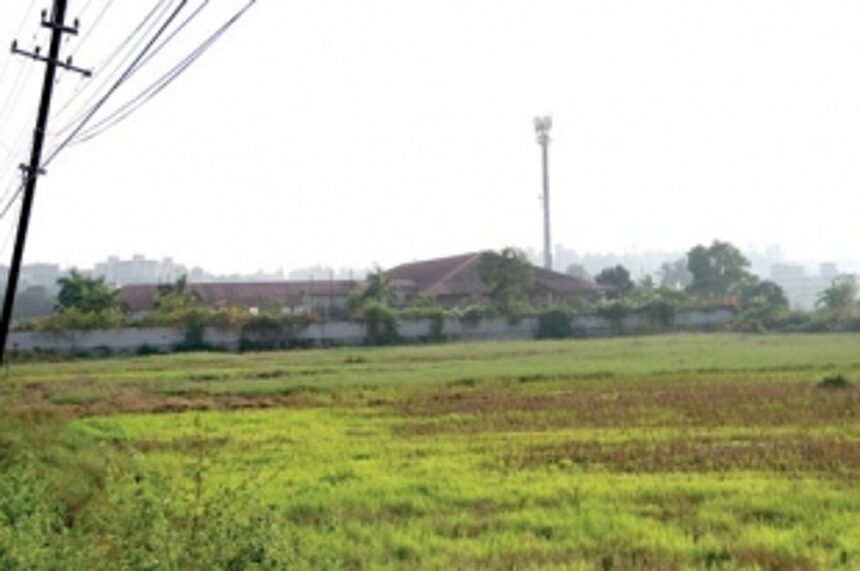
Considering improper urbanization coupled with a poor drainage system and the absence of integrated water management plans, Panjim can suffer a severe weather outbreak like the Chennai flood disaster. The experts in this field feel that with Panjim’s flood-prone areas already vulnerable to the risk every monsoon season, people’s lives could further be threatened if the authorities fail to put in place a rainwater and disaster management system.
“Panjim lacks simple traditional ecological wisdom which demands careful scrutiny of old maps of the city, detection of old drainage systems and increasing the resilience and capacity of these systems by removing all encroachments, constructions, obstructions, illegal land reclamation to restore old drainage network,” Dr Nandkumar Kamat, a researcher and assistant professor at Goa University said.
The scientist mentions that while the old maps show several channels from interior paddy fields draining rainwater in a large area from Miramar circle to NIO circle, in the present scenario massive private real estate development has come up in violation of the Town and Country Planning Act, 1974. “The creeks and rivulets were destroyed,” he exclaimed. Antonio Mascarenhas, member of the Goa State Coastal Zone Management Authority and a former NIO scientist agrees with Kamat’s views as he pointed out to various loopholes in the development planning.
“Panjim is not prepared to tackle a Chennai-like flood situation the way it has expanded in the last two-to-three decades. There is no arrangement made for water to flow into the St Inez creek or the Rua De Ourem creek. The drainage patterns are not paid attention to…” he commented.
The clogging of existing drainage and lack of more drainage in the capital, he said, could spell doom. High intensity rains and incoming high tides have shown the vulnerability of Panjim to flooding in the past. The converting of Portuguese-constructed service road from Kala Academy-Panjim jetty, to a footpath has also been criticized. The scientists blame the emergence of hundreds of private encroachments since 1975 as a major setback of Santa Inez creek.
“There is no simple management for water flow… We need to accumulate the water somewhere, the absence of which could lead to major flooding,” Mascarenhas said suggesting that providing plenty of passages either by the side of the road or over the road to wet lands or creeks could avert possible damage.
He also suggested that the government should ensure maintenance of the existing wet land and low lands to eventually use it as ‘flood base.’ “We should pay attention to the ignored antecedent drains like St Inez creek which was considered as an arm of the Mandovi River in the 1970s,” he revealed.
Kamat fears two serious disaster scenarios in the near future with one involving low lying areas where high intensity rains coupled with incoming high tide could flood the city and weaken the foundations of many buildings, and the second being massive slope instability of the twin Altinho hillocks – the Conception hillock close to the Mandovi waterfront and the Guimares hillock close to Zuari waterfront.
“Nobody has considered the impact of a heavy downpour on soft lateritic clayish, bauxite rich subsoil of these hillocks. All the houses on slopes of these twin hillocks would collapse due to the sinking of the weak foundations if it rains with an intensity of 50 mm per hour for one or two days. That would displace about 20,000 people from Bhatlem, Chincholem, Fontainhas, Mala, Boca da Vaca and Santa Inez permanently,” he said.