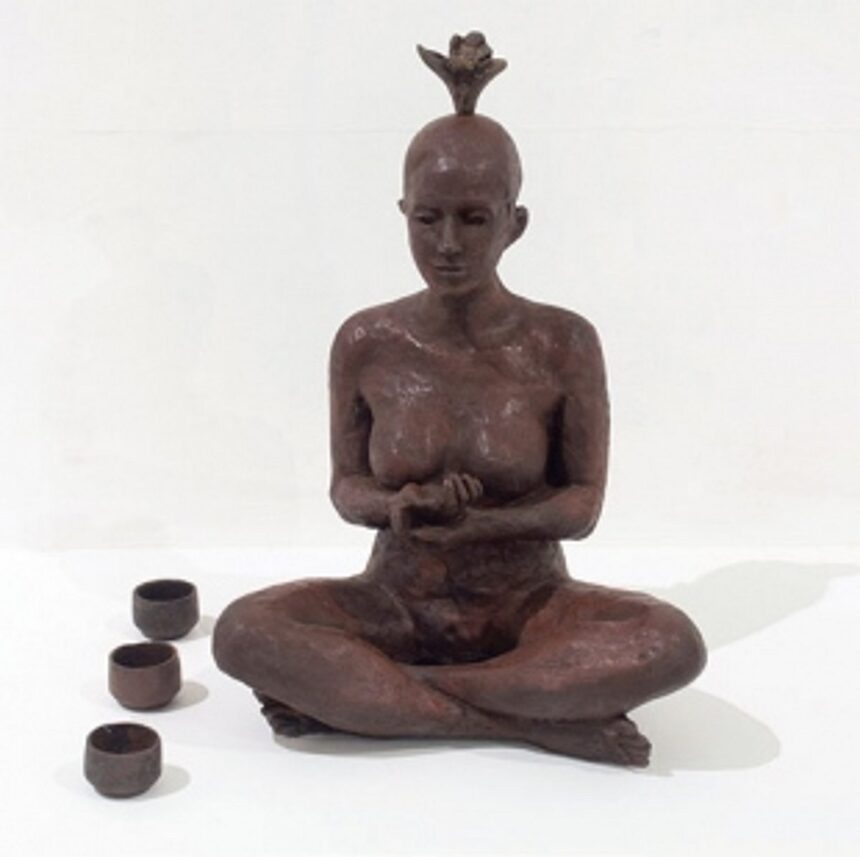
The arts programming at the non-profit Sunaparanta Goa Centre for the Arts has
consistently been on the rise. Its current fantastic show ‘Sculpsit: Between
Thought and Action’, an exhibition of sculptures and drawings, curated by Sasha
Altaf, and in collaboration with The Guild Art Gallery, Mumbai brings us works
by some of India’s most renowned artists including Akbar Padamsee, KG
Subramanyan, Jyoti Bhatt, Himmat Shah, Sudhir Patwardhan, Gieve Patel, A
Ramachandran, Anupam Sud, Navjot Altaf, NN Rimzon, Gigi Scaria, TV Santhosh and
Baiju Parthan. In addition, Bastar based artists Rajkumar Kommar and Shantibai
also present their stunning works.
Shalini Sawhney of the Mumbai based Guild
Gallery believes in promoting critical practices and ideas. Since its inception
in 1997, The Guild artists have participated in significant museum exhibitions
and biennales most notably at the Tate Modern, the Astrup Fearnley Museum of
Modern Art in Oslo, the Herning Kunstmuseum in Denmark, the MAXXI National
Museum in Rome and the Centre Pompidou in Paris. The gallery now partners with
Sunaparanta to bring some amazing artworks to Goa in ‘Sculpsit’.

Produced by Sunaparanta patrons Dipti and
Dattaraj Salgaocar, the show “proposes to envision sculpture not as an
(abstract) continuum but as a material envelope that grows organically from the
original drawing, sketch, maquette or photograph… whereby the artist plays
both the role of the artist and the engraver … emphasising both change and transience,
material and materiality, where the image (drawing / sketch / photograph) and
the form (sculpture) reveal the complex interchanges and the ensuing
interaction between the artists’ drawing and the translation of it in form –
the ‘sculpture’,” writes independent art critic and curator, Sasha Altaf. Altaf
explains that “The term ‘Sculpsit’ literally means ‘he (or she) sculpted it’…
Up to the 1870s, book illustrations required two steps: the artist drawing the
design on paper, and then an engraver translating it to wood or copper.”
Taking from this dialogic relationship between drawing and
sculpture, the exhibition presents an array of diverse insights into the
organic evolution of an artwork, on the expressive possibilities of material
and most importantly on an artist’s thought process.
Among the senior masters – Akbar Padamsee’s contemplative bronze
sculptures are drawn from his paintings of figures and heads. An existential
dilemma may be the only true identity of these faces – the artist’s way of
self-reflecting. Painter and printmaker, Jyoti Bhatt has been recently
exploring photo-documentation processes to capture the disappearance of craft
from tribal communities. These narratives and motifs underpin his works.
Writer, scholar, teacher and art historian K G Subramanyan’s practice spans a
spectrum of media from painting to pottery, weaving and glass painting. Being
actively involved in the freedom struggle, his works have been concerned with
social issues in post-independent India.
Himmat Shah captures life cycles and the realms of impermanence
in works inspired by his birthplace of Lothal, surrounded by the remnants of
the Indus Valley Civilisation. Sudhir Patwardhan’s urbanist narratives explore
inaccessible figures that are self-contained. The politics of home and self are
realized in both his painting and sculptural works. A Ramachandran’s archetypal
imagery is strongly influenced by the socio-political landscape of Kerala. The
artist explores life and nature in rural India and its quest for permanence in
multiple forms.
Gieve Patel’s mythical figure of the Graeco- Roman princess
Daphne addresses themes of power, ambition and betrayal. The narrative follows
the story of the daughter of a river god who transformed into a tree to escape
Apollo.
Navjot Altaf draws from Indian history and craftsmanship,
exploring social and political narratives through her sculptural works. Deeply
affected by the political upheaval in the 1970s, Rimzon explores these themes
in narrative painting as well as conceptual sculpture. Anupum Sud’s sculptures
are based on emotive postures of the female figure. Seen through a feminist
lens, she inter-relates her subjects in both her etchings and in her sculpture.
Baiju Parthan’s diverse practice pays attention to intermingling
technology with its alternate states of reality, genetic engineering and
religion along with notions of post-humanism.
T V Santhosh re-imagines and resurrects obsolete objects that
have become part of our nostalgia today – a bygone era and its residual
imprints. The artist takes inspiration from cinema, news media, art history and
popular culture to create sculptures that depict our present day crisis.
Gigi Scaria reveals the uneasy relationship between man and
nature in works that point to a disturbing reality – one filled with
environmental disasters and an exhaustion of natural resources.
The artists from Chattisgarh also deal with contemporary issues
in their art practice. Rajkumar Kommar‘s wooden carved pillar, with local mahua
flowers, birds and yogic postures, is based on the community of Bastar in
Chhattisgarh. The pillar has humans holding onto each other for support,
together building a tall structure through their laborious efforts and
struggles.
Shantibai’s sculptures express a deep empathy for women and
children. His columnar synoptic narrative is made up of many interlocking
episodes, an attempt to depict the agony of women in vulnerable situations.
There are truly multiple modes of art making and creating on
view here. As Navjot Altaf points out, “the way we make our world is different.
The way we imagine is different.” And so we have these varied perspectives on
view at ‘Sculpsit’, each one thoughtful and unique, prodding the viewer to
think and feel. Visually stunning, deeply moving – this is an aesthetic
experience not to be missed.
Sculpsit: Between Thought & Action is on at the Sunaparanta
Goa Centre for the Arts until December 22, 2019