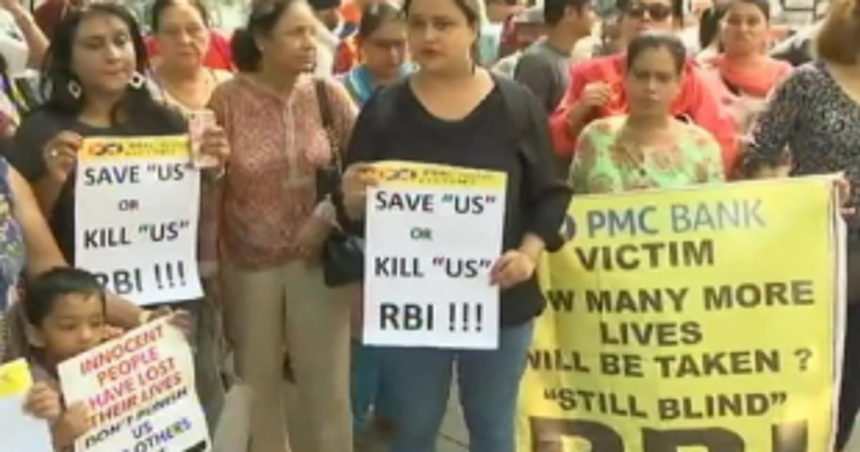
Bank customers are angry and why not? Year after year common middle and lower middle class people are up with surprises. Salaried, pensioners, small and medium business persons are being harassed due to banking mismanagement and poor auditing by regulatory authorities while the economy is in complete slowdown. Such a fiasco of closure of banks and restricted operations has completely shattered the confidence of the investors and customers even though they are getting assurances from the Finance Minister Nirmala Sitharaman.
Several banks in the recent past, be it Mapusa Urban Cooperative Bank, Punjab and Maharashtra Cooperative Bank (PMC) and now Yes Bank have allegedly erred and allegations are that even Reserve Bank of India has given these banks too long a rope. Major names like Vijay Mallya, Mehul Chowksi, Neerav Modi, etc, are still at large abroad and for government it has become a thorn in a flesh. However, this time round the founder of Yes Bank who demitted his office as MD and CEO 14 months ago has been nabbed.

In mounting trouble for Yes Bank founder Rana Kapoor, who was arrested by the Enforcement Directorate in the wee hours of Sunday morning, the Central Bureau of Investigation (CBI) has now stepped in and begun probing the matter. While officials at the probe agency did not make public the nature of the investigation, the CBI will now examine the case against Dewan Housing Finance Limited (DHFL), its promoter Kapil Wadhawan and Rana Kapoor for alleged case of cheating and criminal conspiracy.
As investigation agencies have begun cracking down on Rana Kapoor, the ED is also probing investments worth over Rs 2000 crore, along with 44 expensive paintings and more than 12 alleged shell firms against the Yes Bank founder. In its searches, the ED has also recovered documents pertaining to Kapoor’s family’s assets in London and how the financial means through which those assets had been acquired. While a PMLA court in Mumbai remanded Kapoor to ED custody till March 11, the Central Bureau of Investigation (CBI) is also likely to take cognizance of the matter, soon.
Last year in November let alone private sector banks, even the Public Sector Banks (PSBs) reported frauds of over Rs 95,700 crore in the first six months of the current financial year, Parliament was informed by the Finance Minister Nirmala Sitharaman. She stated that according to the Reserve Bank of India, PSBs reported 5,743 incidents of fraud involving a total amount of Rs 95,760.49 crore from April 1 to September 30, 2019.
Nirmala Sitharaman told the Upper House of Parliament that among these 5,743 cases, most of them had taken place over the last several years, although 1,000 cases worth Rs 2,500 crore had just taken place. State Bank of India reported fraud of Rs 25,400 cror followed by Punjab National Bank of Rs 10,800 crore and Bank of Baroda of Rs 8,300 crore, she said.
In a written reply to another question, Minister of State for Finance Anurag Thakur told the Rajya Sabha that government-owned banks reported 26.1 per cent of all frauds worth over Rs 1 lakh brought to notice during 2018-19, while their lending share was 63.81 per cent in the aggregate gross advances of scheduled commercial banks.
For the record, Rs 71,500 crore worth of frauds involving 6,801 cases were detected in financial year 2019. This is little more than what the Union Government wants to spend on merger of BSNL and MTNL as well as the re-capitalisation package for the PSBs.
Whatever be the action now, people who are queuing up in the counters of the bank are worried, bewildered and clueless on what they are going to face next. With such rampant frauds happening in banks the customers are confused as the element of trust lies shattered.
Banks do charge customers for non-maintenance of “minimum balance” in savings accounts but will the banks pay compensation for restricting the customers of normal operation of accounts during such moratorium imposed by the regulatory bodies? Irony is that those poor customers who cannot maintain minimum balance for the want of money are being charged penalties.
No sector has demonstrated the damage from economic offences more than India’s banks. The fraud at the PMC, for instance, may have triggered the deaths of over a dozen depositors. Who will stem this ongoing rhetoric and who can be held responsible for such negligence, customers want to know.