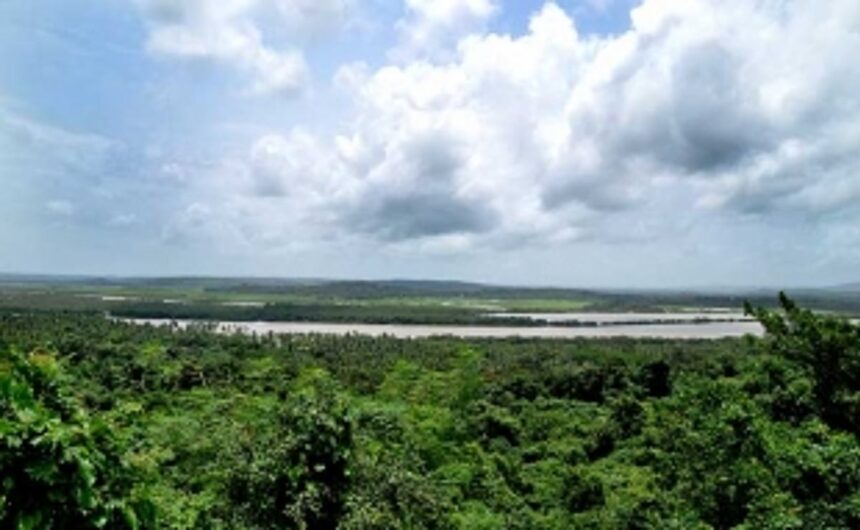
Forest cover is unfortunately seldom seen as green wealth or in any way economically beneficial, which is why large expanses of trees vanish
overnight to make way for ‘development’. Given the huge premium on real estate in Goa currently, private forests have been the most vulnerable in recent years, giving way to housing projects in several parts of Goa. Over the last couple of years, in an attempt to avoid their land being notified as private forest, several frantic land owners have resorted to denuding green belts. Is this frenzy an outcome of genuine
fear of land loss, or plain greed to sell their land to moneybags? A mixture of both, we find out. According to architect Dean D’Cruz, who was also part of the state level committee for drafting the Regional Plan 2021, most forest areas are on slopes, and developers see this as prime
locations, since one building will not block the view of another.
Drawing attention to a common modus operandi, he says there are genuine cases, where people are uncertain about their fate if their land becomes notified as private forest. At the same time, many others whose lands have a thick forest cover are being allowed enough time to deforest. Even before surveys are conducted, people are cutting trees and claiming there never was a forest.
He adds that in the regional plan,
they had suggested heritage parks in
such lands, or creating nature trails,
which would allow monetary gains to
private forest owners.
D’Cruz believes compensatory policies
would put the genuine cases at ease,
but the government should act fast.
But the government which is in the
process of drafting a ‘management plan’
for private forested lands, says it would
take at least six months to formulate
the plan. On the other hand, the exercise
to survey and notify private forests in
North and South Goa could take another
two and half years.
Would this delay and the growing
anxiety of such landowners mean that
more land would be lost to development
in the interim?
Government stakeholders insist that
this will not happen.
Mangement plan
While Richard D’Souza, principal chief
conservator of forests, says he understands
their anxiety, he is quick to add
that the management plan is being formulated
with the intention to tackle
this problem.
“If someone’s area is notified as private
forest and he owns only that land, it is
bound to create anxiety. This is why we
are putting a management plan in place.
Everyone will be given a package as to
how they can go about developing their
land,” he states, adding that slopes however,
will not be converted.
D’Souza is confident that those indulging
in removing and thinning forest
cover will be booked immediately.
“People inform us, we visit the site,
book a case and seize the equipment. A
month ago, we booked some people
for this in Socorro,” he points out. The
forest chief believes the growing buzz
and stir around private forests has more
to do with the fact that Goans want to
sell their land to outsiders, who are
putting pressure on them.
According to Minister for Environment
and Forests Alina Saldanha the management
plan will take another six months
to come out. “The management plan is
in the draft stage at the moment, once
the draft is ready, it will then be placed
in the public domain for suggestions
and objections, which will be considered
as per the law. Once this is finalised it
will be implemented,” she says.
“The forest department is keeping a
strict watch and taking immediate action
against those destroying forests. Cutting
trees to avoid being notified as private
forest is pointless, since we have records
of Google maps. Our aim, through this
management plan, is to give landowners
certain lawful benefits,” she adds.
While deliberations are still in progress,
these benefits may include rights to
plantations or certain other concessions.
Government stakeholders will be holding
a meeting this week to discuss the draft.
Several committees and panels have
been constituted since the 1990s to
survey and notify private forests in the
state.
No field survey earlier
The Sawant and Karapurkar panels in
their reports submitted on December
10, 1999, and September 4, 2000, had
identified 67 sq km of private forests
out of an estimated cover of 200sq km.
But the forests were identified based
on approximation and a field survey
was required to find the actual extent
of such areas.
Similarly, in November 2012, two new
committees under the chairmanship of
P V Sawant for South Goa and under K
G Sharma for North Goa division were
constituted. But both panels could not
complete their work within the stipulated
time.
The current panels, under the chairmanship
of V T Thomas for North Goa
and Francis Araujo for South Goa division,
are expected to complete the task in
another two and half years.
According to Richard D’Souza, the North
and South Goa Forest Committee are
faced with a predicament due to dearth
of surveyors to demarcate the area.
“The NGT (National Green Tribunal)
has asked the chief secretary for a timeframe.
The timeframe they have arrived
at is two and half years, during which
they require surveyors and survey equipment.
The survey cannot be done during
the monsoons, due to the growth. Once
the monsoons are over, they will use
the total station survey method, which
is more accurate,” he says.
The South Goa panel has completed
the survey of Mormugao Taluka, while
the North Goa team has completed the
ocular survey of few talukas.
The current panel is only surveying
areas that were not completed during
previous surveys.
In Goa, the parameters to notify a
land as private forest are 75 per cent of
the crop composition on such lands
should be of forest species, the area
should be either contiguous to government
forest land, or if in isolation the
minimum area should be five hectares.
In case of mangroves area, less than five
hectares will also be considered as
forests whether or not in contiguity to
government forest lands and lastly, the
canopy density should not be less than
0.4.
Keeping it green
Goa Foundation has been an intrinsic
part of saving Goa’s environment.
Speaking about the two cases dealing
with private forests in Goa, advocate
Norma Alvares states that in the case
filed against Meenacshi Martins & others,
the petitioner had requested North Goa
Forest Committee to examine all the
survey numbers which were marked as
natural cover in Salvador do Mundo village
in the Regional Plan for the purpose
of identification as forest.
“So the petition was much larger than
the respondents who were named as
examples of carrying out development
in forest areas,” she states.
Two interim reports have been filed
by the North Goa District Committee
disclosing several survey numbers which
meet the criteria for identification as
private forest.
In the case of survey numbers which
have not been identified as forest owing
to some development on the plot or
area being bifurcated by non-forest sectors,
the NGT has directed the North
Goa Committee to give the details of
the reasons for non-declaration of the
areas as forest so the Tribunal can examine
the same.
The North Goa Committee has assured
the tribunal that it would complete all
the work in Salvador do Mundo by mid
October and the matter is now posted
to October 30, 2014.
In the second case, Goa Foundation
had filed a public interest litigation challenging
the forest clearances granted to
Goa Cricket Association (GCA) for construction
of the stadium at Tivim. In
this case, the government had diverted
4.3725 hectares of private forest land
for an international cricket stadium, as
per Forest Conservation Act, 1980.
Alvares says the conversion of private
forest land was granted, but as the user
agency was not the Directorate of Sports,
but the Goa Cricket Association, and the
forest areas sought to be diverted was
not for stadium but for malls and hotels
and car parking, the Goa Foundation
challenged this clearance as being in violation
of the norms for forest clearance.
“The Ministry then took cognisance
of this matter and initiated enquiry. The
GCA and the government gave an undertaking
to the court that no work
would start without obtaining all approvals.
The court also permitted the
petitioner to make a representation before
the Ministry Regional office. The
writ petition has been disposed of by
the High Court about four years ago. To
the best of our knowledge, the Regional
office of the Ministry has not concluded
the enquiry,” she says.