Sujay Gupta Introduction:
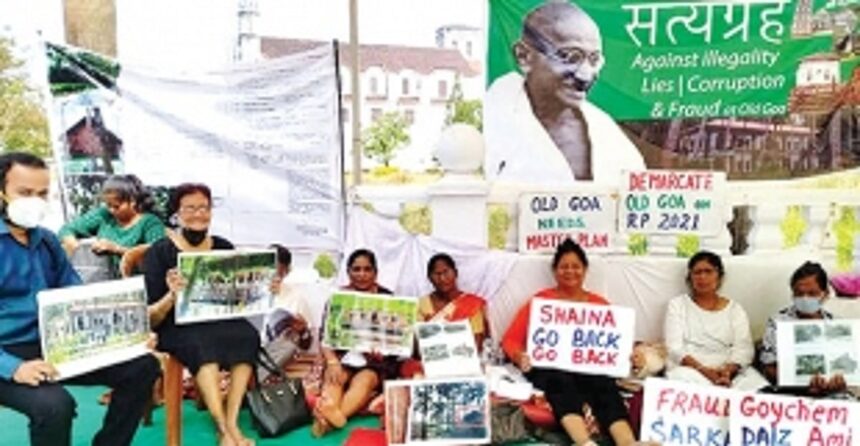
Today we decided to move out of the studios and take to the streets, primarily because people of Goa have taken to the streets for days after days, through feasts and festivals, through rain and shine. People of Goa, especially people of Old Goa have stood, sat, walked, shouted and cried to ensure that the heritage of Goa is completely protected.

We sit here in the backdrop of some completely amazing ancient monuments, ASI protected sites and behind us one illegal monstrosity –an illegal structure which is been blessed, passed and allowed by the powers-that-be.
The sad part is the structure and the house still exists in the name of a Goan family. We know that the real people behind it are politicians, politically backed people and so on and so forth, but what is important is that a lot of permissions were taken in the name of a Goan family. Jose Maria de Pinto is the Goan family, in whose name the land was registered earlier. What is interesting here is that, after these massive agitations and sit-ins and dharnas and fast onto death, finally after the revocation of the TCP license, the Chief Minister said in a statement, that necessary action will be taken and the structure will be demolished.
We are here with very eminent panelists to discuss this thread bare, not only of this particular structure but looking into the entire gamut of illegal structures and how our protective sites are being really protected. They are at risk and are vulnerable by the powers-that-be.
I have with me, Anthony D’Silva who is a well know Human Rights Activist from Velim. He has taken up various causes through his eventful life. Next is Tahir Noronha, young architect of Charles Correira Foundation, who is here in his individual capacity. Next is Glenn Cabral, a resident of Old Goa, who is essentially fighting not only for Goa, but his own piece of land and his surroundings.
Sujay Gupta: I’ll start off by asking you Anthony Bab, tell me a little bit about what you feel about the extent of the peoples’ support and the agitation that has happened. How do you define this?
Anthony D’Silva: This agitation was started almost one and half year back by the people of OId Goa itself, and this later spread to other parts of Goa. We are just at an end moment, where we came in solidarity with them. There were people on a day long hunger strike, satyagrah. We are just the supporting pillars. I came to understand that there is a lot of anger in the people and they wanted to just vent it out. But we saw that everything would be peaceful, because this andolan is called a Satyagraha and we have got support from all the corners. This agitation is not of any party. If people have tried to take any undue advantage, it is not of any party, but there is a misconception that there is a demolition order. That is absolutely nonsense. There is no demolition order. There is an order asking for ‘looking into the matter’.
Sujay Gupta: Tahir if you can just tell us, a lot of people have been turning around and saying that the CM made the announcement saying that it’s all over, as he has allowed demolition now. Can you explain to us why you don’t believe that this is the case.
Tahir Noronha: The Chief Minister said rather clearly that we are going to follow the steps as prescribed by the law to initiate the process of demolition. The TCP has already sent the letter to take necessary action in accordance with that. When one reads the letter and later reads the Goa Panchayati Raj Act, you see that there are two actions the panchayat can initiate against a construction that is found to be illegal. Sub-Section A says that the panchayat may issue notice to revoke the construction license and Sub-Section B says that the panchayat may also issue a notice to initiate the demolition process. In this case, we have with us a show-cause notice by the panchayat which states that you have seven days to please give us a reason as to why we should not revoke the license. It’s very important to note what the panchayat notice says. The panchayat has gone for Sub-Section A of the Panchayati Raj Act and have asked for reasons for why not to revoke the construction license, they have not asked for reasons as to why not revoke the demolition.
Sujay Gupta: But the TCP has issued the revocation (order).
Tahir Noronha: That’s the revocation of technical clearance. How permissions are given in Goa is that first the file goes to TCP or PDA, they give what’s called technical clearance. Then the file is supposed to come to the local body i.e. panchayat and the panchayat is supposed to study on site, TCP’s technical clearances and accordingly grant a construction license or not. In Goa, the sad reality is that every panchayat and every municipality claims they lack the technical know-how so they always issue a technical license which is a direct copy paste of the TCP or the PDA clearance. Ideally, in accordance with the 73rd and 74th Amendments of the Constitution of India, every panchayat and municipality has the power to independently review and issue construction licenses with additional clauses.
Sujay Gupta: Just to make it simple for our readers/viewers, what you are essentially saying is that the TCP has only revoked the technical clearance, but construction license is independent of that, and that still stands. So unless there is a demolition order, the structure can still stand. So what the CM announced and all TCP has said is take necessary action but it is not specified what the action is. The action could be demolition, but that is not yet done.
Tahir Noronha: Yes.
Sujay Gupta: Glen Bab, you’ve been here and also are a local and if you recall when the so called infamous 2011 Regional Plan was scrapped, and when the zoning for this area was being done, if you remember one of India’s best know architect, Edgar Rebeiro had actually written a letter to the then Chief Minister saying that what is very important as far as this RP 2011 is concerned, is that you need to look into the protection of these heritage sites and have a separate plan within the RP, so that this whole zone becomes a demarcated zone and there is no construction whatsoever. Can you give us a broader picture of not just this construction but how the entire heritage precinct is totally vulnerable.
Glenn Cabral: That is what our second demand was –that protected areas should be marked on the RP2021, because without that there are a lot of illegalities going on. There is a blame game between departments going on. So until and unless the zones are marked on RP 2021, this blame game will continue and so will the illegalities. Our first demand is to demolish this illegal structure from the protected area over the period I’ve seen that there is a lot of pressure from the real-estate lobby trying to encroach the buffer zone areas.
Sujay Gupta: That has happened in this area (Old Goa) as well?
Glenn Cabral: This is not just one case, there are other cases as well where illegalities were going on in the buffer zone area. This illegality has attacked the protected area.
Sujay Gupta: Anthony Bab, these real-estate lobbies can’t just encroach into buffer zones unless they are helped by the powers-that-be. It could be the panchayat or the local MLA or could be anybody. So from your experience, tell me don’t you think that until and unless there is a political will this will never happen because the same MLAs who allow these constructions to happen, get voted back to power? Doesn’t it say something of the voters? Even when an MLA blatantly encroaches into these areas, building huge homes in the vicinity of heritage structures he keeps getting voted again and again.
Anthony D’Silva: That is absolutely right. Basically this same thing follows, if you look at the hierarchy. The voters are pressurised by the MLAs , MLAs are pressurised by the cabinet ministers, they are further pressurised by the Chief Minister and the Chief Minister is pressurised by the centre. If you look at this structure, it couldn’t stand without help from the Central government top leaders. So to say, NC Shaina, who is the spokesperson for BJP, without her intervention or through her connection this could never have come so blatantly and that too in a protected site. Rules and regulations have been flouted under their very nose and within a fortnight permissions have been allotted within 14 hours. I’ve known, be some mutations have been completed within 48 hours.
Sujay Gupta: I would now like to draw attention to the first document issued on February 3, 2020, where permission for repairs to the so called existing residential house of survey 4.1 of village of Old Goa was given. I’ll hand over this document to Tahir and ask what are the violations you see in these documents, post permissions that were given. Tell us where you find the loopholes.
Tahir Noronha: I think there are massive issues in this permission as it says:
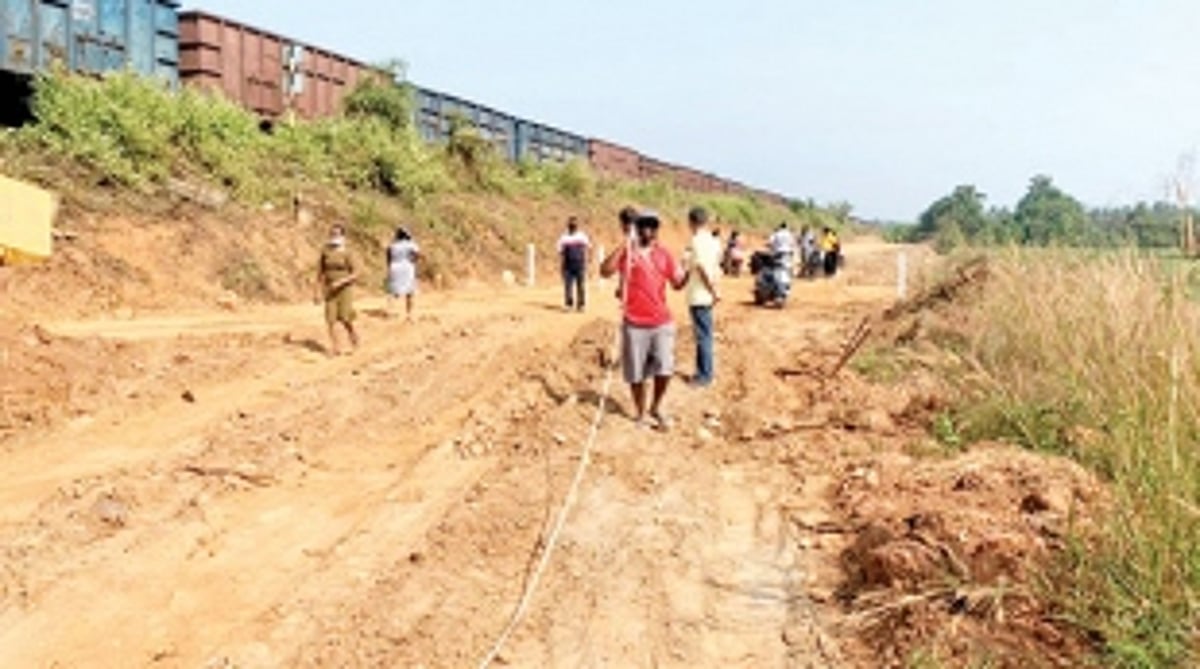
(1) There should be no variation in the length, breadth and height of the structure after repairs in comparison to the existing dimensions. This is very clear because before any construction was allowed, the local ASI man was required to go on-site and measure the length, breadth and height of the existing little hut, which was used to store coconuts and there could be no variation of that. In 2018, the local ASI man had already done this as he had commissioned a survey of all the ASI protected plots in Goa including fort Aguada, Tamdi Surla and several others and at that time the survey showed us the structure being 51sq meters and a ground floor structure. With this point, now if you take a measuring tape and see the size of this construction and you will know that it is a violation of the permission.
(2) Further point 11 says, very clearly, that this permission doesn’t cover the construction. What’s the difference between repair and reconstruction? If you want to change or extend the building, we call it as additions and alterations. When you talk of repair, no additions or alterations are allowed but if you say construction or re-construction, it means you can do additions or alterations. These two to me are the core point.
Sujay Gupta: Glenn Bab, what steps did you all as citizens and activists take, to point these out to the authorities?
Glenn Cabral: We first held a press conference for people of Goa saying that all this is going on here for which we had to approach the court also, but received a cold shoulder from them. Our voice was not heard. Then we came onto the streets to inform the people and simultaneously we wrote to all MLAs to raise this issue in the Goa Assembly. It was not done. After that we felt that this agitation needs to reach all villages.
Sujay Gupta: The Chief Minister said that he had not received any representation or complaint. Can you just clarify that for us.
Glenn Cabral: We had already presented a memorandum to the Chief Minister and for that we asked for appointments or else you not taken in. Then with our delegation, we met him and submitted a memorandum.
Sujay Gupta: Under what banner did you do so?
Glenn Cabral: There was no banner as such, we went to him as citizens of Old Goa. Simultaneously we also gave a memorandum to the TCP Minister who is also the minister for archives and archaeology. TCP minister had given us assurance that he will look into the matter and the structure will be demolished as soon as possible. This was around one and half month back. But after that there was no progress.
Sujay Gupta: So what you’re saying is that the government was completely aware of it and didn’t hear this through newspaper reports, as there were clear representations with them. Tahir can please explain to us the significance of this particular map as there are 2 issues we are taking up – demolishing the illegal structure and demarcations of protective zones and buffer zones in the regional plan. Tell us as to how our buffer zones have not been properly demarcated and put on the plan properly for us.
Tahir Noronha: (Showing the map) In 1968, the ASI took over the monuments in Old Goa. That came to be known as the protected areas. The 1986 Regional Plan, improved in 2021 did not show these protected areas, neither did the regional plans from 2011 till 2021. Infact most of the heritage monuments have been zoned as settlement zones and this causes a lot of confusion to the people of Goa. One example where this has been done is in Delhi Master Plan where protected areas have been zoned as white with a label saying PROTECTED AREA because then it becomes easy for a town planner who is giving permission as well as citizen who is selling his land to know that this falls under a different department and one needs to get permission from that department. In Goa what happens is that Town Planning Department and other departments have a list of all the protected areas but they finally take a decision on where exactly the structure is in respect to the boundaries of the protected areas through a site inspection. Further in 2010, the law that governs the ASI, AMASR Act, was amended to introduce buffer zones. This Regional Plan came out in 2011. So this plan needed to not only show the protected areas, but also needed to show the buffer zones which originated from the end of the protected areas boundary. Now in this particular case (pointing to map) we have seen the minutes of the conservation committee meeting, where it is written that the conservation committee visited the site and measured the distance of the proposed construction from the protected area boundary and found it to be 100 to 300 meters away from the protected boundary? So this is where all the games are played.
Sujay Gupta: So what you’re saying is that when they did this plan, they kind of left these loopholes, so that ways and means could be found to actually do a different kind of zoning and allow people to sell, and that confusion has happened. Do you think this was done only for this structure or they have plans to do it all over the place in this area?
Tahir Noronha: I can give you the example of Fort Aguada against which the Goa Foundation has filed a PIL in the High Court and it is a very similar thing. Again a site inspection has shown, that a proposed construction has to be certain number of meters away from the protected area of Fort Aguada, when actually one looks at it on the map, it is not so. This type of confusion has been deliberate to the 21 ASI monuments and 54 state monuments across Goa.
Sujay Gupta: Anthony Bab, let us get back to the peoples’ movement. How do you see this movement going forward and what is needed to ensure that this movement not only for the demolition of this structure, but also to ensure that our heritage sites are protected.
Anthony D’Silva: There has to be some concrete conviction among the people and this conviction has to reach the grassroots. We have to reach out to the people with information about the permission for the repairs to the existing residential house. This word ‘REPAIRS’ must reach the grassroots people. Once people are aware that permission for REPAIRS, is not permission for reconstruction, there is no construction. So once people are sure this is wrong, then people will come forward.
Sujay Gupta: This is a very good point. I would like to point out one observation of the quote, where they actually mentioned that the words RE-CONSTRUCTION and REPAIR are still unsettled by law. So, at the end of the day, that became a very big window for them to continue the way it continues. Don’t you think there should be a proper legal movement also to ensure that these terms are settled in law?
Anthony D’Silva: Thousands of questions are pouring in. Let it reach out loud and clear to everyone who all are going beyond the circle of this issue, let this issue be put to rest. Once this is done, the rest will follow.
Sujay Gupta: Finally, Glenn Bab. Do you think looking back at this agitation, if people had not come out in this manner and that if this peoples movement had not happened would the government had even moved? Point number one. Point number two, do you think that if the elections were not taking place in the next 2 months, whatever has happened so far would not have happened? Do you agree with that?
Glenn Cabral: I feel that if elections were not approaching now, they wouldn’t have acted in such a quick manner. They are only scared of the elections otherwise they wouldn’t have listened to peoples’ voices as we were fighting this issue for almost 1 year now. Just because elections are round the corner, they are afraid people might vote them out.
Sujay Gupta: Thank you Glenn. I conclude this segment of the debate. Just to say where we stand now is at the crossroads. The government has shown some kind of an intent to set this right but this intent itself is (a) public condition (b) strategic (c) the real intent will be actually visible only when the demolition order will be given if they buy time in a manner where they try and delay due to words or delayed correspondence and get into inquiries and so on, then people might think this is being done just to buy time till end of February and then put the whole thing back into cold storage. So the message that is going on from these grounds is that you need to act now and the demolition has to happen now, because after elections we do not know the issue is (what will happen), what dispensation will come to power and these things get completely lost. I thank all three of you for very insightful points raised. I hoped this little talk of ours adds to the whole picture and hope this give a break in taking this discourse forward.
Sujay Gupta Introduction:
2nd Segment
Sujay Gupta: In the first segment we were talking of the huge protest that has emanated over an illegal structure, a private residential building in the heritage precinct of Old Goa. We will continue discussions on Old Goa by speaking to other activists and people who have made this movement into their own. Olav D’Souza is from Seraulim and is a part of the whole parishioners movement of Seraulim from South Goa and Ana Gracias, a social activist from Chimbel. This shows the extent to which people have been hurt. There are people who are not necessarily from here, but feel they are from here and are coming in from all corners of Goa and become a part of this movement. So Olav tell us a little bit about this movement.
Olav D’Souza: We have come to this place to show our solidarity to the people who are opposing this illegal structure. We have come here as parishioners of Seraulim. I would also request not just parishioners but whole village from Seraulim to come forward for this and show their support to them, because this structure is totally illegal and we would want that to be demolished.
Sujay Gupta: Here I would like to point out that this is a movement across faiths, across castes, across economic standards. Because we are in front of one of the holiest places in the world, and as we sit here, we realise that this movement has really touched the hearts of people. It’s almost like people say that it took our home, our faith or our faith in humanity has been completely breached which is why it is striking a chord among people from deep south of Goa to deep north of Goa across all faiths. That is a real message that is coming out. Ana could you tell us more about this and what has been your experience and what led you to take this up. You’re from Chimbel but this shows the reach that it is touching different people in different parts.
Ana Gracias: I came to know about this illegal structure and that too at a heritage site, I was shocked because we were also fighting for Chimbel Lake as well as Mount Carmel Church in Chimbel which was in ruins and it was the first Goan church built by the Goan priests. We succeeded in this and got it tagged as a heritage site. So this gave me a motivation to help people in Old Goa in their fight. I took the initiative by saying believing that my silent protest and my prayers will be heard by the government and they will demolish the structure.
Sujay Gupta: Olav tell me how do you all plan to spread this awareness in your villages or towns because of course your parish has taken up this cause. So how do the first movers ensure that this doesn’t die down. How do you plan to take it beyond your villages?
Olav D’Souza: Initially what happened was that we attended the earlier meetings held in Old Goa and found that we needed to support this cause and then we have a club in the village and I put up this message in the club groups and everyone supported this and that is how we joined the movement. When we telecast this interview on the channels, people from Betalbatim, Benaulim, and Colva will be aware of this movement and might be ready to join us also. Not just Catholics but people from all faiths have shown support for us. St. Francis Xavier is the saint of all people and they have faith in him.
Sujay Gupta: Ana, before we end this last segment, tell us the role of the political class, not talking of any particular party here, but people interventions have happened in Goa in the past. We obviously see State support in allowing these illegalities to continue. My question is do we need better politicians or a governance that is sensitive to the people. At the same time the counter question is how do you form that governance, the people need to make the right choices. Finally decisions are taken or not taken by the people who are voted to power. So, effective choices need to be made as to who you are bringing to power. What are your thoughts in this?
Ana Gracias: I would suggest that we need a change, since for the past 10 years, I have seen that development is done, but mostly it is destructive development. Everywhere I went, I saw destruction, and many illegalities done. Even if they wanted to build a road, it was illegally done. All politicians get their work done illegally. It is actually we who elect them by showing our trust in them, but ultimately most politicians are already corrupt.
Sujay Gupta: Thank you Olav and Anna for your thoughts and let’s keep this people’s movement going and I believe you’ve thrown a small pebble into the ocean and I hope more people come forward to do that, so the waters can be moved and revolution of sorts can really happen. What we see gives us a lot of hope. Thank you for contributing your time and effort and your sacrifices will hopefully be rewarded.