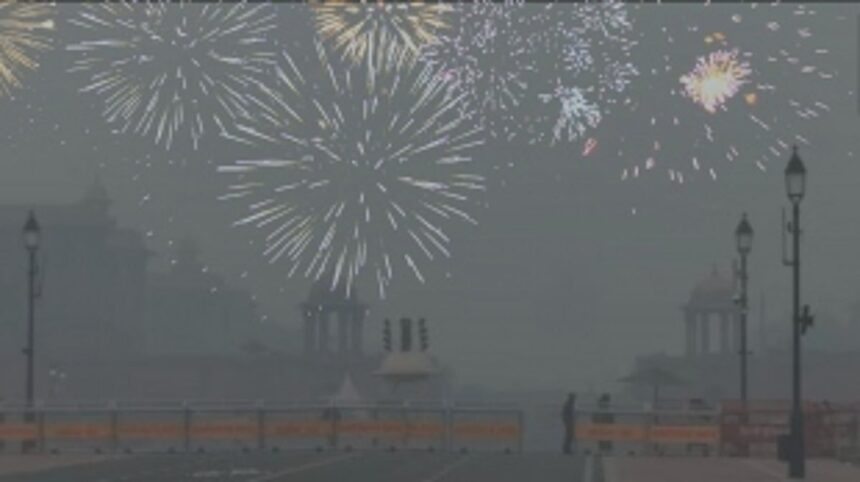
Delhi and the National Capital Region (NCR) are once again in the headlines due to their alarming air quality, exacerbated by the bursting of firecrackers during Diwali celebrations. On Monday morning, the region was engulfed in a thick blanket of smog, with visuals from across Delhi depicting a hazy atmosphere that significantly reduced visibility to just a few hundred meters. In some areas, the Air Quality Index (AQI) levels exceeded 900, with an astonishing AQI of 999 recorded in the iconic India Gate area.
Even in the Major Dhyan Chand National Stadium area, the AQI stood at 999 initially, later dropping to 553. Pusa recorded an index of 970, while the Anand Vihar area, one of Delhi’s most polluted regions, witnessed an AQI of 849.

The issue of pollution in Delhi-NCR has become a matter of heated debate, with Delhi BJP Vice President Kapil Mishra expressing his support for residents who chose to burst firecrackers. Mishra’s statement on social media (X) on Sunday night resonated with many: “Proud of You Delhi. These are voices of resistance, voices of freedom and democracy. People are bravely defying unscientific, illogical, dictatorial bans. Happy Diwali.”
Prior to Diwali celebrations, Delhi had experienced its best air quality in eight years, with an average AQI of 218. However, as evening fell, widespread firecracker usage led to a sharp increase in pollution levels and the onset of the thick smog that now blankets the region.
The debate over pollution and the impact of Diwali celebrations on air quality in Delhi-NCR remains a pressing concern, drawing attention to the need for a balanced approach to protect the environment while preserving cultural traditions.