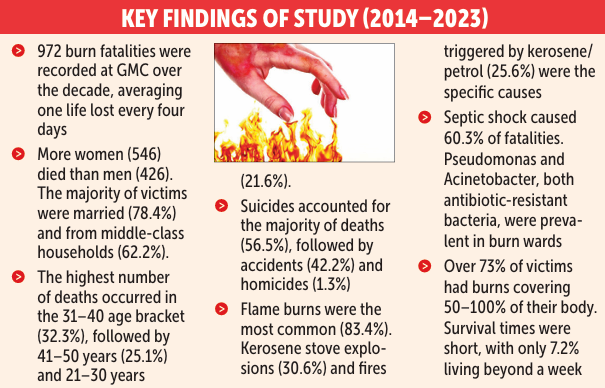
A comprehensive decade-long study, based on data from Goa Medical College (GMC) and conducted in collab oration with its Department of Forensic Medi cine and Toxicology, has revealed that burn inju ries claimed nearly one life every four days in the State between 2014 and 2023, underscoring a per sistent and complex public health challenge linked to unsafe domestic fuel use, suicides, and hospital care deficiencies. The study, titled: “Epidemiological, forensic and clinical insights into burn injuries: A decade-long retrospective analysis from Goa Medical College,” was carried out by researchers from the Na tional Forensic Sciences University’s Goa campus in collaboration with Dr Chetan L Karekar of GMC’s Department of Forensic Medicine and Toxicology. The team analysed post mortem reports, inquest papers, hospital case files, and patient records to identify patterns in burn deaths and understand their social, medical, and forensic dimensions. The findings reveal that 972 burn fatalities were recorded at GMC over the 10-year period. Of these, 546 were women and 426 men, a gender disparity that researchers say re flects domestic and psy chosocial pressures. “Burns are not mere ly a medical concern but also a medico-legal and public health challenge,” the report observed, em phasising that many cases are rooted in family con flict, unsafe home envi ronments, and untreated mental-health distress. The age profile showed the highest prevalence of burn deaths in the 31–40 age group at 32.3 per cent, followed by 41–50 years at 25.1 per cent and 21 30 years at 21.6 per cent. Married individuals ac counted for 78.4 per cent of victims. Contrary to the perception that burn deaths are concentrat ed among economically weaker sections, 62.2 per cent of the victims came from middle-class house holds. Flame burns were by far the most common, constitut ing 83.4 per cent of cases. Kerosene stove explosions ac counted for 30.6 per cent and fires triggered by kerosene, petrol, or diesel for 25.6 per cent, identified as the prima ry causes, while chemical and scald burns were compar atively rare. Researchers noted that despite widespread awareness about safer cooking fuels, the use of kerosene and other volatile substances remains a recurring hazard in Goan homes. The year-wise analysis showed significant fluctuations but no lasting decline. The numbers rose from 42 burn deaths in 2014 to 48 in 2015 then surged to 102 in 2016 and 98 in 2017. The highest toll was recorded in 2018 with 148 deaths. Numbers dropped to 94 in 2019 but rose again to 110 in 2020, followed by 92 deaths in 2021, 140 in 2022, and 98 in 2023. The study found that suicides accounted for 56.5 per cent of burn deaths, accidents for 42.2 per cent, and hom icides for 1.3 per cent. “The predominance of suicidal burns is an alarming indicator of psychosocial distress within the community,” the authors wrote, calling for greater mental-health outreach and domestic conflict in tervention. In clinical terms, infection emerged as the most se rious complication in burn care, with septic shock re sponsible for 60.3 per cent of fatalities. Microbiological analysis from GMC’s burn wards found Pseudomonas species in 35 per cent of cases and Acinetobacter in 31.9 per cent, both known for strong antibiotic resist ance. More than 73 per cent of victims had burns cov ering 50–100 per cent of their body surface, typically considered unsurvivable. Survival times were short. Just over one-fifth of patients, at 21.6 per cent, lived between 12 and 24 hours, while 22.6 per cent survived between three and seven days, and only 7.2 per cent lived beyond a week. Forensic analysis attributed most deaths to a combination of sepsis, hypo volemia, toxaemia, and neurogenic shock. Beyond the statistics, the researchers emphasised the urgent need for systemic reform. “The concentration of burn fatalities among the middle class, especially mar ried women, necessitates urgent interventions in men tal-health care, domestic conflict resolution, and safe household fuel practices,” they concluded. The team also urged better infection control in hospi tals, the creation of dedicated burn units, and stronger psychosocial support networks for victims and families. The persistence of the same causes—unsafe stoves, ker osene misuse, and suicides by self-immolation—across an entire decade, the study warned, shows that preventive and safety measures have not kept pace with the risks. Unless Goa strengthens its medical infrastructure and so cial support systems, researchers cautioned, the State will continue to lose lives to preventable burn injuries year after year.
Goa Study Reveals One Burn Death Every Four Days Over Past Decade, Majority Women