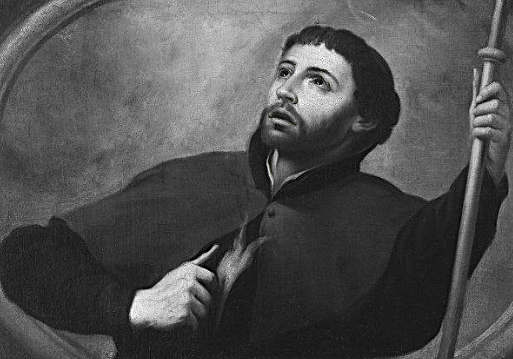
Relics of saints are regarded as treasured possessions of the Church, valued not merely as historical keepsakes but as tangible links to the divine and as signs of Christian hope. These sacred objects are categorized according to their closeness to the saint, commonly described as first-, second-, and third-class relics, making it important to understand what each class entails and which objects fall into these groups. First-class relics are considered the most exalted; they consist of actual parts of a saint’s body, such as bones, hair, or nails, and also include relics associated with Christ’s Passion, for example, fragments of the True Cross. Second-class relics are objects owned or used by the saint, like garments, books, rosaries, or instruments connected with the suffering or death of a martyr. Third-class relics are items, such as rosaries, pieces of fabric, or prayer cards, that have been brought into contact with a first- or second-class relic.

Relics were thought to confer honor and spiritual benefits upon their holders, leading monasteries, cathedrals, and even private individuals to seek highly esteemed examples and to celebrate their acquisition through elaborate decoration of worship spaces and homes. Reliquaries are the special containers fashioned to house and display these precious relics, which were considered more valuable than jewels and more worthy of esteem than gold, and so were often encased in or adorned with gold, silver, ivory, gemstones, and enamel. In that era, there was intense interest in relics, with many people attempting to obtain them as intermediaries between earthly life and the divine, believed to secure various spiritual favors for those who possessed them. Because of this devotion, many obtained fragments of the saint’s body or clothing, and custodians of the body frequently felt justified in distributing such relics as gifts, resulting in numerous churches, chapels, and households in Goa and elsewhere possessing relics of St. Francis Xavier.
A large number of relics drawn from the body of St. Francis Xavier is now spread across different parts of the world. A major collection, described as the “sacred relics of St. Francis Xavier,” is presently kept in a crystal urn enclosed within a silver casket, which rests on a marble mausoleum in a chapel dedicated to the saint inside the Basilica of Bom Jesus in Old Goa. Until roughly six decades ago, these remains were generally called the incorrupt body of St. Francis Xavier, but the terminology shifted to “sacred relics” after a 1951 examination by Dr. Wolfango da Silva and Dr. Pacheco de Figueredo revealed that the contents included a shrunken skull, two legs, the left arm and hand, along with many bones, loose vertebrae, ribs or rib fragments, and scraps of skin. Over the centuries, various portions of the body were removed and distributed as relics by clergy and others, and by a little more than one hundred years after the saint’s death there was already a fervent demand for bodily relics. The lower part of the right arm was taken to Rome in 1614, and in 1619 the upper part of the same arm was divided into three sections and sent to Jesuit colleges in Malacca, Cochin, and Macau, with many other relics now housed in different regions globally.
The Holy Spirit Church in Margão, a church built by the Jesuits, preserves a first-class relic of St. Francis Xavier. Another notable relic, housed outside Goa, is kept at St. Francis Xavier Church in Bhatpal, Karnataka, a site that draws Catholic pilgrims from Canacona and the surrounding Karwar area during the feast. In this church, a small glass casket holds a fragment of the saint’s bone, labeled with the Latin word “ossibus,” which denotes “bone.” Historical narratives report that one of the earliest people to remove a piece from the saint’s body was a sailor of the ship Santa Maria, who was sent ashore to recover Francis Xavier’s remains; amazed by the body’s preservation, he cut off a piece of flesh roughly the size of a finger from below the left knee as proof. Another Portuguese individual, José Bravo, is said to have taken a larger section of flesh, which is presently kept in a reliquary at the basilica. A toe of the saint is likewise preserved in another reliquary in the basilica’s sacristy, while the shoulder blade was sent to Macau. Later, a Jesuit superior general requested more relics, resulting in the removal of all internal organs from the chest and abdomen for distribution to several countries, including Japan.
The Pereira Bragança House in Chandor possesses one of the saint’s fingernails, which according to the family, was gifted to a Jesuit priest within the family. This relic is enclosed in a gilt silver monstrance-type reliquary set with diamonds, which is itself placed inside an ornate wooden oratory. The oratory is mounted on the altar’s retable, positioned just below the statue of the patroness of the family chapel, Our Lady of Piety (N.S. de Piedade).
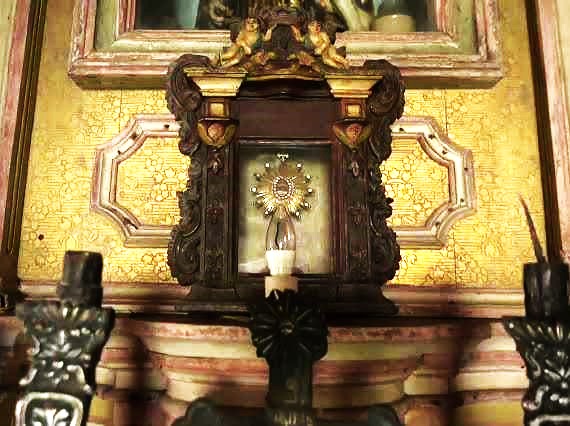
The reliquary at the Pereira Bragança House in Chandor
It is reasonable to say that nearly every devout admirer of St. Francis, both within Goa and beyond, owns third-class relics of the saint. Among them is the Andrade family from Ámbajim in Margão, who safeguard a few pieces of the old fabric that once lined St. Francis Xavier’s casket; these remnants can be seen in a reliquary resting on their family oratory table, a reliquary specially made in 2021 to hold these relics.
The reliquary at Casa Andrade is carved from rosewood in a Baroque style, drawing inspiration from 18th-century ramalhetes, and its decorative patterns are outlined with a yellow ochre oil-based pigment. The central shield-shaped niche features six floral motifs based on the Parijat flower (Nyctanthes arbor-tristis), a species native to South and Southeast Asia and found locally in Goa, and this niche houses the third-class relics of St. Francis Xavier accompanied by a paper strip with the Portuguese inscription “FRAGMENTOS DA URNA DE SÃO FRANCISCO XAVIER,” translated as “Fragments of the casket of Saint Francis Xavier.” The same floral motifs are repeated on the base of the reliquary. On the front is a cast brass image of St. Francis Xavier, modeled on the familiar depiction of the saint located to the left of the entrance inside the Basilica of Bom Jesus in Old Goa. The three-sided pedestal supporting the figure is decorated with silver Parijat flowers, while the saint’s halo, styled as radiating rays, and the cross in his left hand are also rendered in silver.
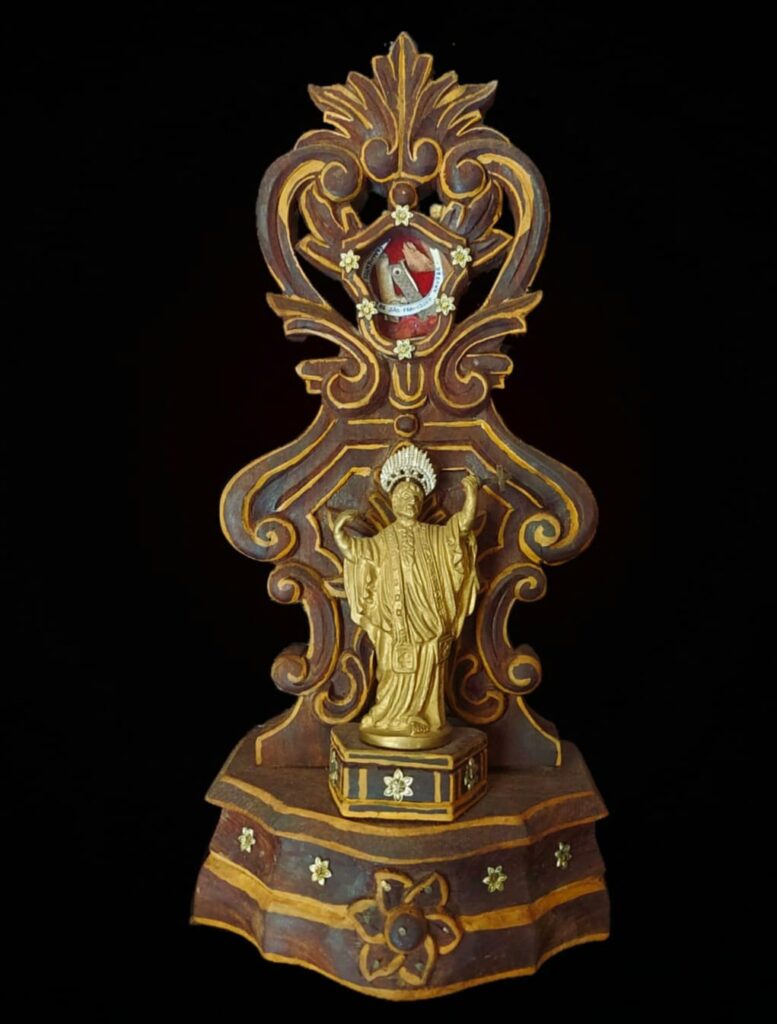
The reliquary at Casa Andrade
On the back of the reliquary, an inscription in Portuguese explains that these pieces of St. Francis Xavier’s casket were salvaged from dust and from being discarded during restoration work carried out in 2020–2021, and that the owner regarded these fragments as a blessing from the saint and therefore commissioned the reliquary to enshrine these third-class sacred relics. The reliquary received a blessing at the Patriarchal Seminary of Ráchol from Fr. Avinash Rebello on Friday, April 16, 2021.
Relics of St Francis Xavier are preserved in several other locations around the world. In the Saint Francis Chapel at Portais, Panjim, a piece of the saint’s skin is kept. The St Francis Xavier Church in Borim houses a relic consisting of a small fragment of his vestment, while the SFX Chapel on Monte Hill in Benaulim also maintains a piece of his vestment. At the SFX Chapel in Siolim, devotees can venerate a relic that includes a piece of St Francis Xavier’s old wooden coffin.
Outside Goa, St Xavier’s Church in Pune preserves an old chasuble dating back to the time of the saint. In the United States, the Blessed Sacrament Catholic Parish in Rhode Island is home to a relic in the form of a piece of the saint’s skin.