The festival of ‘Nagpanchami’ has both scientific as well as
religious connotations. On this auspicious day, it is interesting to delve into
the unique connect between man and snake. “The main reason behind worshipping
the cobra is that snakes used to be very beneficial to farmers as they would
help keep the rodent population under control. In those days, there were no
chemical pesticides available so snakes would act as a natural pesticide,
thereby saving many-a-farmer a lot of trouble. Hence, to express their
gratitude towards these cobras, people would worship them in the form of a clay
idol,” informs environmentalist Rajendra Kerkar.
Seconding this reasoning is Amrut Singh, Founder and
President of Animal Rescue Squad, who adds, “Man and snake have always shared a
unique bond, but each respects the other’s space. If a snake enters your house,
there is no need to panic. It is important to keep away from it as snakes can
be of two types: venomous or non-venomous, and it might be difficult for a lay
man to tell the difference. So it’s best to stay away and contact animal
rescue.”

Cobras are, in fact, revered not only in India, but in other
parts of the world as well. “In Goa, there are around 100 temples dedicated to
the worship of the cobra, one prominent temple being that of Brahamanimaya. In
the complex of Mahadev Temple of Tambdi Surla is a sculpture of a cobra which
is worshipped as Subramaniyam (Kartikeya), son of Lord Shiva. There also are
small forest patches in honour of the cobra which are to be kept clean in order
to maintain the sacredness of that place. Also, no one even dares to kill a
cobra as they are believed to be the presiding guardian of that particular area
and killing of such a cobra is considered as inviting the wrath of god,” says
Rajendra, highlighting the different aspects of this man-and-reptile bond.
In the village of Cotambe in Quepem taluka, the people don’t
worship a clay idol of a cobra, as is a common practice elsewhere, but visit
the temple to worship Nagraj and offer ‘puja’. A large number of devotees flock
to the temple of Nagueshi to worship the Lord of serpents. There are many
shrines dedicated to cobras and in Goa, we also have villages named after
Nagraj, including Nagve in Sattari, and Nagoa in Bardez and Salcete. At the
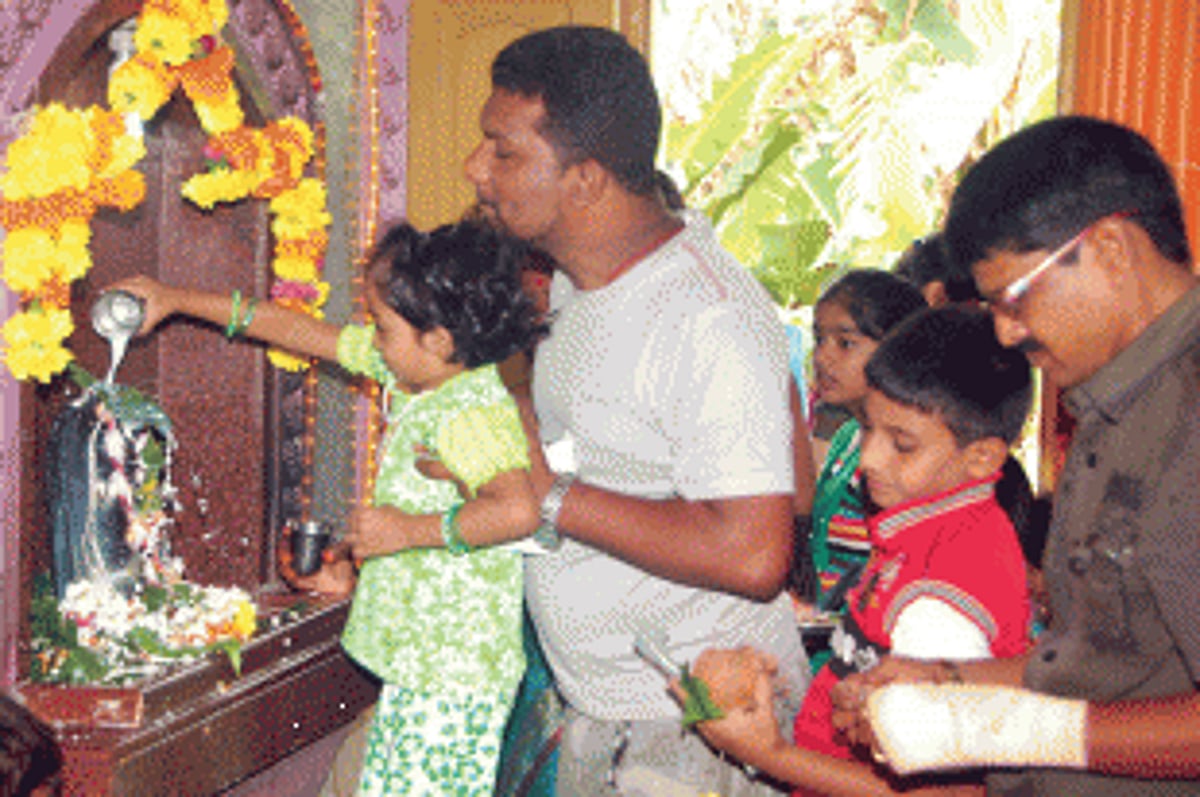
various shrines, ‘abhishek’ is performed to Lord Shiva by pouring milk on the
Shivlinga. Women also offer milk and cornflakes outside the anthills.
In many Hindu houses, clay idols of the cobra are worshipped
on a leaf of Arum by offering wild flowers Balsam, cornflakes and milk. Then
‘aarti’ is performed and a sweet ‘patoli’ is offered to Nagraj before
distributing the same amongst family members. The ‘patoli’ is made by spreading
a paste of par boiled rice onto a turmeric leaf and filling it with a mixture
of jaggery and grated coconut before steaming it.
The tradition
‘Nagpanchami’ is a traditional worship of snakes or serpents
observed by Hindus throughout India and also in Nepal. The worship is offered
on the fifth day of bright half of Lunar month of Shravan (July/August),
according to the Hindu calendar. Serpent deity made of silver, stone or wood or
the painting of snakes on the wall are given a bath with milk and then revered.
Places in Goa where Nagpanchami is celebrated
Brahmanimaya temple,
Coparde
Tarda, Darbandora
Mahadev Temple,
Tambdi Surla
Nagueshi Temple,
Ponda