ROBIN ROY
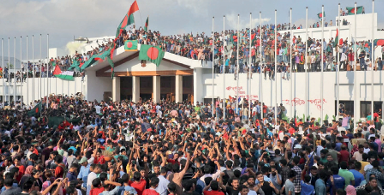
India on Sunday suspended visa operations at its mission in Bangladeshi port city of Chattogram until further notice. The move comes in the wake of a fresh wave of unrest witnessed in Bangladesh following the death of noted youth leader Sharif Os man Hadi. On Saturday, security was beefed up at the Indian Assistant High Commission office and the visa application centre in Bangla desh’s Sylhet city. The enhanced security meas ures were put in place to ensure that “no third party can exploit the situation,” Additional Depu ty Commissioner (Media) of the Sylhet Metropolitan Police Saiful Islam was quoted as saying by The Dhaka Tribune newspaper on Saturday. Tens of thousands of people attended the funeral prayers, and ahead of the ritual, chant ed anti-India slogans like “Delhi or Dhaka – Dhaka, Dhaka” and “brother Hadi’s blood will not be allowed to go in vain.” Earlier on December 17, the Ministry of External Affairs (MEA) summoned Bangladesh envoy Riaz Hamidullah and con veyed its strong concern over certain extremist elements an nouncing plans to create a secu rity situation around the Indian mission in Dhaka. Meanwhile, Former Bangladesh Prime Minister Sheikh Hasina said she will not return to the country under the current circumstances, calling legal action against her as “politically motivated”. She also blamed the interim government led by Muhammad Yunus for the breakdown of law-and-order situ ation in the country. “You cannot demand my return to face my political assassination,” Hasina said in an interview to the media. She added that she would return only when Bangladesh has “a legitimate government and an independent judiciary”. ‘Politically vested’ verdict Criticising the former verdict delivered by the country (Bang ladesh’s) International Crimes Tribunal (ICT), which found her guilty of crimes against humani ty linked to the July–August 2024 uprising, Hasina described it as a “political assassination in judicial robes”. She also alleged that she was denied the right to defend herself and to appoint lawyers of her choice. “This has been a witch hunt against the Awami League,” she said, while adding that her faith in Bangladesh’s constitu tional system remained intact. Referring to recent unrest following the killing of student leader Sharif Osman Hadi, Hasina blamed the interim government for failing to maintain order. Lynching of Dipu Chandra Das As protests intensified, Bang ladesh witnessed another dis turbing incident that underlined the deteriorating situation. Dipu Chandra Das, a Hindu man, was lynched by a mob over allegations of blasphemy amid the unrest. The killing sparked interna tional condemnation and high lighted the growing vulnerabil ity of minorities in Bangladesh during periods of political chaos. While the interim government later condemned the lynching, the damage was already done. For India, the incident reinforced concerns that extremist mobili sation is increasingly spilling into communal violence, with minori ties paying the price. The episode also exposed the hollowness of Dhaka’s claims of stability, as mobs operated with impunity even as tensions with India escalated. “The strain you are witness ing is entirely of Yunus’ making,” Hasina said, adding that India’s concerns over the safety of its diplomats were justified. “Such incidents destabilise Bangladesh internally but also our relationships with neigh bours who are watching with jus tified alarm. India sees the chaos, the per secution of minorities, and the erosion of everything we built together. When you cannot main tain basic order within your bor ders, your credibility on the in ternational stage collapses. This is the reality of Yunus’ Bangla desh,” she said. On elections due in February, Hasina, “An election without the Awami League is not an election, but a coronation,” she said, warn ing that any government formed without broad participation would lack moral authority. Who was Hadi Hadi was a youth leader who participated in the student-led movement in 2024 that led to Hasina’s ouster. He was set to contest the February parliamen tary elections as an Independent candidate. A day before his death, protest ers marched toward the Indian High Commission in Dhaka, de manding that Hasina be brought back to Bangladesh. This prompt ed the Indian mission to close its visa application centre for Bang ladesh nationals for a day. The anti-India protests once again erupted after the Bangla desh Police said they had iden tified the two masked men who shot Hadi, adding that they be lieved the attackers had fled by crossing the border to India. The claim that Hadi’s attackers have fled to India has provoked anger among his supporters. It is obvious that Bangladesh’s instability and the rise of the Ja maat-e-Islami will give enough reasons for New Delhi to frown. Also, given the current context, India is also concerned over the Assembly elections in Bengal and Assam early next year. Key factors Among the key reasons behind the chaos are three key factors: Bangladesh’s past three con troversial polls, India’s refusal to return Sheikh Hasina and alleged role in rehabilitating Awami League. In the last elections in Bang ladesh, allegations were levelled against India for interfering on behalf of ousted leader – Sheikh Hasina. Awami League General Sec retary Obaidul Quader had then said that even though the opposi tion tried to sabotage the election in collusion with foreign coun tries, “India stood by its side.” Ousted former Prime Minister of Bangladesh Sheikh Hasina said statements – like the one a Bang ladeshi politician recently made referring to India’s Northeast and the Chicken’s Neck – are “danger ous”, reflecting the extremist ele ments that have strengthened un der the Yunus-led current regime. Meanwhile, National Citizen Party (NCP) leader Hasnat Ab dullah recently said, Bangladesh can shelter separatist forces from India and sever the seven north eastern states – also known as the “seven sisters – from the rest of the country. Hasina said this “serves only ideological fantasies, not Bangla desh’s national interests”. India has every right to view such statements with concern, she said, adding that these voices do not represent the Bangladeshi people, who she said “under stand that our prosperity and security depend on strong ties” with New Delhi. Meanwhile, pointing to the on going round of turmoil in Bangla desh, the Rashtriya Swayamsevak Sangh (RSS) chief Mohan Bhagwat on Sunday called upon the Hin dus and minorities there to stay united and urged the members of the community, spread across the world, to help them. Speaking at a seminar in Kol kata, the RSS chief said, “They (Hindus) are a minority there (Bangladesh), and the situation is quite difficult. And Hindus all over the world must help them.” (Robin Roy is a Senior Journalist and former Senior Associate Editor, O Heraldo, Goa)