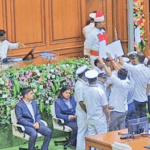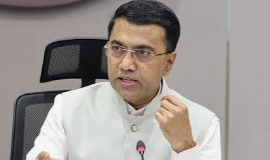
PANJIM: Goa Governor Pusa-pati Ashok Gajapathi Raju’s announcement of a State-lev-el Happiness Index, made during his customary inau-gural address to the winter session of the Goa Legislative Assembly on Monday, has triggered a wider debate on whether the initiative signals a genuine shift towards peo-ple-centric governance or is merely another symbolic pol-icy announcement.
At a time when govern-ments across the world are seeking to redefine devel-opment beyond GDP figures and infrastructure expan-sion, the Goa government’s proposal has been projected as a forward-looking attempt to place citizens’ well-being

at the core of policy-making. Critics, however, argue that without addressing pressing governance failures, the idea risks remaining an exercise in optics rather than impact.
Emphasising that true pro-gress should be measured not only through economic growth and infrastructure but also by the happiness and well-be-ing of citizens, the Governor announced that the State will develop a first-of-its-kind Happiness Index to assess the quality of life of its people.
Addressing the Assembly, the Governor said the pro-posed index would evaluate citizens’ well-being across parameters such as health, education, environment, cul-ture, and community life.
“True progress is measured not only by economic growth or infrastructure, but by the happiness of our people. Hap piness is not a luxury — it is the foundation of a thriving and resilient society,” he said. “I am proud to announce that my government will take a concrete step in this direction by preparing a first-of-its-kind Happiness Index for Goa. This index will assess the well-be ing of our residents across health, education, environment, culture, community life, and more,” the Governor added. “By embedding happiness at the heart of our Viksit Goa vision, my government aims to ensure that growth is inclu sive, sustainable, and closely aligned with the well-being of every resident,” he said. While the announcement aligns Goa with global con versations on well-being-led governance, responses from academia and civil society suggest that its credibility will rest entirely on whether it leads to tangible change on the ground. Reacting to the statement, Peter F Borges, Former Chair person, Goa State Commission for Protection of Child Rights and Assistant Professor, Social Work, Goa Universi ty, said, “In Goa, development is still seen mainly through infrastructure — highways, buildings, events — while the wellbeing of people has been pushed to the background. In recent years, even welfare and protection efforts have turned into optics: ribbon cuttings, staged programmes, and photo-driven initiatives with little real impact. A Hap piness Index will matter only if it shifts the focus back to everyday lived realities — safety, mental health, social security, justice, quality of public services, and dignity in communities. If it highlights these gaps and forces genuine action, it can help. If not, it risks becoming just another pol ished announcement.” More critical voices dismissed the initiative altogether, pointing to what they describe as a widening gap between policy rhetoric and lived reality in the State. Goa BachaoAbhiyan (GBA) Convenor Sabina Martins was sceptical to say the least, “The government tramples our rights, prevents us from laying a wreath on martyrs memori al and mourning the 25 dead at Birch, committed irregular ities, cut hills, damaged water bodies, NDZ, poor Air Quality Index, crumbling infrastructure, polluted environs, casino ills, aggravated violence against women, dacoities, unem ployment. The list is long. Where is the happiness here to measure? Urgent action is needed to mitigate issues.” As the State pushes its ‘Viksit Goa’ narrative, the pro posed Happiness Index has opened up a fundamental ques tion: can happiness be measured meaningfully without first fixing governance, environmental degradation, and social insecurity?