Concerns over borrowing and carrying capacity
The political analysts and experts have expressed their views on the budget.

Senior advocate Cleofato Almeida Coutinho said, “The State is borrowing too much. Basically, the budget is nothing new, just relabelling of existing issues. They are just renewables. You can say it is old wine in a new bottle. But the serious issue is we are borrowing too much. One major failure is that there is no provision for assessing the State’s carrying capacity.”
Referring to constructions, particularly mega housing projects, senior Adv Coutinho opined that the State should have made provision for assessing carrying capacity on two counts: tourism carrying capacity and how much more can be built in the State. Both are related and require budgetary outlay. You cannot give it to a major agency that will charge the State heavily.
“I remember in the last Assembly session, the government said it would assess carrying capacity in tourism sector. But nothing has happened and no budgetary provision is made,” he added.
A budget stripped of taxation powers
Blaise Costabir said, “GST has taken the sting out of the budget. The main part of the budget was taxation. Nothing is left now. I have concluded that this is just a wasteful exercise for a change. Now in GST regime, there is no change in taxation, everything is standard.”
Election year ‘jumlas’
According to All India Trinamool Congress (AITC) national spokesman and political analyst Trajano D’Mello, the budget presented by the Chief Minister Pramod Sawant contains announcements of ‘jumlas’ to deceive the Goans in the ensuing election year.
“The budget failed to provide motivational incentives for farmers, particularly the youth, to take up agriculture. With a hue and cry of shortages of basic infrastructure like water, electricity and roads, no financial provisions have been made to study the carrying capacity to arrest large scale constructions in the State,” he said.
A populist push: Putting money in every hand
Economist and principal Manoj Kamat said that this is the first time the Chief Minister has presented an all-pervasive budget covering all categories of people. This was expected in a populist election year. The social sector has been extensively addressed in the budget in addition to health and education. It will put money in everyone’s hands without charging an extra rupee.
Global headwinds and the MSME growth engine
Former Vice Chancellor of University in Chattisgarh and Professor DM Deshpande said, “Chief Minister Pramod Sawant has presented his 7th State budget. Like on previous occasions, this budget too is remarkable for its details and coverage. He has projected a revenue surplus of over Rs 1,600 crore. However, there will be formidable challenges in the coming year, with another war in the Middle East, energy prices, and a negative impact on the tourism industry.”
“The thrust on manufacturing industry, especially MSMEs, is welcome as Goa is being recognised as a potential hub for innovation and startups. This is the last full budget before Assembly polls next year. Hence, sops have been given to certain groups and a promise made to fill 2,500 government posts. Barring the ‘sin’ tax hike on casinos and licence fees for new liquor shops, no other taxes were increased. In a nutshell, a growth-oriented budget with a reliance on funding by the Centre,” he added.
Fiscal stability via Central assistance
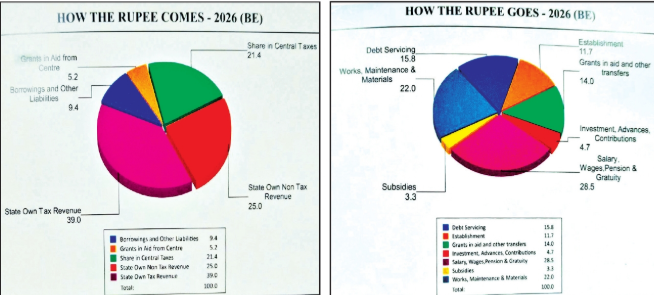
Senior journalist Prakash Kamat said, “In his State Budget for the year 2026-27 of Rs 30,195 crore, the Chief Minister has maintained fiscal stability due to liberal assistance from the Centre and he claims that it is also due to his prudent fiscal management.”
“Goa is a unique tiny State which has very limited resources or opportunities for taxation. Moreover, its small population means not much scope for taxation and for non-tax revenues because it would mean a heavy burden of taxes on the people. So the only way for this State to mobilise resources for development is through different Central schemes for building its capital assets for example, tourism or other infrastructure, and to keep its development booming,” he added.
The Chief Minister, therefore says, “The government may need to look at innovative ways to generate revenue.”
The Chief Minister has made a significant allocation of Rs 251 crore for the Department of Sports and Youth Affairs in the 2026-27 State budget with a focus on strengthening sports infrastructure and supporting athletes across the State. While this is a welcome sign, it would have been good if he had announced an Inclusive Sports Policy that would ensure any infrastructure for sports being built in the State is mandatorily inclusive and accessible, so that aspiring children and adults in the disability sector could easily access these facilities.
It is noteworthy that the Chief Minister has mentioned that the recent global scenario and its subsequent effects are expected to have a significant impact on Goa’s economy and spoken of a focus on employment generation. Some schemes to incentivize industry and trade to employ local youth would have been a good thing. People are too dependent on the government as an employer, which is not a good thing for a progressive State.
Inflation and the case for increased social security doles
The budget indicates a growth of 7.21 per cent as compared to the Rs 27,993.97 crore annual financial statement for the previous fiscal year and focuses on employment generation, sustainable development and green innovation.
In the emerging scenario, and also considering the fact that Goa has a high cost of living and inflation of essential things like fish and vegetables is high due to tourism, it is time that the government substantially increased the social welfare monthly doles like the Dayanand Social Security Scheme (DSSS), Griha Adhaar for women and other marginalised people. These doles have not been revised for over 15 years to say the least. So the announcement of a review of the social security schemes and proposals for an increase in the dole amount is welcome. A mere announcement in the budget is not enough, its implementation on a time-bound basis is very important.
The proof is in the pudding: Concerns over time-bound execution
Whether a budget is effective or not can only be determined by its implementation; the proof of the pudding is in the eating.
Is the budget implementable in a given timeframe? Have any time frame measures been put? Is there a review mechanism with the State government so that at the end of the year, people know how much of it has been implemented and how much just remained media headlines?
Staying within the 3% GSDP Cap
The Ministry of Finance has capped the fiscal deficit to GSDP ratio at 3% of GSDP for the financial year 2026-27.
Considering this, the fiscal deficit of the State for the financial year 2026-27 is projected to be Rs 3,895 crore, which is well within the limits set under the Fiscal Responsibility and Budget Management (FRBM) Act. The State government will have to control extravagant, populist spending if it has to strictly adhere to fiscal discipline to be eligible for good Central funding like the previous year.
Gender budgeting: Addressing the social impact of casinos and liquor
“I have a suggestion to the Chief Minister. Goa has issues like casino, liquor proliferation which are necessitated by tourism. But the flip side of it is that these things have more adverse impact on the life of women. Social tensions in families due to casino gambling including crimes and deaths due to liver cirrhosis affect women. So there have to be measures within annual budget to ensure that these effects of various aspects and allocations in the budget are studied under what is known as “Gender Budgeting”, he said.
“In simple words Gender budgeting is a strategy to achieve equality between women and men by focusing on how public resources are collected and utilised. So within the State Budget the Finance Minister has to do gender budgeting announcement for a few departments to begin with,” Kamat added.
“Make a commitment that all budget allocations to these departments will be analysed and accordingly budget allocations through social security schemes or cover, allocations will be made so that women who suffer adverse impacts of certain departments are helped with appropriate allocations for them through scheme s in education, health, social welfare, etc. At the end of the fiscal year, the report of the Gender Budgeting needs to be prepared, analysed and presented to the House which will guide fresh gender budgeting. This gender budgeting need not be all at a time but should start with around three departments led by tourism,” he added.
‘Viksit Goa 2037’
“The Goa State Budget for FY 2026–27, presented on March 6, 2026 by the CM aims to promote economic growth, infrastructure development, and social welfare under the vision ‘Viksit Goa 2037.’ It includes measures related to tourism, infrastructure, environment, and governance. However, like any budget, it has both positive and negative aspects,” said Shivanand Pandit, an autonomous Finance and Tax Advisor.
“A major strength of the budget is its emphasis on infrastructure development, including better electricity supply, improved public services, and the growth of new regions. Investments in power, sewage systems, and urban infrastructure aim to raise living standards while supporting economic growth. Tourism, the backbone of Goa’s economy, receives significant attention in the budget through policies aimed at strengthening tourism-related businesses and services,” he added.
“Measures such as regulating casinos and promoting tourism development are intended to sustain revenue, generate employment, increase tourist inflow, and support local industries like hotels, restaurants, and transport. Another positive aspect is that the government has not introduced any new taxes, instead planning to increase revenue through higher GST collections and the revival of mining activities. This approach helps reduce the financial burden on citizens, maintain consumer spending, and makes the budget more acceptable to the public. The budget also allocates funds for MSMEs and industrial development, which can encourage entrepreneurship, create jobs, and diversify the economy beyond tourism. Additionally, the announcement of motor tax exemptions for electric vehicles and rationalisation of vehicle taxation promotes green mobility, helps reduce pollution, and supports Goa’s move towards sustainable development,” Pandit added.
The risk of central dependence and rising licensing burdens
However, according to Pandit, the budget also has its Dark Side.
“There are several concerns with the budget. Many promises rely heavily on financial support from the Centre, and delays in these funds could stall projects and reduce the State’s financial independence. The budget also proposes a 200% increase in new casino licensing fees, which may discourage investment and affect tourism revenue. Higher fees for liquor shop and restaurant licences could burden small entrepreneurs and limit competition in the hospitality sector. Fiscal pressures remain a worry, as rising debt and deficits could strain future budgets if revenue targets are not met. The budget focuses more on announcements than on addressing deeper structural issues like unemployment, economic diversification and long-term sustainable growth, leaving the economy heavily dependent on the tourism sector,” he added.