Vivek Menezes
In the absence of pragmatic, balanced perspectives from the state itself, former foreign secretary Nirupama Menon Rao has been outstanding in speaking out for India and Indian interests via social media, where she posted earlier this week about “a tendency, especially in Western and some Indian commentary, to wrap Israel’s actions in the language of ‘security necessity’ until the reality becomes unrecognisable.”

Not since the Sino-Indian military debacle in 1962 (when China penetrated deep into Assam until Tezpur, before unilaterally withdrawing) has India seemed so helpless on the world stage, after a series of bad bets and miscalculations by Narendra Modi and his PMO. It is true no one could have predicted the stunning defeat – both in terms of strategic warfare and global hearts and minds – that an obviously well-prepared and resourceful Iran imposed on the combined might of Israel and the USA over the past month. Still, even though India stayed out, New Delhi lost all the same, because Modi ostentatiously backed the losers at every step.
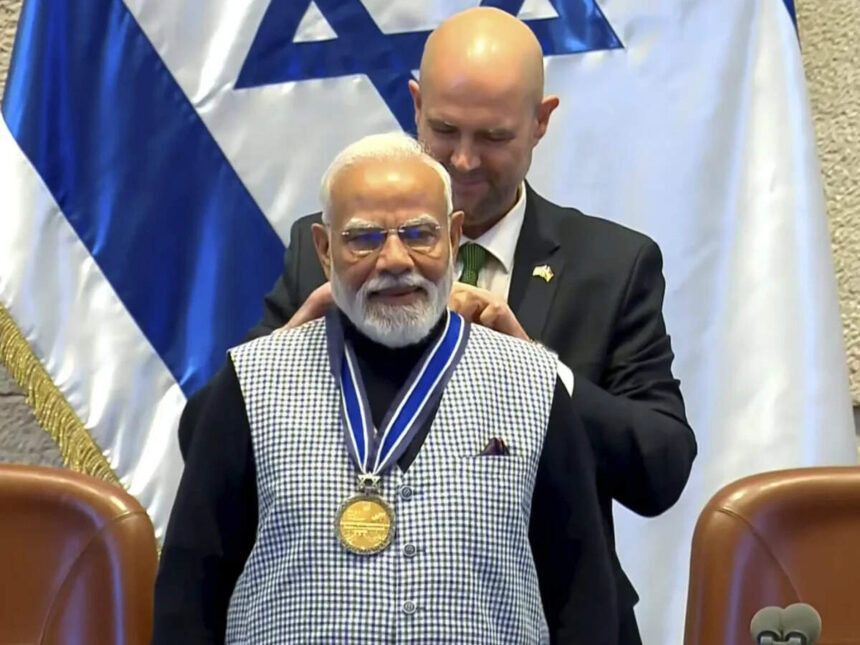
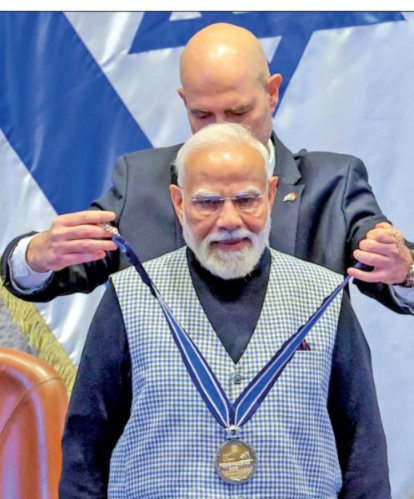
Worst of all was the explicit humiliation in the photograph on this page, as the PM flew to Israel to accept the “first-ever” Speaker of the Knesset “award” and declare “we feel your pain. India stands with Israel firmly, with full conviction in this moment and beyond.” 36 hours later, they started bombing Tehran.
“Why go at that point?” asks Navdeep Suri, the distinguished former Indian ambassador to Egypt and UAE, in an insightful interview with a newspaper. “Looking at the facts objectively, I think the prime minister’s visit to Israel, his whole embrace of Netanyahu, getting a medal from the Knesset, all of that was badly timed. And this is because we knew that a war was imminent.
[And] if you did [go], did you try to use your leverage and friendship and relationship with Netanyahu to dissuade him from pursuing a course of action that has been so destructive to our national interest? Here’s a friendly country which has embarked unilaterally, or, ‘with the Americans,’ on a course that has damaged our economy. Today, our GDP forecasts have been downgraded by everybody from Moody’s to Goldman Sachs to IMF. So, we’ve paid a real price for it.”
Suri says, “I think there was zero downside to having issued an immediate message of condolence when Iran’s former Supreme Leader Ali Khamenei was killed. This is standard protocol. It doesn’t cost you anything to do it. And we should have done that right away.
Not only did we not do that, but we were also tardy in going to the Iranian embassy in Delhi to sign the condolence book. It happened five days later. Finally, the Foreign Secretary went.
Third, you had an Iranian ship that participated in Indian exercises, at the International Fleet Review in Vizag. They were guests of the government of India. They had saluted our president. Again, the delay from our side [in condemning its sinking by the US] left much to be desired.
When the Hamas attacked Israelis, we were right in condemning that. Our subsequent actions, particularly in the UN Security Council, demonstrated a marked tilt towards Israel. On top of that, when we were negotiating the FTA with America, we were being very mealy mouthed in terms of criticising anything that might offend the Americans.
So, I think we’ve sacrificed a degree of our much-vaunted strategic autonomy. In recent weeks, we’ve been trying to claw back some of it. In a sense, we are trying to make up for lost ground. We shouldn’t have made those mistakes in the first place.”
In the absence of pragmatic, balanced perspectives from the state itself, former foreign secretary Nirupama Menon Rao has been outstanding in speaking out for India and Indian interests via social media.
She posted earlier this week about “a tendency, especially in Western and some Indian commentary, to wrap Israel’s actions in the language of ‘security necessity’ until the reality becomes unrecognisable. That instinct to soften, qualify, and contextualise can easily slide into evasion.
But the record of the present conflict does not permit that comfort. Israel has not merely responded. It has driven escalation through choices, expanding targets, widening the theatre, and privileging force over restraint in ways that have predictably hardened positions and drawn others in. That is not incidental. It is strategic behaviour with consequences.
To say this is not to deny that others act, retaliate, or contribute to the spiral. But it is equally not credible to pretend that all actors are operating on the same scale or with the same intent.
What should trouble us is this: When a state begins to act as if overwhelming force can reorder an entire region, it does not stabilise the system. It unsettles it. Force is outrunning judgement. And on that count, Israel’s role in pushing this crisis outward and upward cannot be wished away.”
Rao says the current negotiations signal “recognition of limits: military objectives may have been met, but political end states remain elusive. Israel finds itself in a more ambiguous position.
Having driven escalation, it is now tethered to a process it does not fully control. Its objectives, particularly around regime change or long-term degradation of Iran, sit uneasily with a negotiation track shaped elsewhere.
Iran emerges with a measure of strategic resilience. It has absorbed strikes, retaliated, and then shifted the frame from ceasefire to conditions for a broader settlement: sanctions relief, security guarantees, and regional de-escalation.
In doing so, it has moved from target to negotiating actor without conceding core positions. Pakistan’s role has unfolded not as architect, but as conduit and catalyst. It has provided the channel through which messages travelled, deadlines were softened, and a narrow diplomatic opening created.
That is not mediation in the classic sense, but it cannot be dismissed with stray witticisms either. What we are witnessing is not resolution of conflict, but repositioning. The war has not ended. It has entered a different phase, where coercion and negotiation now proceed together.
For India, the implication is clear. Do not read this as de-escalation alone. Read it as a system under strain, where outcomes are still fluid. India should state its position with clarity: support de-escalation, safeguard maritime flows, and resist alignment with any one narrative of this conflict.
This is not a moment for silence. It is a moment for calibrated voice.
(Vivek Menezes is a writer and co-founder of the Goa Arts and Literature Festival)