As India debates women’s reservation, Goa’s record highlights enduring gaps in representation, finds VITHALDAS HEGDE
If the Central government succeeds in fast-tracking the implementation of the Women’s Reservation Bill, it could mark a watershed moment in Indian polity. The proposed move to reserve 33 per cont of seats for women in the Lok Sabha and State Assemblies has the potential to significantly reshape political representation and decision-making in the country.

Set against the national debate, the situation in Goa reflects both the possibilities and the limitations of achieving gender parity in politics.
A long road to representation
The Women’s Reservation Bill-officially the Nari 1 Shakti Vandan Adhiniyam, 2023 was passed by Parliament in September 2023. However, its imple-mentation has been tied to the completion of the Cen-sus and the delimitation of constituencies, delaying its rollout until at least the 2029 Lok Sabha elections. The government is now exploring ways to delink the process in order to fast-track its enforcement.
The demand for women’s reservation has persisted for decades. While women constitute nearly half of India’s population, their representation in legislative bodies remains disproportionately low. At the grass-roots level, however, the 73rd and 74th Constitutional Amendments mandating 33 per cent reservation in local bodies have demonstrated encouraging results, bringing more women into governance and leadership roles.
As former State Information Commissioner Adv Juino De Souza notes, such measures are intended to “empower women by increasing their representation and ensuring their participation in decision-making, policy formulation and governance.”
Goa’s uneven record
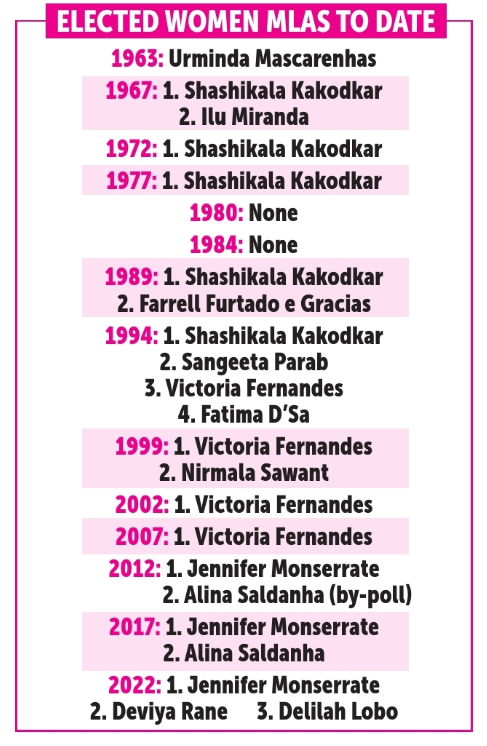
Goa’s experience reflects the broader national chalIlenge. Since the first Assembly elections in 1963, only 14 women have been elected to the State Legislative Assembly-a strikingly low number. There have been periods of complete absence. After the defeat of former Chief Minister Shashikala Kakodkar in 1980, the Assembly had no women members. In 1985, three women-Sulochana Katkar, Phyllis Faria and Sangeeta Parab-were nominated to ensure minimal representation, underscoring the structural imbalance.
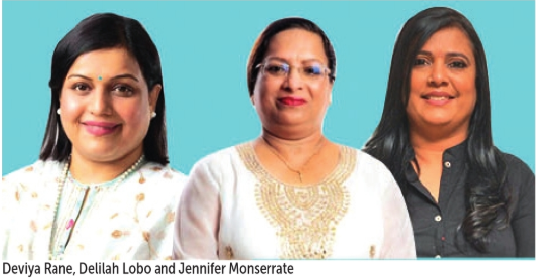
Even today, representation remains modest. The current Assembly has just three women MLAs, and notably, their spouses are also legislators-raising questions about the depth and independence of political participation.
Former South Goa Zilla Panchayat chairperson Nelly Rodrigues points to entrenched barriers within party structures. Political parties, she says, continue to prioritise the so-called “winnability factor” over representation. “This perception has to change,” she argues, noting that women-despite forming nearly half the population are often denied opportunities. She also flags the recurring issue of proxy representation, where women enter legislatures through familial political networks rather than independent political trajectories.
Senior journalist Suhas Belekar echoes this concern, observing that “barring a handful, women whoare either related to politicians or connected to those in power are often elected.” He stresses that political parties must move beyond tokenism and actively support women who have built credibility through grassroots work, instead of limiting them to campaign roles.
Promise and pushback
Supporters of the Women’s Reservation Bill argue that it is a necessary corrective to long-standing structural inequalities. Women currently constitute only around 15 per cent of the Lok Sabha, and increasing their representation could bring greater attention to issues such as education, healthcare, sanitation and social infrastructure. There is also precedent to support this optimism.
At the level of panchayats and municipal bodies, reservation has enabled women to step into leadership roles and influence local governance in meaningful ways. Yet, the policy continues to generate debate. Critics raise concerns about tokenism, proxy leadership and the absence of a sub-quota for Other Backward Classes (OBC) women, arguing that without such provisions, the benefits may be concentrated among more privileged sections.
Political activist Dr Leila Athaide offers a more structural critique. While acknowledging the intent behind the policy, she argues that reservation risks undermining merit-based representation and could reduce electoral competition to category fulfilment. In her view, such measures may lead to symbolic participation rather than genuine empowerment, particularly in patriarchal settings where decision-making authority may still rest with male relatives.
She further contends that reservation addresses the outcome rather than the underlying causes of un-derrepresentation. Barriers such as limited access to education, financial constraints and lack of political exposure continue to restrict women’s entry into politics. Without addressing these structural challenges, she suggests, reservation alone may have limited long-term impact.
Beyond quotas: The way forward
The larger question, then, is whether legislative reservation alone can bridge the gender gap in politics.
In Goa, the answer appears layered. While reservation may create space for greater participation, representation must also increase in absolute numbers. Political parties in the State have the opportunity-and responsibility to take the lead by fielding more women candidates, rather than waiting for a Central mandate to compel change.
This would require a shift in mindset: moving beyond entrenched notions of “winnability” and investing in women leaders at the grassroots level. Creating pathways for capable, independent women to enter electoral politics can, over time, build a more balanced and credible political landscape.
Ultimately, representation must go beyond numbers. It must translate into meaningful participation, autonomy and influence in governance.
The Women’s Reservation Bill may well be a historic step. But its true measure will lie in whether it can transform not just who gets elected, but how pol-itics itself is practised.