Dolcy D’Cruz
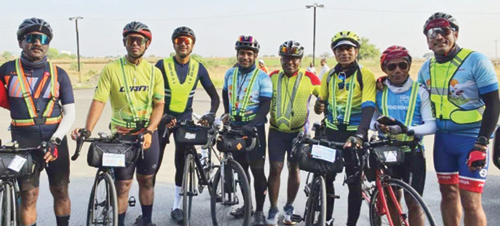
The 1000 km Brevet de Randonneurs Mondiaux (BRM), organised by the Hubli Cycling Club, pushed cyclists to their limits as participants rode from Hubli to Kanyakumari between April 9 and April 12. Battling intense summer heat and physical exhaustion, nine cyclists from Goa not only took part but all successfully completed the demanding ride, showcasing exceptional endurance and determination. Sameer Naik, a software engineer, stood out with an outstanding performance. He completed the ride with a moving time of 40 hours and secured second place among the 29 riders who started the event. “In the timesheet, I am placed second among riders who participated. My full time of the ride was 59 hours,” informs Sameer Naik from Margao.

The event saw 40 registered riders, but 11 did not start due to the harsh conditions, leaving 29 cyclists at the starting line, including nine from Goa. Despite the odds, all Goan participants finished the ride, clocking an average moving time between 42 and 43 hours. The journey was particularly punishing due to soaring temperatures, forcing riders to adapt their strategies. Many chose to cycle through the night to avoid the daytime heat. Sameer explains, “It was making more sense to ride during the night. The first night I rode continuously without any breaks, not sleeping at all.” On the second night, he managed only a brief half-hour nap at a petrol pump in Dindigul, Tamil Nadu. Sleep deprivation was a common challenge. Riders often stayed awake for over 24 hours, relying on constant motion and caffeine to push through. “Even if the ride is not over and you try to go to sleep, you cannot sleep because that anxiety is still there,” Sameer shares. The ride was entirely unsupported, as cyclists had to carry their own equipment and handle any mechanical issues independently. Food, rest, and recovery all came at the cost of time, which continued to run regardless of stops.
Riders carefully managed their diets, initially sticking to simple meals like dal khichdi and curd rice before eventually incorporating protein-rich foods to sustain energy levels. The Goan contingent represented several cycling clubs: Goa Road Riders, ProPedalerz Cycling Club, Fit Swagger Goa, and Panjim Cycling Club. Their collective performance highlighted the growing endurance cycling culture in the state. For Fintan Dourado, who had previously completed longer rides, this event proved uniquely challenging. “This 1000 km ride was tougher than the earlier 1200 km ones because of the heatwave. For continuous three nights, I had no sleep. In the daytime, we had to go slow because of the heat, and make up distance at night.” Riders often travelled in small groups for safety, especially on poorly lit highways. Equipped with powerful lights, they navigated long stretches of road, stopping only briefly at petrol pumps for rest, food, or even a quick wash before continuing.
Advocate Shashikant Naik, a Curchorem based lawyer, completed the ride in 42 hours and described the conditions as extreme. “It was an extreme condition. I will think twice to do it in the same condition,” he admitted. “Till 200 kms, the weather was good, then it became very hot.” He emphasised the importance of preparation, adding, “I started hydration 10–12 days before the ride, drinking 5–6 litres of water daily.” Rest was minimal for most riders. “We didn’t even take a rest of one hour,” Shashikant noted. “Once we stopped at a bus stop for barely 12 minutes because I was feeling giddy.” Despite the punishing conditions, the successful completion by all nine Goan cyclists stands as a testament to their grit, preparation, and resilience. Their achievement not only highlights individual excellence but also underscores the strength of Goa’s cycling community in endurance sports