SHASHWAT GUPTA RAY
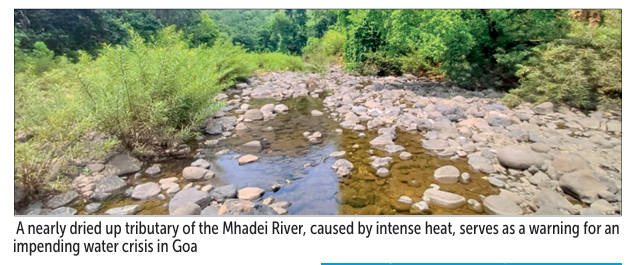
Goa is staring at a potentially devastating water crisis this year as the State enters the 2026 monsoon season un der the shadow of a developing El Niño — a climate phenomenon historically linked to deficit rainfall — while years of reckless construction, ecological destruction and poor water management continue un checked. Scientists warn that if rainfall weakens after August, as projected under El Niño conditions, Goa’s already fragile water se curity could rapidly deteriorate, exposing the consequences of unregulated urban expansion, shrinking groundwater re serves and polluted freshwater sources.

The alarm comes after an unusually harsh summer that saw soaring humidity, extreme ‘feels like’ temperatures and abnormally warm nights across the State. “Although daytime temperatures in coastal Goa mostly stayed in the 34–36.5°C range, humidity pushed the ap parent temperature (‘feels like’) to extreme levels. Panjim recorded a ‘feels like’ temperature of 47–48°C in late April. The moisture in the air reduced the evaporative cooling ef fect of sweat,” former Director of the National Institute of Oceanography (NIO), Dr S Prasanna Kumar, told O Heraldo. He added that Goa also experienced one of its warmest May nights in decades, with minimum temperatures hov ering between 28.6°C and 29°C, offering little respite even after sunset. More worrying, however, is what these conditions may signal for the coming monsoon. “The pre-monsoon rainfall in Goa during March and April recorded around a 52 percent deficit. Reports of below-nor mal rainfall and above-normal temperatures in Goa during April and May (until now) in 2026 align with the special conditions currently being experienced in the Arabian Sea in terms of rapid warming (local factor), compared to the rest of the tropical oceans, along with the developing El Niño condition (remote factor) in the tropical Pacific Ocean,” Dr Prasanna Kumar said. Meteorologist and former Chief Scientist at NIO, Dr M R Ramesh Kumar, said Goa’s rainfall history during El Niño years offers little comfort. “El Niño is a recurring climate phenomenon character ised by unusually warm sea surface temperatures in the central and eastern equatorial Pacific Ocean. It disrupts normal wind and atmospheric pressure patterns, causing a ripple effect of extreme weather events — such as severe droughts, floods and heat waves — across the globe,” he ex plained. “Out of the 13 El Niño years analysed for Goa, nine re corded deficit rainfall, while four experienced normal to excess rainfall,” he said. While factors such as the Indian Ocean Dipole helped Goa escape severe deficits in some past years, scientists say there is no guarantee the State will be similarly spared this time. “Under the influence of the ensuing super El Niño, rainfall in Goa is also likely to be affected, with a lower amount of seasonal rainfall. There could be longer dry spells or ‘break monsoon’ conditions, leading to an overall rainfall deficit. This could severely impact agricultural activities,” Dr Pras anna Kumar warned. Even if heavy rainfall events occur, experts say they may come in destructive bursts rather than sustained seasonal rain capable of replenishing reservoirs and groundwater. “At the same time, sporadic and extreme rainfall events and cloudbursts may increase. This may trigger flash floods and mudslides in hilly areas and slopes across the State, while also increasing the risk of urban flooding,” he cautioned. But environmentalists say climate change alone is not responsible for the looming disaster. They argue that government-backed overdevelopment has systematically weakened Goa’s natural ability to withstand water stress. Water conservationist Tallulah D’Silva warned that ram pant construction across the State is accelerating ecologi cal collapse. “We could face an extreme water crisis. There is un checked construction activity happening across Goa. Mas sive residential projects are using Goa’s wells rather than relying on the Public Works Department (PWD). These projects pose a massive threat to our ecology and to the people,” D’Silva said. She pointed specifically to large-scale projects being built on ecologically sensitive plateaus — natural recharge zones critical for groundwater preservation. “Plateaus naturally act as giant sponges that absorb rainwater and facilitate groundwater recharge. But un checked development on plateaus like Kadamba and Por vorim will prevent water percolation during the rains,” she said. Her warning cuts to the heart of Goa’s growing environ mental crisis: even if rains arrive, increasing concretisation may prevent the land from storing water effectively. Over the years, environmentalists have repeatedly flagged the destruction of wetlands, hill-cutting, concreti sation of open spaces, contamination of water bodies and indiscriminate real estate expansion. Yet approvals for mega housing projects, tourism infrastructure and com mercial developments have continued with little visible restraint. Critics argue that successive governments have treat ed Goa’s ecology as expendable while ignoring mounting warnings from scientists, conservationists and local com munities. Seeking urgent corrective measures, D’Silva called for scientific wastewater management, rainwater harvesting and an immediate halt to ecologically destructive mega projects. “If the government fails to stem the rot, there could be water rationing, which may lead to conflicts within the State,” she warned. For many Goans already grappling with erratic water supply, shrinking wells and worsening heat, the fear is no longer about a distant climate threat – it is a real crisis that may soon reach their doorstep.