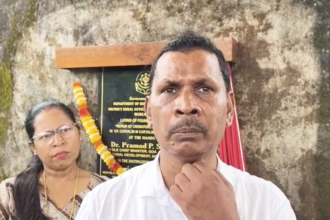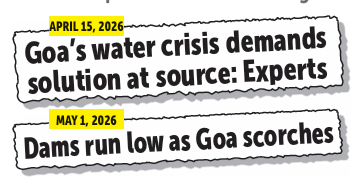
After years of warnings from environ mentalists and sustained reporting by O Heral do on Goa’s worsening water security, the State government on Sunday finally acknowledged the looming threat of a water crisis, with Chief Minis ter Pramod Sawant an nouncing that rainwater harvesting will be made mandatory for all bore well users. The announcement comes amid forecasts of below-normal mon soon rainfall and growing concerns over depleting groundwater reserves, even as critics accuse the government of waking up too late to a crisis of its own making. Speaking to report ers on the sidelines of an event, Sawant said the Wa ter Resources Department (WRD) has been directed to issue a circular making water conservation meas ures compulsory for all borewell users. “Rainfall is expected to be lower this year, making water conservation ex tremely important.
I have instructed the WRD to issue a circular stat ing that all borewell users must undertake water conservation measures. It is necessary to conserve water and recharge reservoirs, wells and groundwa ter sources. We must save water wherever possible; otherwise, there could be a major water availability crisis next year,” the Chief Minister said. The government’s sudden concern over water con servation has, however, drawn sharp criticism from activists who say successive warnings about ground water depletion, shrinking water bodies and environ mental destruction were ignored. Social activist Dipesh Naik questioned both the timing and the logic behind the move. “All borewells should be banned. This year, the pre diction is that there will be less rainfall. There has been rain for hardly one or two days, but WRD en gineers opened the sluice gates and allowed the wa ter to flow out. Actually, we should have waited for the rains to intensify. Secondly, I do not understand this idea of conserving water through borewells. Hills have been destroyed and forests have been razed to facilitate big projects.

There are many dams in the State that have not been desilted and, because of this, their holding capacity has decreased. We have made this demand earlier too — that if there is a water shortage, dams like Selaulim should be desilted. This statement has been made merely to please people. We have never faced a water shortage in the State as we receive one of the highest amounts of rainfall. It is the government’s mismanagement that has created problems related to water and electricity,” Naik said. Environmental groups argued that Goa’s water concerns cannot be divorced from large-scale ecolog ical degradation. Goa Green Brigade convenor Avertino Miranda said, “Goa is facing the serious consequences of climate change, resulting in an erratic monsoon. Any shortfall in rainfall will have far-reaching implications not only for Goa’s agriculture sector but will also lead to a scar city of potable water. The rapid destruction of Goa’s environment, especially the loss of green cover due to the reckless policies of the Goa government in pro moting mega housing and hotel projects, has caused irreversible environmental damage and contributed to deficient rainfall.
It’s high time the Goa government gave up its environmentally destructive policies, par ticularly the land-use changes under Section 39-A of the TCP Act, and immediately imposed a moratorium on tree-felling permissions without any delay.” Critics also pointed to the government’s neglect of traditional water conservation systems that sus tained villages for generations. Santa Cruz Congress Block Committee president John Nazareth said, “Earlier, there was a traditional system of conserving water. In most villages, there would be two or three lakes. But unfortunately, the government has paid no attention to them and the lakes are polluted. If the government is really serious, then it should restore and maintain these lakes. In St Cruz alone, there are two lakes that are in a sorry state. Borewells are sucking out water. The fact is that people have lost confidence in the government. State ments are being made merely for the sake of it. The government should walk the talk.” Environmental ac tivist Arturo D’Souza also questioned the feasibility of the government’s proposal and warned about the unchecked exploitation of aquifers. “The question is how this recharging of water is going to happen. If you take out water from the aqui fer, what will be left for a lake? Lakes have to survive.
There is also a question mark over how deep bore wells can go. Today, borewells can be dug 500 feet be low the ground, which means you are sucking out the entire aquifer. As always, the government comes out with some crazy, half-baked ideas. Water is already being extracted by borewells, so how will they con serve it? Our wells are already contaminated and the government is doing nothing. We are already facing water shortages. The question is: what is the Chief Minister doing about contaminated borewells? What is the WRD doing to safeguard potable water in wells? You are giving a free hand to those who are digging borewells,” he said. For years, environmentalists have warned that rampant hill-cutting, shrinking green cover, indis criminate construction and the unchecked prolifera tion of borewells were steadily eroding Goa’s water security. Sunday’s announcement marks the govern ment’s clearest admission yet that the crisis is no longer a distant possibility but an imminent threat.
The question now being asked is whether manda tory rainwater harvesting alone can reverse years of neglect and environmental mismanagement, or whether it is simply another belated and reactive response to warnings that should have been heeded long ago.