AMAN VERMA
In many cities around the world, finding a public toilet is treated as a basic urban necessi ty. British standards rec ommend public toilets every 300 to 500 metres in busy commercial are as. China follows a similar benchmark in high-footfall tourist zones, while urban planning studies in Aus tralia and Oman frequent ly use a 500-metre accessi bility target. In Panjim, however, finding a public toilet can feel less like accessing a civic amenity and more like stumbling upon a rare urban landmark. Despite being Goa’s capital city and one of the country’s flagship Smart City projects, Panjim operates with only around 30 public toilets under the Corporation of the City of Panaji (CCP), with three facilities remaining shut due to litigation. For residents, com muters and tourists, the issue is not merely the number of toilets available, but whether the near est one is usable when urgently needed.

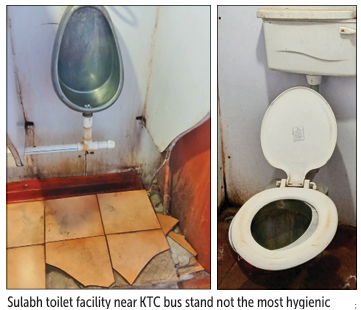
The consequences are already shaping behaviour. “I am always stressed when I leave for work. I trav el by bus, so I avoid drinking water until I reach my workplace in Panjim. I have started this practice af ter I had to use the public toilet near the bus stand in Panjim. The stench there was unbearable,” said Sneha Naik from Vasco. Her experience raises an uncomfortable question for a city aspiring to smart governance: if commuters are planning their hydration around public toilet con ditions, how smart is the infrastructure really? The Corporation’s defence comes in two registers: maintenance and land. On maintenance, a CCP em ployee was reassuring. “Most toilets are functioning properly. Cleaning is carried out multiple times a day and dedicated personnel are assigned to maintain the facilities,” he said, adding that staff are “deployed across the network to ensure the facilities remain operational and hygienic.” A toilet staffer echoed the same figure — cleaned ‘seven to eight times a day’. A staff member at one public toilet facility offered a similar assessment. “It gets cleaned around seven to eight times a day. We try to maintain it,” he said. Aarav Makhija, a tourist visiting Panjim, was less impressed by the preperation. “Some public toilets are in very poor condition. This is basic civic infra structure,” he said. Riya Sharma, visiting from Ben galuru, simply stopped trying: “I ended up using ho tels because I couldn’t rely on the public toilets.” Ivan Petrov, from Russia, offered the most accurate sum mary of the experience: “Some are fine, many are not. You don’t know what you will get.” Camila Reyes from Chile put it more plainly: “I didn’t feel comfortable us ing most public washrooms.” The reliance on private establishments has become so routine that many businesses have quietly become part of the city’s sanitation network.
An F&B manager at a 4-star hotel in Panjim said even non-customers regularly depend on the hotel’s washrooms. “People just walk in and use washrooms. We don’t stop them. That shows the gap in public fa cilities,” he said. CCP officials maintain that maintenance is not the problem. Yet the gap between official assurances and public perception remains striking. While authorities speak of cleaning schedules, users speak of odour, discom fort and avoidance. On the question of expansion, CCP Municipal En gineer Amit Murudkar is candid about the wall the Corporation keeps hitting. “The main issue is land availability. If suitable places are available, we can construct new toilets. There is no issue from our side,” he said, pointing to Miramar as a case in point: “Everybody knows Miramar beach, but we don’t have a proper space there for a toilet facility.
If land be comes available, even through another department, we can build one.” CCP Mayor Rohit Monserrate said, “There is no space in Panjim. People keep demanding more toilets, but the reality is we simply do not have land available everywhere,” he said. “Everyone wants world-class facilities, but they don’t understand the physical limits we are working under. You cannot create land where there is none,” Monserrate added. Maria do Ceu Fernandes, a resident of Mapusa, dis missed the land scarcity argument as lame. “Land in any large city is sparse. The administration needs to have the will to make people centric decisions. Basic amenities are not optional. I have seen in other large cities abroad, public toilets placed even on footpaths. They are very visible, clean and one not too far from the next,” she said. On cleanliness at the public toilets, the Mayor also argued that many complaints never formally reach the Corporation. “People talk about issues, but very few actually come forward with formal complaints. If we don’t get proper reports, we cannot act on assumptions,” Mon serrate argued. He stressed that maintenance depends on report ing mechanisms. “Sulabh is maintaining these toilets. If there is a problem, it has to be reported properly so that action can be taken. Otherwise issues remain unaddressed,” Monserrate said. “Sometimes the perception is worse than the real ity. If something is dirty, it should be reported imme diately instead of becoming a generalised criticism,” he added.
On expectations from users, the Mayor was blunt. “You cannot expect a public toilet to function like a five-star hotel. That comparison itself is wrong. These are basic civic facilities,” he said defending the condi tion of the public toilets in the city. Yet critics argue that citizens are not demanding marble floors or luxury amenities — merely toilets that are accessible, functional and clean enough to use without hesitation. Consumer activist Roland Martins of GOACAN said the deeper issue is accountability. “The feedback is there, but there is no serious mechanism to ensure action is taken and tracked,” he said. He also pointed to institutional buck-passing. “Different departments keep passing responsibili ty. Nothing moves properly,” Martins added. For a city marketed as a Smart City and one of Goa’s foremost tourism destinations, the debate over public toilets has become an awkward reminder that urban development is ultimately judged not by glossy pres entations or digital dashboards, but by the mundane necessities people depend on every day. Panjim’s Smart City project boasts of many firsts but, it has not solved the question of where a visitor can find a clean toilet within reach. By the standards of the UK, China, Australia, and Oman, that is not a mi nor gap. By the standards of any city that would like to be called smart, it might be the most embarrassing one.