SHASHWAT GUPTA RAY
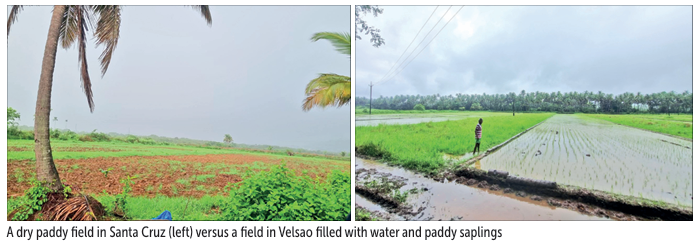
Farmers in Sal cete taluka are faring bet ter with paddy transplan tation compared to their counterparts in Tiswadi and Bardez despite the delayed monsoon, mainly due to stronger communi ty involvement in farming, better utilisation of existing natural water sources for irrigation, and the destruc tion of traditional water bodies in North Goa caused by rampant construction activities, experts said. Santa Cruz farmer Servi to Dias said that the delay in monsoon rains has sig nificantly impacted paddy sowing. “While Bondvol Lake remains a vital ecological and agricultural wetland, unpredictable rainfall has highlighted the need for better water management. Although the local MLA assists with the annual cleaning of water channels, we face several systemic is sues,” Dias said. He said the existing canal system, which can bring water up to 4 km to fields, requires formal permission from the department be fore water can be released. “This process needs to be streamlined to ensure timely irrigation during dry spells. Deforestation and climate change have reduced natural water availability, making us more dependent on exist ing water sources such as Bondvol Lake. While the community farming pro ject has been active for six years, we need more ro bust irrigation facilities to support crops during both the monsoon and winter seasons rather than re lying solely on the lake,” Dias said. Prominent progressive farmer, youth leader and entrepreneur from Calan gute, Narusha D’Souza, said unchecked construction, illegal conversion of agri cultural land under Section 39A of the TCP Act and the consequent destruction of water resources are adversely affecting farming in the coastal belt of Bardez taluka. “The uncontrolled construction boom in Bardez taluka has emerged as a ma jor flashpoint for environmental degradation. Traditional agricultural lands, an cestral orchard lands and ecologically sensitive water bodies are being rapidly concretised. Construction activity and massive dumping are choking traditional waterways and khazan lands. The release of sewage into fields is destroying soil fertility,” D’Souza said.

Joe Cotta, a farmer and coordinator for community farming in Betalbatim, said that although several fields are yet to be cultivated, the village’s relatively healthy groundwater table has enabled farmers to proceed with transplantation despite the meagre rainfall received so far. “Several factors have helped the South, including proactive community in volvement led by figures such as Father George Quadros, support from local MLAs and a higher degree of mechanised farming. Additionally, the South ben efits from robust natural irrigation systems and the use of ponds for second crops,” Cotta said. Rekha Damodar Sutarkar, a farmer coordinator from Velsao, attributed the success of local farmers to two key factors: the practice of cultivating two crops annually and the effective maintenance of the village’s water catchment lake, which has helped ensure adequate water availability. Fr George Quadros, widely celebrated as the “Paddy Man of Goa” for spear heading an agricultural revolution across the State by introducing affordable mechanised community farming to combat labour shortages and revive barren lands, said several factors have contributed to Salcete taluka’s success. “Farmers in Salcete taluka are more open to change, new technologies and mechanisation. This has allowed them to complete transplantation across 50 hectares this season even before the rains arrived.
There is strong public par ticipation in the maintenance of local lakes, which act as natural reservoirs and keep the land moist and cool. This microclimate allows for successful agricul ture even with minimal initial rainfall,” Fr Quadros said. He also highlighted the “community unit” approach in Salcete, where farmers operate collectively rather than individually. “In contrast, North Goa appears to face challenges such as the neglect of tra ditional water bodies, a lack of unified community action, hesitation towards mechanisation and the disappearance of water sources. My advice to farmers in North Goa would be to begin working as a collective village unit to maintain their fields and water bodies,” he said. Former Director of Agriculture Neville Alphonso said that in South Goa, par ticularly Salcete and Mormugao, farmers have successfully completed sowing and transplantation. This resilience stems from proactive land preparation be ginning in mid-April, the use of wells and local lakes for nurseries, and tradition al knowledge of residual soil moisture. “Conversely, North Goa — including Tiswadi and Bardez — faces significant challenges. The traditional practice of waiting for rainfall before beginning cul tivation has left many fields dry. Additionally, rapid development has depleted local wetlands and irrigation channels,” Alphonso said. Former Chief Engineer of the Water Resources Department Sandeep Na dkarni said the traditional agricultural landscape has changed significantly. Landholdings have become increasingly fragmented over generations, with plots often reduced to sizes that make mechanisation and modern farming uneconomical. “To address this, I believe the Agriculture Department needs to explore out of-the-box solutions, such as reviving collective farming models similar to the historical comunidades.
Encouraging a society-based approach within specific catchment areas could allow for more sustainable, large-scale cultivation,” Na dkarni said. He added that while farmers often rely on a single source that may dry up dur ing summer, Goa possesses numerous small lakes that are currently neglected. “These resources need to be rejuvenated to ensure a more resilient water sup ply. A collaborative model is essential: the government could provide the initial capital for rejuvenation projects, while the local community and stakeholders take ownership of ongoing operations and maintenance,” he added.