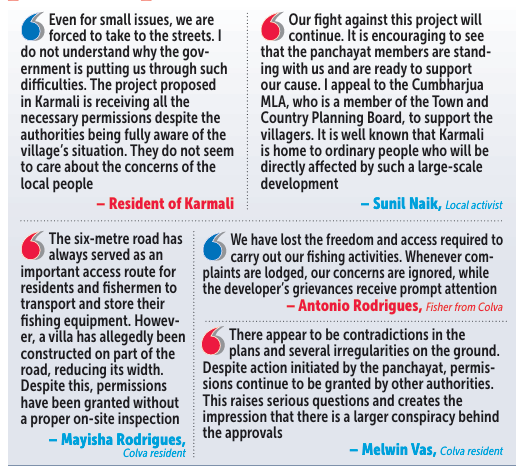
As the anti-mega project agitation at Karapur-Sarvan entered its 79th consecutive day and residents in Benaulim continued to oppose a con troversial land conversion proposal, fresh protests erupted in Karmali, Colva and Navelim on Monday, signalling a widening grass roots backlash against de velopment projects that vil lagers say are being pushed through despite mounting local opposition. The emergence of three new flashpoints in a single day has intensified con cerns over what residents across Goa describe as a pattern of authorities fa vouring developers while sidelining local communi ties, panchayats and envi ronmental concerns. In Karmali, residents gathered outside the PWD office at Banastarim to de mand the withdrawal of a water availability certifi cate issued for a proposed mega project in the village. Protesters questioned how authorities could certify water availability when vil lagers themselves continue to face basic infrastructure challenges. “Even for small issues, we are forced to take to the streets. I do not under stand why the government is putting us through such difficulties. The project proposed in Karmali is receiving all the neces sary permissions despite the authorities being ful ly aware of the village’s situation.
They do not seem to care about the concerns of the local people,” a resident said during the protest. Villagers argued that the proposed development would place additional pres sure on already strained resources and accused authorities of ignoring local ob jections while facilitating project clearances. Reiterating the village’s opposition, local resident Sunil Naik said the agitation would continue until the permissions were withdrawn. “Our fight against this project will continue. It is encouraging to see that the panchayat members are standing with us and are ready to support our cause. I appeal to the Cumbharjua MLA, who is a member of the Town and Country Planning Board, to support the villagers. It is well known that Karmali is home to ordinary people who will be directly affected by such a large-scale develop ment,” Naik said. Naik said villagers had formally requested the PWD to revoke the No Objec tion Certificate issued for water supply to the project. “We have consistently appealed to the MLA to stand with the people of Karmali.

Our struggle against this project will continue, as we do not want such a massive development in our village,” he added. While Karmali residents questioned the allocation of basic resources to a mega project, villagers in Colva alleged that authorities had overlooked serious irregularities while granting permissions for a proposed 10-bungalow develop ment. At a press conference, residents claimed the project had encroached upon a traditional access road used by fishermen and local residents, reducing its width and affecting access to the beachfront. Mayisha Rodrigues alleged that while approved plans showed a six-metre wide road, construction on the ground had narrowed it considerably. “The six-metre road has always served as an important access route for resi dents and fishermen to transport and store their fishing equipment. However, a villa has allegedly been constructed on part of the road, reducing its width. De spite this, permissions have been granted without a proper on-site inspection,” she claimed. Residents also questioned the role of the Town and Country Planning Depart ment, alleging that approvals continued despite discrepancies identified on the ground. They pointed to a stop-work order issued by the local panchayat that was later set aside by the Block Development Officer and alleged that a former panchayat secretary who had declined to issue a completion certificate was sub sequently transferred.
For members of the fishing community, the issue goes beyond planning vio lations. “We have lost the freedom and access required to carry out our fishing ac tivities. Whenever complaints are lodged, our concerns are ignored, while the developer’s grievances receive prompt attention,” fisherman Antonio Rodrigues alleged. Another resident, Melwin Vas, said the continuing approvals despite repeated objections had fuelled public suspicion. “There appear to be contradictions in the plans and several irregularities on the ground. Despite action initiated by the panchayat, permissions continue to be granted by other authorities. This raises serious questions and creates the impression that there is a larger conspiracy behind the approvals,” Vas alleged. The villagers said they would approach the Vigilance Department and other authorities seeking an independent inquiry into the approvals process. A similar battle over planning permissions is now unfolding in Navelim, where residents of Dongorim ward attended a site inspection and renewed their objections to a proposed project, arguing that the existing road infrastructure is wholly inadequate for a development of the scale being proposed. During the inspection, residents pointed to difficulties faced by vehicles ne gotiating the narrow access road, saying the incident demonstrated the area’s inability to handle additional traffic that would be generated by the project. They also urged the panchayat to take an immediate decision on the proposal rather than allowing it to drift towards deemed approval, a mechanism that res idents fear could be used to bypass local opposition.
According to villagers, enough objections and supporting material have al ready been placed on record to justify rejecting the project. They warned that any delay could allow the proposal to secure approval by default, despite wide spread local resistance. Advocate Pratima Coutinho, who accompanied residents during the inspec tion, said the agitation would continue if the panchayat failed to act on the con cerns raised by the community. Taken together, the developments in Karmali, Colva and Navelim point to a growing confrontation between village communities and the institutions re sponsible for regulating development.