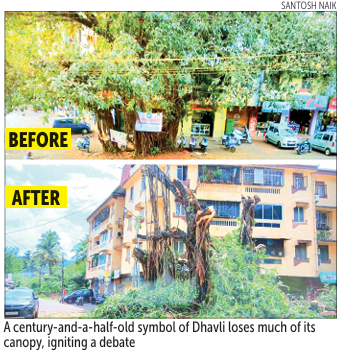
Even as author ities across Goa defend tree cutting in the name of development, the drastic pruning of a 150-year-old banyan tree at Dhavli has become a potent symbol of growing public distrust over how the State treats its natural heritage. What officials describe as a routine safety meas ure has left many resi dents shocked, with vil lagers alleging that the iconic banyan was reduced to a shadow of its former self under the pretext of trimming hazardous branches. For generations, the sprawling tree at Dhavli Junction on the Ponda-Mar gao road served as a land mark and gathering spot. Images of its heavily cut canopy have dominated lo cal social media platforms in recent days, triggering criticism and grief in equal measure.
Residents shared child hood memories, poems and photographs recalling a time when the banyan stood virtually alone in the area. Many lamented what they saw as the irreversible disfig urement of a living monument that had outlasted genera tions of residents. The backlash reflects a broader concern increasingly voiced across Goa — that mature trees are often viewed as obstacles to be managed rather than assets to be protected. Panch member Sonali Tendulkar defended the action, saying public criticism ignored the circumstances that led to the pruning. According to her, residents had complained earlier this year about branches that had become danger ous after some had fallen, narrowly avoiding injury to pas sers-by.

She said legal permission had been obtained to remove three hazardous branches, but additional pruning was un dertaken after concerns emerged about branches obstruct ing fire brigade access and affecting nearby residents. Ten dulkar claimed some occupants of neighbouring buildings had complained of branches touching their flats, while in sects, reptiles and bees associated with the tree were cre ating difficulties for families. “If no action had been taken and an accident occurred, the same people would have questioned why nothing was done,” she argued, maintaining that the intention was nev er to destroy the tree.
Kavlem Deputy Sarpanch Sushant Kapileshwarkar ech oed the defence, stating that the pruning had been carried out in the larger public interest and that the banyan would regenerate over time. For many residents, however, the issue extends beyond questions of safety. They argue that once a century-old tree loses most of its canopy, the ecological, aesthetic and cultural value accumulated over decades cannot simply be restored by waiting for new growth. The controversy has also reignited demands for great er transparency and expert oversight whenever heritage trees are subjected to major pruning.