AUGUSTO RODRIGUES
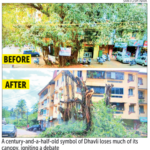
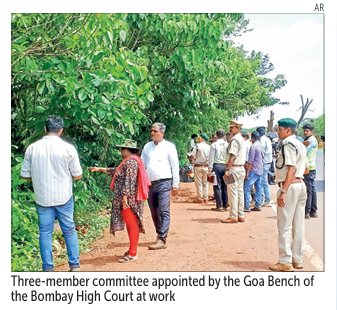
Questions over the benchmarks used to de termine whether a tree should be felled or trans located emerged during the inspection carried out by a three-member com mittee appointed by the Goa Bench of the Bombay High Court. The committee com pleted its inspection of the 80 standing trees from among the 422 trees that had been granted felling permission. Villag ers from the affected ar eas expressed hope that the Public Works Depart ment (PWD) would not allow its commitments to tree replantation to be forgotten over time. Despite the heat, the three-member team, ac companied by officials of the Forest Department, began its inspection a day after the court order. Mem bers also had to endure verbal abuse from a small section of the public, but this did not distract them from the task at hand. The fate of the 80 stand ing trees — out of the 477 trees for which permis sion had been sought and the 422 for which permis sion was granted — does not appear likely to sway in their favour. Committee members largely focused on balancing infrastruc ture development with measures such as replan tation and translocation. “The chances of a tree surviving after transloca tion, and the survival of three saplings planted in place of every tree felled, were the operative as pects of our inspection. One needs to be practical and not parochial,” said Dr Pradeep V Sarmokad am, one of the committee members, on the side lines of the inspection.

Trees measuring four metres or less in height and hav ing a girth of less than one metre were identified as suit able candidates for translocation. “At least 80 per cent of the trees having girth less than one metre and height of four metres or less could be considered for relocation,” states the Report of the Joint Site Inspection conducted on January 7, 2026. Records submitted before the Goa Bench of the High Court indicate that 200 trees along the Cortalim-Ver na-Nagoa stretch were marked for felling despite their recorded height being four metres. Of these, 30 trees were located in Cortalim, 137 in Na goa and 33 in Verna. Documents submitted to the High Court also show that among the 55 trees shortlisted for translocation, 35 are four metres tall, 10 are five metres tall, three are six metres tall, two are eight metres tall, while four have no recorded height. The benchmark used to determine which trees should be felled and which should be translocated became a major point of contention between Malisa Zemira Si moes, counsel for the petitioners in PIL WP No 1617 of 2026 (F), and Advocate General Devidas Pangam. “Cutting trees for development is understandable. What is worrying is the PWD’s poor compliance with replantation requirements. Trees are planted mere ly because an order has been passed, but they are not nurtured afterwards. As per news reports, thousands of trees have reportedly not been replanted. That is the real problem,” said Verna-based engineer Lume Quadros.
Like Quadros, many residents of the three villages where inspections were carried out have accepted the need for some trees to be felled or translocated to facil itate development. However, concerns remain. “Just a few days ago, the PWD started planting a large number of trees away from the national highway. Will these trees also one day face the axe in the name of de velopment?” wondered local resident Neomi Vaz. “The Forest Department is a regulatory body. Imple mentation rests with the PWD, and there needs to be a concerted effort by PWD officials to ensure proper plan ning regarding where and what types of trees should be planted,” explained another member of the High Court-appointed committee, speaking on condition of anonymity. Dr Roshni Kutty, South Asia Coordinator of the ICCA Consortium and a member of the Kalpavriksh Action Group, believes that the success rate of tree transloca tion is negligible. “More than 90 per cent of such trees perish,” she al leged. “Felling a mature tree and planting two or three sap lings does not compensate for the carbon sequestration lost. Mature trees make a significant contribution to car bon absorption, and that loss cannot be offset simply by planting a few new trees,” she said. “With proper planning and effort, infrastructure de velopment and environmental protection can go hand in hand. The problem begins when decision-makers look for shortcuts.
Imagine how much carbon we are failing to trap and instead releasing into the atmosphere. Yet we continue to claim that we will achieve carbon neu trality by 2070,” Kutty added. The Goa Bench of the Bombay High Court directed a three-member committee comprising Ramesh Kumar, Additional Principal Chief Conservator of Forests; Dr Pradeep V Sarmokadam, Member Secretary of the Goa State Biodiversity Board; and Dr Uttappa A R, Senior Scientist at the Indian Council of Agricultural Research (ICAR), to inspect the 80 standing trees, the 55 trees recommended for relocation, and the alternative sites proposed for replantation and translocation by the Ex ecutive Engineer of the PWD Highways Division.