TALLULAH D’SILVA
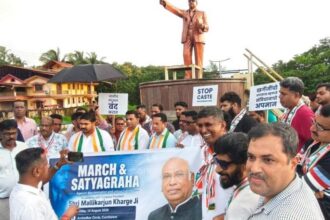
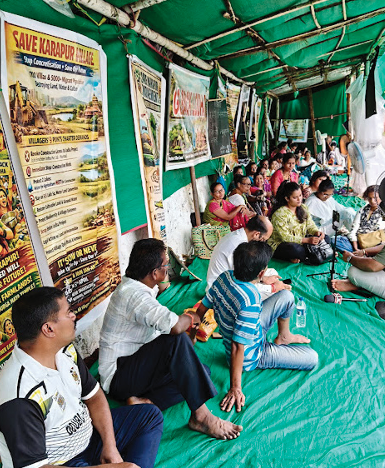
And we rushed to see why the local people were up in protest and why others from Goa were also standing up in solidarity with them. Ironi cally architects, engineers, de signers, developers, contractors and builders have been missing from such scenes of new devel opment aka concretisation in Goa. However, accompanying me were a couple of young archi tects and students of architec ture, who were the only ones concerned and keen to under stand the issue. So we drove up to Karapur via the picturesque Banastarim and Amona villag es. The drive into Karapur was mesmerising with the valley lush green with orchards and wetlands and the hillsides too full of vegetation with the on set of the monsoons. Karapur village too has springs, agrarian lands and biodiverse plateaus. We first met the villagers at the protest site.

There was a group of men along with the son of the soil Dr Swapnil and there was an army of women— young, middle aged and the el derly. All full of life, experience and a deep concern for the im pending destruction of their motherland—the project site of the ‘One Goa’, by Abhinandan Lodha Group. Any tourist, visitor or guest visiting Goa, even if for the first time will not be able to ignore the fact that Goa is beautiful, rich in its natural assets and is abundantly endowed. Her peo ple are kind, gentle and loving to all. One must say at this point that this is the true wealth and luxury of Goa. And anybody would be a fool or an utter id iot to buy into any dream that is sold at the cost of its mother (land). The women lamented that the plateau is rich with medicinal plants that cures all ailments. The men were sad that the near by Gogal waterfall is showing signs of distress with near dry water as nearly six borewells have been built at the project site. Dr Swapnil’s father shared how the plateau is like a mother that gives milk to her children as it stores rain water in its aqui fers and feeds the aquifers, per ennial springs and nurtures the community across the year. We then drove to the ‘pro ject’ site and we were horrified to see the hill sides cut, deep trenches already dug out, exces sively concretised super wide roads made right from the main road to the project site and then all over more such concrete roads all over the vast plateau, valleys and the hill slopes! It seemed that crores of rupees were already spent on making these unsustainable roads oblit erating vital wildflowers and the unique plateau ecosystems that are more biodiverse than the Western Ghats.
Young Architect Kaniksha Bandodkar from Khorlim re acted, “Today I felt a sense of immense horror and happiness at the same time. I was tense at the pace of this project being completed in such a hurry and happy to see villagers coming together to save their land. Be ing there with them, I felt closer to nature through them. Accord ing to online research, the youth population of Goa is far larger than the older lot. And yet here I was seeing so many old peo ple — some visually impaired or may have had some other problems – out on the street to protest and protect the land that has given so much to them.’ Young student of Architecture Nishtha Gawas from Dodamarg had this to share, “This is not a protest but a demonstration of a concern for the village, its envi ronment and future!” Dhruv Usadadiya, student of architecture from Rajkot Gu jarat asserted, “I am visiting Goa for the first time. It is very beautiful. As architects we must design sensitively. We must in corporate natural materials, use waste materials and sustainable design to make the buildings truly green.” Nigel De Souza, a young artist and 3D animator is very vocal about Goa’s urbanisation and adds, “Goa can have modern amenities but these must be limited to urban towns and cit ies not in verdant villages and hinterlands. Modern develop ment cannot have swimming pools in every villa, borewells on every plateau and an artifi cial beach is the most bizarre idea in a land full of the most serene beaches. If we continue with this mindless development and concretisation in our pre cious villages, Goa is doomed to face severe water shortages and rising heat because of the indiscriminate cutting of trees, hill slopes and land conversion.” Kaniksha added, “I believe, as an Architect and as a hu man first, we need to be more mindful of our surroundings.
As youth we need to save and con serve our land, water and biodi versity. Not only for us but for future generations.” Nishtha also reiterated, “I truly understand what develop ment actually is! Every land has a living landscape full of history, biodiversity and human stories. Can we just erase this? Is that development? Don’t I have a re sponsibility to design with sen sitivity for the land, its people, culture and ecology?” And collectively they ask. “Are the rich really fools? Don’t they see the real luxury of Goa’s nat ural environment, its rivers and biodiversity? Don’t they have a sensitive heart? Or is it rogue developers, builders, architects, engineers who are misleading them with such mirages and bogus advertisements luring all to a life of “hedonism in a fool’s paradise?” The Rakhandars in Veerbhad ra pose cry out, “If anybody sees our land in its richness, they will feel its lush beauty and hear her soul stirring call. Please come, see our land. We will show you. And once you see our mother land, you will not be able to be party to any kind of destruction of her soul!” (Tallulah D’Silva is an Archi tect and silver awardee of the Golden Door Award 2020 for truth and integrity.)