AUGUSTO RODRIGUES
AMBAULIM/ BENAULIM/ FATORDA: As the ongoing FIFA World Cup celebrates football at its highest level, the death of 26-year-old Dai lon Carvalho during an inter-vil lage football match in Benaulim on Tuesday has cast a harsh spot light on the sport’s neglected side in Goa. His death has left family members, locals and football lovers questioning whether enough prior ity is being given to player health and safety by the Goa Football Association (GFA). “Minutes before he fell to the ground, the ball struck his head from a player’s shot and he said, ‘Ouch’. The game continued and suddenly I saw him writhing on the ground. There was chaos because an ambulance could not be organ ised and, within a few hours, I learnt that he had passed away,” said a distraught Oswin Rodrigues, goal keeper of the opposing team on the fateful evening. Dailon was representing United Boys of Ambaulim in their pre-quarterfinal match against Guardian Angel Sports Club in the 47th Cana Benaulim Soccer Tournament organ ised by Sporting Club Cana Benaulim. “As soon as he collapsed,” recalled Peter Fernandes, who had travelled from Ambora to watch the match, “he appeared to lose consciousness.

They kept giving him CPR and he seemed to keep coming back to life and then losing consciousness again. With no ambulance available, some one rushed him to hospital in a car.” The car carrying the unconscious player met the ambu lance midway to the hospital.”They tried to revive him, put him on oxygen and rushed him to the hospital. He was de clared dead on arrival,” disclosed a colleague of the victim, who is yet to recover from the trauma. “I am sure that had there been an ambulance, Dailon would not have died. He died because he was a player in an inter-village football tournament, and the welfare of play ers like us does not matter to the GFA,” said the colleague, requesting anonymity. The GFA neither provides ambulance support to clubs conducting inter-village tournaments nor makes it manda tory for organisers to keep one on standby during recog nised competitions. “The post-mortem revealed that Dai lon died of a heart attack and that he had multiple blocks in his arteries,” claimed Joao Fernandes, president of United Boys of Ambaulim, the club Dailon represented.
According to Iyno D’Souza, former secretary of Goa Velha Sports Club, the tragedy underlines the need for systemic reform.”The GFA needs to ensure that every player under goes a medical examination before registration through designated health centres with which it should sign MoUs. The responsibility of providing an ambulance for every match should rest with the organisers,” he said. An unstarred Legislative Assembly question (No 145) tabled by Fatorda MLA Vijai Sardesai reveals that the GFA paid Rs 16.62 lakh to a medical specialist for services dur ing two Bandodkar Gold Cup tournaments. According to the reply, Rs 9.82 lakh was paid for the tournament held from August 10, 2024, to September 6, 2024, while Rs 6.8 lakh was paid for the tournament held from April 2 to April 18, 2024. “My club has an ambulance for every match.
Unfortunately, the GFA does not seem to accept that ambulances are essential. Forget ambulances, during an underage tour nament conducted by them at Duler, one of my boys broke his hand and there wasn’t even a stretcher available. Things are bad,” alleged Roysal D’Souza, president of Anjuna Gym khana Sports Club.”The GFA spends money where it should not. When it comes to players and clubs, there is no money. But elsewhere, it spends in lakhs. Such an attitude leads to tragedies,” he added. “Apart from calling it horrible luck, I do not know what to say. Normally, an ambulance is stationed outside the Benaulim Panchayat, just a few minutes from the ground. Unfortunately, it was not there that day and we could not get the one from Margao either,” lamented Joel Fernandes, organising secretary of the tournament.”Football exists because of inter-village tournaments and the players who participate in them.
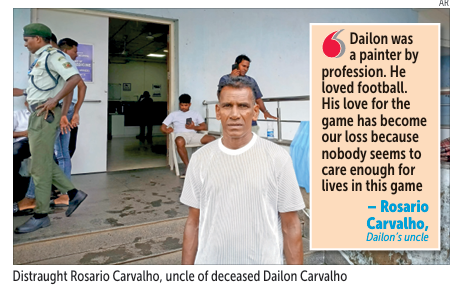
Yet we are left to fend for ourselves,” he added. Enquiries with clubs and private ambulance operators indicate that hiring an ambulance with a paramedic costs around Rs 3,500 per match. GFA president Caitano Fernandes agreed that mandato ry medical screening and ambulances are necessary but maintained that clubs are reluctant to shoulder the re sponsibility.”When we made medical tests compulsory for players above 40, clubs objected. The same will happen if ambulances are made mandatory,” he said. “Dailon was a painter by profession. He loved football. His love for the game has become our loss because nobody seems to care enough for lives in this game,” said his uncle, Rosario Carvalho. For a sport celebrated as the beautiful game, the tragedy has exposed an ugly question: how much value is placed on the lives of those who play it at the grassroots. As Carvalho put it, “Only when health and safety become non-negotia ble will lives begin to matter.”