Beijing: China has revived plans for the China-Myanmar-Bangladesh Economic Corridor (CMBC), a major connectivity project that could reshape regional trade and infrastructure along India’s eastern border.
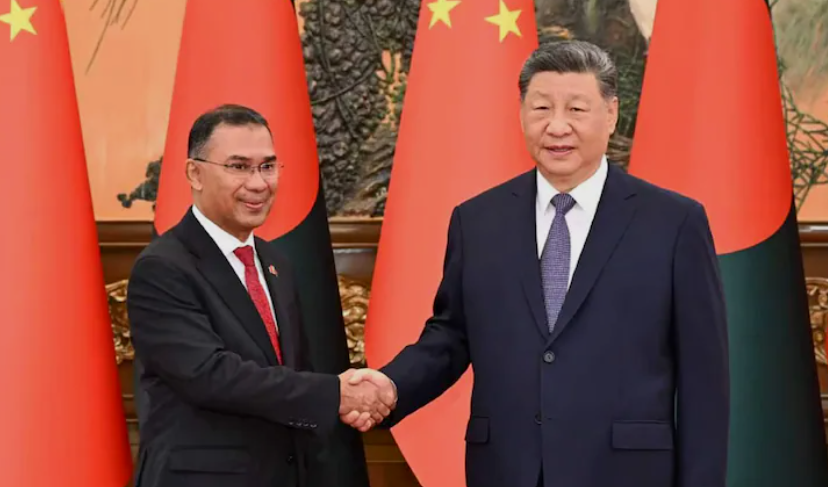
The proposal was discussed during Bangladesh Prime Minister Tarique Rahman’s four-day visit to Beijing, where he met Chinese President Xi Jinping. According to China’s Foreign Ministry, both leaders explored ways to advance the corridor to strengthen regional connectivity and economic cooperation.

The proposed corridor would begin in Kunming, the capital of China’s Yunnan province, and pass through Mandalay in Myanmar before extending to Bangladesh, providing China with another strategic route to the Bay of Bengal.
The initiative follows China’s development of the China-Pakistan Economic Corridor (CPEC), which connects western China to the Arabian Sea through Pakistan. India has consistently opposed the CPEC, arguing that it passes through Gilgit-Baltistan, a region in Pakistan-occupied Kashmir that India claims as its own territory.
Speaking on the proposed eastern corridor, Chinese Ambassador to Bangladesh Yao Wen said the idea was first proposed around 15 years ago under the Bangladesh-China-India-Myanmar (BCIM) Economic Corridor initiative.
“We proposed the Bangladesh-China-India-Myanmar Economic Corridor about 15 years ago and achieved some progress. But due to various reasons, we have not achieved the results China had expected,” Yao Wen said.
When asked whether India could become part of the revived project, the ambassador said the initiative remains open to all countries willing to participate.
“The only idea of the corridor is connectivity and regional economic cooperation,” he said, stressing that the project is intended to promote trade and infrastructure development.
The revival of the corridor comes amid growing geopolitical competition in South Asia and could have strategic implications for India, particularly as the proposed route would run close to its eastern frontier while enhancing China’s access to the Bay of Bengal.
While China has positioned the project as an economic and connectivity initiative, analysts believe its strategic significance is likely to attract close attention from New Delhi, especially in light of ongoing regional security concerns and China’s expanding infrastructure footprint across South Asia.
(This story is published from a syndicated feed)