India celebrates August 15 as its Independence Day, marking the end of British rule in 1947. However, the choice of the date was not without controversy at the time. Soon after Lord Louis Mountbatten announced August 15, 1947, as the date for India’s independence, astrologers across the country began examining the significance of the day.
According to historical accounts, astrologers in Varanasi and several parts of South India considered August 15 inauspicious. Their objections created an unusual challenge for Indian leaders, who were faced with a choice between retaining the date selected by the last Viceroy and addressing concerns over its astrological significance.

Why did Mountbatten choose August 15?
The date was selected during the final months of British rule. Mountbatten had originally been working with a deadline of June 1948 for the transfer of power, but the process was brought forward and independence was ultimately fixed for August 15, 1947.
The date also carried personal significance for Mountbatten. Historical accounts cited by The Indian Express say that August 15 was the second anniversary of Japan’s surrender in the Second World War.
In Freedom at Midnight, authors Larry Collins and Dominique Lapierre described Mountbatten’s choice as a symbolic one. He regarded the anniversary of Japan’s surrender as an appropriate marker for the end of one era in Asia and the beginning of what he saw as a new democratic Asia.
The date, therefore, had political and symbolic importance for Mountbatten. But for astrologers, the question was whether August 15 was an appropriate day for the birth of a new nation.
Astrologers objected to August 15
After the date was announced, astrologers began consulting their charts and reportedly warned that August 15 was not an auspicious date for such a historic event.
Astrologers in the holy city of Varanasi were among those who opposed the date, while similar objections emerged from several parts of South India. Their concerns became significant enough that Indian leaders sought a compromise rather than simply ignoring the objections.
The solution was unusual: the date would remain August 15, but the hour of independence would be changed.
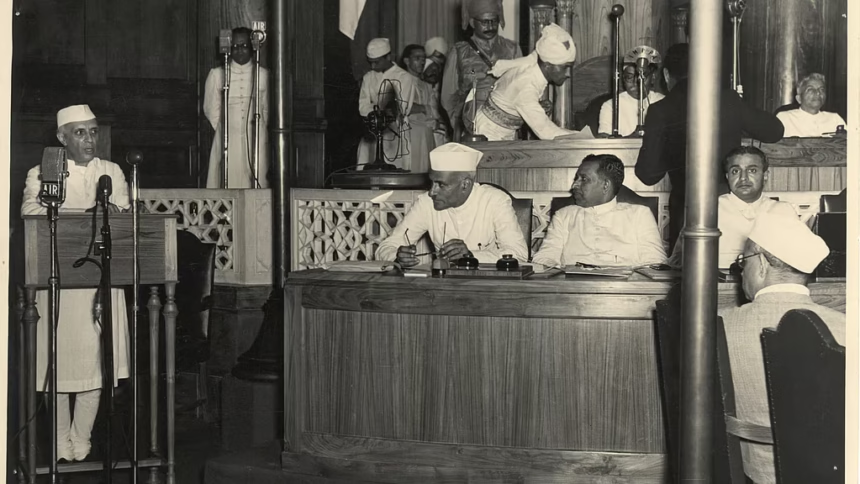
This compromise resulted in the Constituent Assembly holding a special session on August 14 that continued into midnight. India would formally enter independence at the stroke of midnight, allowing the country to retain the date chosen by Mountbatten while accommodating the astrological concerns surrounding the timing.
How midnight became part of India’s freedom story
The midnight transition eventually became one of the most iconic moments in India’s history. Instead of beginning the celebrations during the daytime on August 15, the Constituent Assembly gathered on the night of August 14 and carried its proceedings into the early hours of August 15.
The arrangement effectively settled the dispute without changing the date of independence.
What began as a disagreement over an auspicious date thus helped shape one of the most memorable traditions associated with India’s independence. August 15 remained the official date, while midnight became inseparably linked with the moment India became free.
The episode also reflects the unusual combination of politics, history, symbolism and traditional beliefs surrounding the birth of independent India.