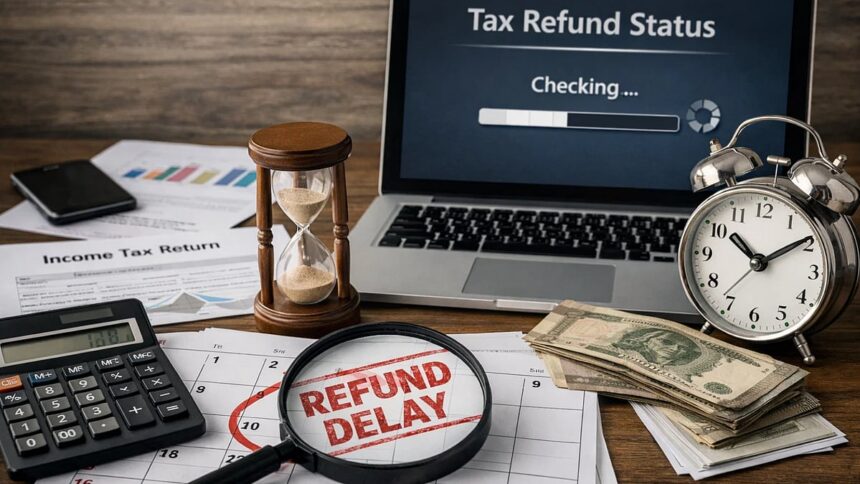
Many taxpayers wait for their income tax refund after filing their Income Tax Return (ITR). While some refunds are credited within a short period, others may take longer to arrive. A delay does not necessarily mean there is an error in the return or that the taxpayer has done something wrong.
The Income Tax Department says refund processing begins after the ITR has been successfully e-verified. Taxpayers are generally advised to allow around four to five weeks for the refund to be credited. If the money has not arrived within this period, there are several things that should be checked.

ITR Has Not Been E-Verified
One of the first things taxpayers should check is whether their return has been successfully e-verified. Filing the ITR alone is not enough for processing to begin.
The return must be e-verified, or the signed ITR-V must reach the Centralised Processing Centre within the prescribed period. The current time limit for e-verification or submission of ITR-V is 30 days from the date of filing.
If the return remains unverified, refund processing will not start.
Bank Account Details Could Be Incorrect
Problems with the bank account linked to the ITR can also delay or prevent a refund from being credited.
Taxpayers should check whether the bank account selected for receiving the refund is correct and has been pre-validated on the income tax e-filing portal. An incorrect account number, IFSC code or other banking issue can result in the refund failing.
Pre-validating the bank account can help ensure that any refund due is credited without unnecessary complications.
Differences in Income or Tax Details
The Income Tax Department compares information reported in the ITR with data available in its records. Differences between the return and information shown in Form 26AS, the Annual Information Statement (AIS) or other records can lead to additional processing.
For instance, discrepancies in reported income, TDS or tax payments may require verification before the refund is released.
TDS Details May Not Match
TDS is an important component of many refund claims. However, if the TDS claimed in an ITR does not match the tax credit reflected in the department’s records, processing can be affected.
Such mismatches may occur when an employer, bank or another deductor has reported incorrect TDS details or has not yet filed or corrected its TDS statement.
Taxpayers should therefore check Form 26AS and AIS and ensure that the TDS claimed in the return matches the information available with the department.
ITR May Be Under Verification
Some returns may take longer because the department’s automated systems identify information that requires further checking. This does not automatically indicate an error or wrongdoing by the taxpayer.
Taxpayers should regularly check their registered email address and the income tax e-filing portal for any communication, clarification request or intimation from the department.
You May Have Received an Intimation
If discrepancies are identified during processing, the Income Tax Department may issue an intimation. The refund amount can also differ from the amount originally claimed if adjustments are made during processing.
Therefore, taxpayers waiting for a refund should check their email and e-filing account for any intimation or processing communication.
Refund May Have Failed
A refund can sometimes be processed but fail to reach the taxpayer’s bank account because of incorrect or unresolved bank details.
In such cases, taxpayers may need to submit a refund reissue request through the income tax e-filing portal. The portal provides a service-request facility for taxpayers whose previously issued refunds have failed.
How To Check ITR Refund Status
Taxpayers can check their refund and ITR processing status through the Income Tax Department’s e-filing portal.
After logging in, go to ‘e-File’, select ‘Income Tax Returns’ and then click ‘View Filed Returns’. Choose the relevant assessment year and open the return details to check whether the ITR has been processed and whether a refund has been issued.
If a refund has been issued, the status should provide information about it.
What To Do If Your Refund Is Delayed
If the refund has not arrived after the usual four-to-five-week period, taxpayers should first confirm that the ITR has been e-verified. They should then check their bank account details and ensure that the account is pre-validated.
It is also important to compare the income and TDS information in the ITR with Form 26AS and AIS. Taxpayers should check their registered email and e-filing account for any intimation or communication from the Income Tax Department.
A delayed refund, by itself, does not necessarily mean there is a problem with the return. In many cases, the delay may simply be due to verification, data matching or banking-related issues.