Team Herald
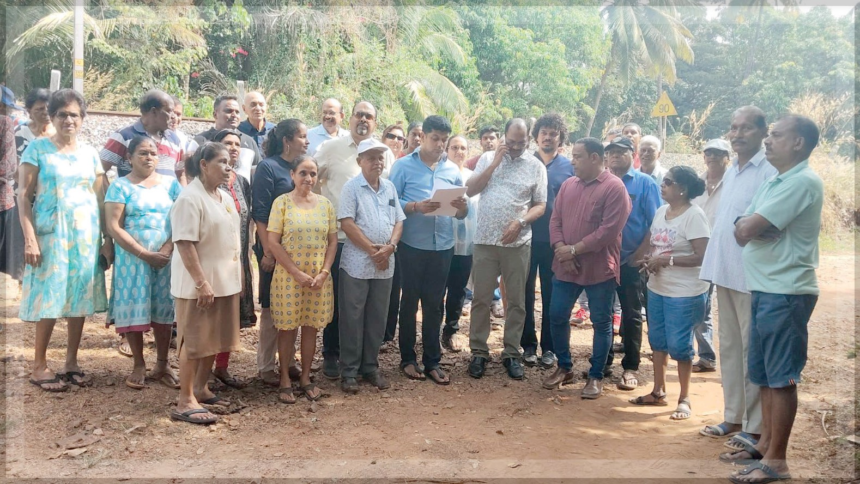
MARGAO: Armed with property documents, the locals voiced their strong opposition to the alleged illegal construction of double tracks on the land, in front of their houses at Primeiro Vaddo-Velsao, which they claimed does not belong to

the Railways.
They pointed out that the construction activity undertaken by the Railways will block access and violate their Right of Way.
The locals lamented that truckloads of mud had been dumped by the Railways to level the century-old mud road. This action, they claimed, has already left several houses landlocked and also obstructed one of the entry points to this mud road.
The villagers, supported by residents from neighbouring areas, civil society, Goa Pradesh Congress Committee (GPCC) President Amit Patkar, GPCC South Goa President Savio Da Silva, and other Congress leaders, asserted their position against the ongoing construction.
Velsao Sarpanch Maria Diana Gouveia and local panch Francisco Braganza also participated in the emergency meeting called by the villagers.
Speaking to the mediapersons, the locals rejected recent claims that the Railways owned the land. Referring to Portuguese-era property documents, they explained that their ownership extended up to the railway line. They also presented official correspondence from the Directorate of Settlement and Land Records (DSLR), which confirmed that the Railways did not own the disputed land. Further, they also showed past communication from Rail Vikas Nigam Limited (RVNL) to the local authorities that stated that the Railways did not have access to this area.
It is pertinent to note that RVNL is carrying out the double tracking project construction work in Goa for South Western Railway (SWR).
The villagers also pointed out that this specific area in Velsao was not part of the land acquired for the double-tracking project.
At the meeting, it was agreed that the Velsao Village Panchayat would begin the process of constructing a tarred road for the villagers. It was also resolved that the locals via the panchayat would write to the South Goa District Collector, who is responsible for Right of Way issues.
The villagers emphasised that the Right of Way, as per existing laws, cannot be denied to residents, particularly to those who possess documents proving ownership.
Sandra Rodrigues, an affected resident, presented letters she had written to the panchayat in 2022, asking for a tarred road to be built and also a letter she had written to the local MLA recently, outlining the difficulties caused by the construction. She stated that relevant property documents had been sent to the concerned authorities with these letters.
“If you see the photos attached to my letters, they show vehicles passing here that are not from our village. This proves that the public has also been using this road, so it’s not just for us alone,” Rodrigues said.
The villagers also expressed concerns about the destruction of the drainage system, which caused waterlogging last year, and feared that flooding would worsen if a retaining wall was built on the Right of Way.
“Once they use this road to build the wall or lay the second track, how are we supposed to enter or leave our homes? We will be landlocked,” Rodrigues added.
GPCC President Amit Patkar criticized the government’s inaction. “When the late Chief Minister Manohar Parrikar was in power, he promised not to allow double tracking in Goa. Why is Chief Minister Pramod Sawant now pushing this project despite opposition? This is a blatant disregard for public grievances. The government is clearly prioritising corporate interests involved in coal transportation over the rights of locals,” Patkar stated. He assured the villagers that Congress MLAs would raise the issue during the upcoming State Assembly session.
After the meeting, which saw participation from senior citizens whose families have lived in the village for generations, a signature campaign was launched.
Goencho Ekvott (GE) Founder Orville Dourado Rodrigues condemned RVNL for conducting construction work as late as 2.30 am, disturbing residents’ sleep. “Are we not human beings? Is this how people should be treated? Imagine if someone blocks access to your house. The single track is already causing problems—what will happen when there are two tracks? Will the government care?” he asked.
Locals expressed frustration at what they described as systemic neglect and appealed to authorities to intervene before the situation worsened further.