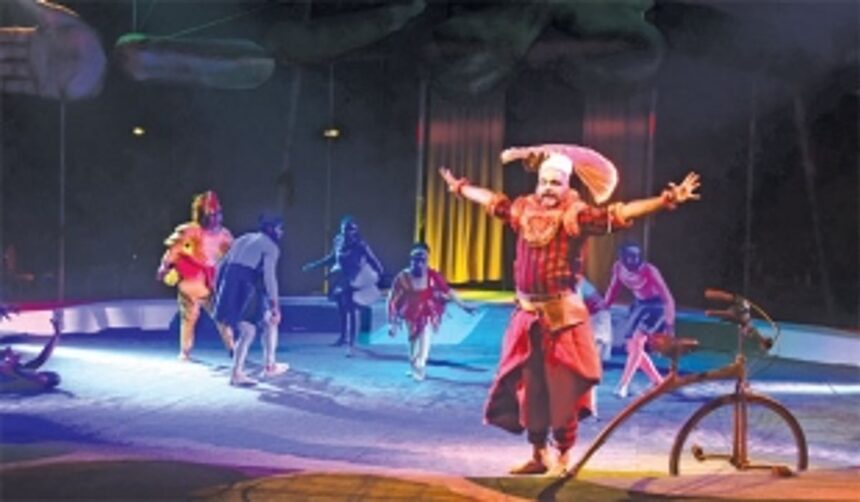
‘Talātum’, is a contemporary adaptation of Shakespeare’s
‘The Tempest’. Set in a circus tent, the play is performed
using circus and other subaltern theatrical practices.
Directed by Abhilash Pillai and curated by Anuradha
Kapur and Lillete Dubey, the performance fulfils the
basic elements of the festival, an act which combines
multidisciplinary arts, old traditions and young artists.
Explaining the process of how ‘Talātum’ was selected
as the main performance from their bouquet of plays,
Lillete says, “Anuradha Kapur, who used to teach Abhilash
Pillai, maintains the practice of keeping in touch with her
students. During one such correspondence, he must have
mentioned that he was planning ‘Talātum’. When we were
planning for the festival, this happened to be one of the
ideas we were tossing around, that sort of dovetailed into
the thoughts we had for the festival. We were looking at
elements like multidisciplinary arts, old tradition and young
artists, which all fitted into this play.”
She further adds, “It is also a well known Shakespearean
story, ‘The Tempest’, which is a classic. It is a very simple,
almost two-line story that allows all these elements, like
circus and magic, to work with it. We felt it would be a good
one for the first year of the festival. Abhilash has created it
just for the Serendipity Arts Festival and it has been funded
by the festival. It is a huge and expensive production and
we are working on taking it to different cities now so that
more people can see it and we can also start recovering the
money.”
‘Talātum’ has a total of 50 artists from all over India,
including 12 circus artists and six professional actors. The
entire cast and crew trained for 6-8 weeks in Mangalore,
where they set up their own commune. “Besides the circus
acrobatics, there also are moving parts in ‘Talātum’. People
have used some elements like Cirque du Soleil, which,
though famous, is not theatre. What we are doing is taking
text and trying to tell a story trough the circus,” says Lillete.
With Serendipity…, both the curators were given
complete creative freedom. “We were curating and we
knew little about what the other curators were doing
but there are things way beyond the curators. There are
conclaves, talks, workshops and so much more happening.
I take my hat off to Sunil Kant Munjal, who heads the
Serendipity Arts Trust. There are many with the vision but
very few are willing to go all out with it and zap people with
the arts,” she says.
Aside from Serendipity Arts Festival, Lillete has two
successful plays currently running in India. “There is one
project which I am dying to bring to Goa – a play based on
the first woman to ever sing on a record in 1902, Gauhar
Jaan. She was like a rockstar who sang and composed;
she was very famous. In those days, there were no posters
so her pictures were printed on matchbox covers all
over Europe. She was half Armenian and half Indian, very
beautiful and had all these tragic love affairs. The play has
already completely 40 shows. I also have a solo of my
daughter, Ira, which is ‘Nine Parts of Desire’, on the survivors
of the Gulf War in Iraq. With war still around us, it focuses
on women who have done nothing but are caught in this
crossfire of the war and how they survive through times like
this. She does nine different roles in it. I am working on an
opera on the Mahabharata which is fully sung. I am talking
to Vishal Dadlani to supervise. I finished 25 years this year
and I wanted to do something big,” concludes Lillete, who
is excited about her next film, ‘Sonata’ with Shabhana Azmi
and Aparna Sen.