Dolcy D’Cruz
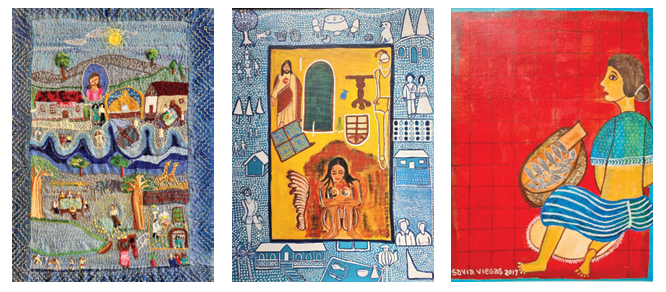
Renowned artist, writer, art historian, and academic Savia Viegas from Carmona brings together multiple strands of her creative practice in ‘Gozali / Conversations’, a solo exhibition with Goan culture. At the heart of the exhibition are two textile-based series, ‘Love Tales’ and ‘Carmona’s Talking Quilt’. Crafted on upcycled denim, these hand embroidered works transform fabric into storytelling surfaces. Through intricate stitching, Savia narrates stories of love, womanhood, and everyday life, delving into emotions such as desire, anxiety, memory, and silence. The series serves as a metaphor for the gradual decline of a once-vibrant Goan Catholic community, while also reflecting the rapid transformations shaping contemporary Goa.

Some works evolve slowly, lingering unfinished for months, while others come together more quickly. Yet each piece ultimately takes between two to three months to complete. She uses old clothes worn on important occasions and use handmade crochet, tatting and bobbin lace. Savia’s work was previously shown at the Goa Open Arts Festival in February 2026, then at Museum Of Goa in March and will now be showing at Carpe Diem, Majorda from today, April 18 to May 17. Speaking about how she incorporated Goan culture, oral histories, and feminist perspectives into her art and writing, Savia explains, “The Goan village has always been the locus of my imaginative work. I have been born and raised in a village and its rich tapestry is what I try to recapture in literature, painting and now in hand-woven textile art. In many ways Goan villages are unique because they are semi-urban, populous, gentrified, more like census towns. However as a youngster, when I moved to Mumbai, I felt a lack because as a frock-wearing Goan I was very different from the rest of Indians, demure in their saris and salwar-kameez.
Wanting to blend in, I hid my identity in an amorphous river as I wore saris, and other external paraphernalia of Indic identity. It was all so very clear.” She further adds, “Having lived away from Goa from 1976 to 2005, my return reawakened sensibilities of my own past f lashing before me an understanding which became central to my creative life. The journey to create was so exciting as I retrieved the past from that amorphous river and in many ways began to understand that life. My life in the city and the skills it taught me or reading history and understanding the dynamics of power and the second sex went a long way in tailoring my approach to my creative work.” Savia’s literary and artistic journey began in 2000. Gozali is a retrospective of her work since then and brings forth to the surface many conversations between Goa’s past and present which constitute its identity. “I may be that proverbial eavesdropper -turned flaneur and fabulist who just presents them to the public for reading and viewing pleasure. These stories are Goan as Goan can be but a reifying of our own past has made us undervalue them giving primacy to literature and art coming from the west as being the real stuff.
I am a story teller so whether it is the medium of the word and paper or colour and canvas or thread and textile my compulsion to form the arc of the story is the same only the mediums through which it is conveyed happen to differ. I don’t write a story any differently from the way I embroider or paint it. But choosing up cycled denim was a deliberate choice to pay homage to the art of my mother who used her skill to raise us. But there were other reasons too for embroidery though a powerful political craft is often reified as woman’s work as against the status enjoyed by fine art,” she says. Savia’s engagement with denim began during Covid time. She was cleaning her mother’s cupboards after she passed on and found a quilt that they had both planned but her mother had executed. Savia resized it and then found that it contained many stories of her childhood. “I began look at some of the stories of those years and what opened up was an archive of stories that had not travelled beyond the hushed conversations of the village. I hand embroidered those oral narratives which were displayed at Museum of Goa in 2024. I was quite astounded by the public’s response to the work. Emboldened, I worked on a series of love stories which were stories of men and women and love.
These stories also were well received. ‘Carmona’s Talking Quilt’ had ten stories but ‘Love Tales’ has a series of 24 stories and of which I only 17 have been completed so in that sense it is still a work in progress,” informs Savia. At the exhibition at Carpe Diem, 14 works of this series which are all based in Goa will be on display besides the 35 other works which look at Goan life. The entire work focuses on creating a local atmosphere, trees, houses, lotus ponds, people which are able to carry forward and create a new thrill of our own stories. Listening to the narrative of Virginia’s pre-nup one visitor commented ‘Hey she is our own. There are stories of caution and good counsel in ‘The Quilt Series.’ Stories of ‘Love Tales’ are rich and complex but fascinating in the way they unfold. They may not be your happy ever after stories but they explore the rich gamut of human emotions. ‘Gozali / Conversations’ opens on April 18, at 7 pm at Carpe Diem Art Gallery in Majorda. The exhibition will remain on view until May 17, open from 10 am to 7 pm, Wednesday through Sunday.