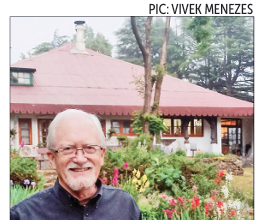
V K Murthy had the distinction of being one of the first technicians to receive the Dada Saheb Phalke Award (2008). A pioneer in the field of cinematography, particularly in the black and white era, his camera work has been immortalised in four long decades, from his early work with the legendary Guru Dutt in the 1950s in films like ‘Pyaasa’ and ‘Sahib Bibi aur Ghulam’ to his work with Shyam Benegal in ‘Bharat Ek Khoj’ and the acclaimed Kannada movie ‘Hoova Hannu’. He also had the privilege of shooting India’s first cinemascope movie ‘Kagaz Ke Phool’. The International Indian Film Academy, Amsterdam awarded him the Lifetime Achievement Award forhis accomplishments (2005).
Honoured to have learnt from the master himself, renowned cinematographer and filmmaker, Govind Nihalani looks back at this most glorious era in V K Murthy’s life and the impact it had on his own work. Apprenticing with the master, Nihalani was to soon imbibe his thinking. “Murthy had a definite philosophy to cinematic image. “Every shot is a part of the narrative and has to be put in sequence. He not only looked at cinema as an image, but also as a mood and emotional experience,” he explains. “Murthy picked up a lot of techniques from British films and also the Mistry brothers. It was his long association with Guru Dutt that gave him the opportunity to create a different style. After he shot the first cinemascope movie, which was quite a challenge for him, he developed his own style and experimented. He began to look at the subject matter from two aspects – the artificial, imagined within the walls of the studio and the other a realistic one away from the sets,” Nihalani elucidates. V K Murthy’s experimentation and improvisation continued whether it was with light or lenses.
Speaking of his collaboration with Guru Dutt, Nihalani explains that this relationship went way beyond the sets. The director and cinematographer were so in sync that each understood what the other required to make it the perfect shot. In later years when Nihalani himself was to take V K Murthy on board as his cinematographer for ‘Tamas’, it was this ‘in sync’ understanding between the two that brought about the best results. Murthy adapted to the colour era with equal verve. “He kept his techniques the same, but paid more attention to contrast,” states Nihalani.
If cinematographers have lost their sheen today, Nihalani
attributes it to the directors who do not push them enough
to deliver their best. “Murthy was such that he encouraged
cinematographers to think as independent individuals,
drawing out the best in them. Now the emphasis has changed,
but cameramen are more capable today and have evolved
with new technology,” maintains Nihalani.