The earliest fans were probably used to quicken the burning of a fire or to keep bothersome insects at bay, but they eventually took on a prestigious role. For centuries, large, long-handled fans were ceremonial symbols of power, the privilege of pharaohs, priests and kings. Even today, fans of this type are carried in formal papal processions.
Fan making was an art in China and Japan by the time the first European ships reached the Orient in the early 1500s. Along with other riches unfamiliar to Europeans, Portuguese sailors brought back fans to the markets of Europe. It is most likely that fans reached Portuguese-Goa during this period.

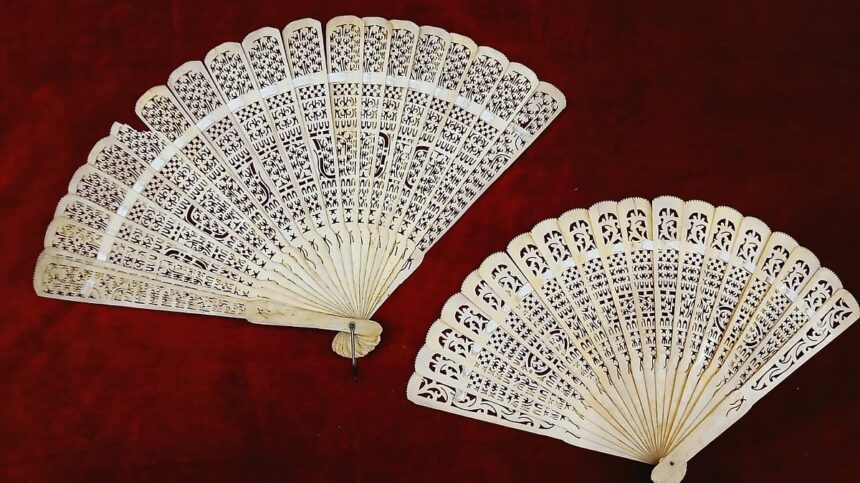
Folding fans are thought to have originated in Asia between the 7th and 10th Centuries, and it was there they first became a part of daily life. These fans, as well as the European fans they eventually inspired, were of two types. Pleated fans have a leaf (or mount) of pleated fabric, paper or leather. The leaf is supported on a series of sticks that are joined at one end by a rivet. Guards, which are the two end sticks, protect the fan when it is closed. Brise fans are folding fans that have no leaf. The sticks themselves widen toward their outer ends and overlap to form the body of a fan. To hold the fan together, the sticks are artfully strung with ribbon or string. Cockade fans are folding fans of either the pleated or brise type that open to a full circle.
By the mid-1500s, Europe had begun to make its own fans and Paris soon became the center of fan production. By the 1700s, the art of the European fashioned fan had reached its peak. Gold, silver, ivory, silk and precious gems were used in making fans, as were simpler materials such as wood and leather.,
Many 18th Century pleated and brise fans were painted with reproductions of masterpieces. After the discovery of Pompeii in 1748, fans blossomed with neoclassical motifs. Later in the century, the success of the Montgolfier brothers` hot-air balloon made that lofty subject popular with fan artists.
From the beginning of the 18th Century, wealthy brides and widows were equipped with delicate marriage and dour mourning fans. Other fans commemorated national events, such as inaugurations or the deaths of public figures.