However, since it is a tourist destination, the floating population would be little over 25 lakhs at any given point of time. According to the census, in a total area of 3702 sq kms there are 394 people for each sq km of land which is higher than national average of 382 per sq km.
Also, Goa has the fourth highest road density in the country among other States with a road network stretching 2,854.94 kms per 1,000 sq km of area. It does not stop here. Goa also has a higher road density compared to its bigger neighbouring States, like Karnataka and Maharashtra.
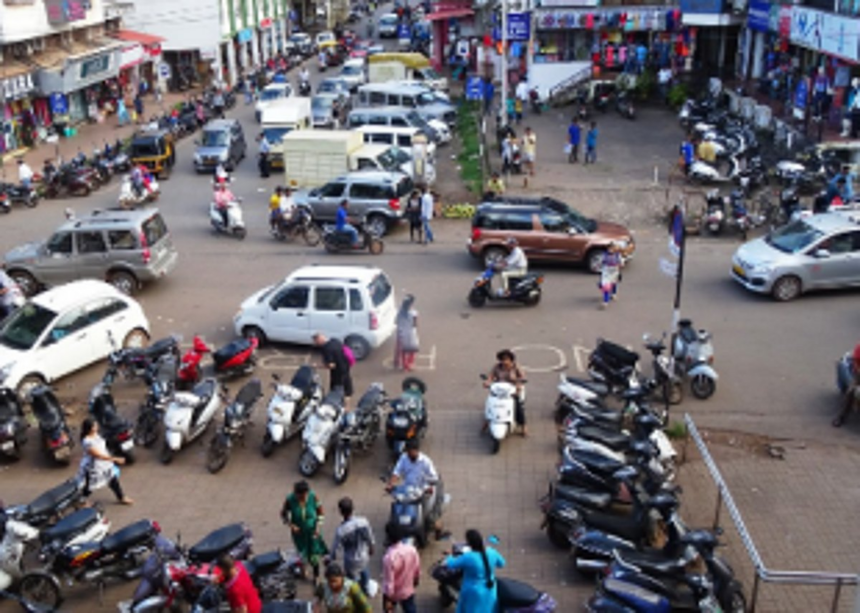
In fact, Goa has topped the list of Indian States with the maximum traffic density of 551 vehicles per 1,000 people. This translates to a vehicle for every second citizen of the State. Goa has one of the highest per capita incomes in the country so it is natural for people to aspire for a better lifestyle which includes upgrading to higher quality vehicles.
The latest Economic Survey released early this year for Goa, has pegged the average number of vehicles registered annually in the state at 80,000. The trend, which has been observed from the 2016-17 fiscal, indicates that there was a considerable rise from the 74,563 vehicles registered during 2015-16.
There has, therefore, been a steady increase in traffic on Goa roads with a total of 86119 new vehicles being registered in 2017-18 alone. As of December 31, 2018 the total number of such vehicles stands at 13.8 lakh. Over half of the 86,119 vehicles registered in the 2017-18 fiscal were two-wheelers. The infrastructure development is moving at a snail pace as compared to the rolling out on new vehicles on the road each year.
The Motor Vehicles (Amendment) Bill 2019 was passed by Parliament in July last year and its steep fines were to come into effect from September 1, 2019 though some States pushed it back saying people needed time to get acquainted with the enhanced penalties. Under this newly amended Act, traffic fines and penalties were revised and increased by almost 200 per cent of their original amount, which implied a huge dent on vehicle owners’ monthly spending due to driving errors. But even though these fines were supposed to be implemented countrywide from September 1, 2019, there were several States, including Goa, were hesitant about doing the same.
After delaying it for four months, the Goa government imposed traffic violation fines as per the amended Motor Vehicle Act from January 2020 onwards, based on Gujarat model. The Gujarat government has reduced fines related to certain offences.
The Gujarat government had reduced some fines under the amended Act in September. While the new Act stipulated a fine of Rs 1,000 for riding without a helmet, the Gujarat government finalised the amount at Rs 500. Similar was the case with driving a four-wheeler without wearing a seat-belt. The penalty for driving without a licence was brought down by the Gujarat government from Rs 5,000, as suggested by the new Act, to Rs 2,000 for two-wheelers and Rs 3,000 for four-wheelers.
Well, unfeasibility is one such reason that was cited by many States for putting their implementation on hold. Following this, States like Gujarat, Karnataka and now, Goa has decided to slash traffic rates as put forth under the Motor Vehicles (Amendment) Act, 2019. However, there was one good thing that Goa did was to introduce the concept of e-challan and payment through POS machines.
This automated E-challan is issued when one violates any traffic rule which is detected by the cameras placed strategically on every road. Following this, the owner of the vehicle will receive an SMS that will notify that the challan has been issued and present it with detailed information about the time, date and place of the traffic violation. One will need to pay the traffic fine of the raised challan within 60 days of receiving it.
On an average one person dies per day in road accidents in Goa. Two-wheeler riders in Goa continued to top the fatalities charts as they accounted for 182 of the 262 who lost their lives in road accidents in 2018. Accidents on Goa roads continue unabated even after implementation of new laws.
Unless we have proper infrastructure, heavy fines to stem errant drivers it is going to be a challenge maintaining even vehicular traffic and curtail unfortunate deaths on road. This can only come if traffic police is empowered to issue heavy fines. The drivers should also fear of law violation.