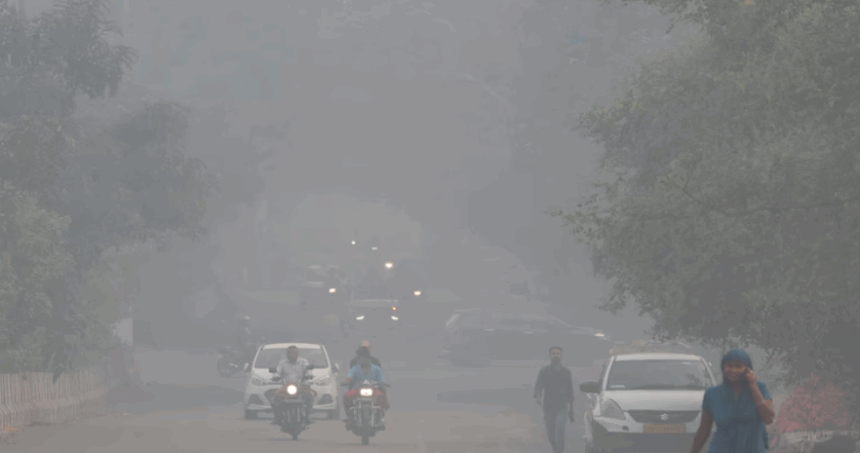
Delhi remained shrouded in a thick layer of toxic haze for the second consecutive day post-Diwali, as residents continued bursting firecrackers beyond the two-hour window set by the Supreme Court. According to data from the Central Pollution Control Board (CPCB), the city’s air quality index (AQI) was 345 at 7 am, placing it in the ‘very poor’ category.
Of the 38 monitoring stations across the capital, 34 recorded ‘very poor’ to ‘severe’ air quality, with Punjabi Bagh and Wazirpur hitting the ‘severe’ zone at AQIs of 433 and 401, respectively. For context, an AQI between 0-50 is considered ‘good,’ 51-100 ‘satisfactory,’ 101-200 ‘moderate,’ 201-300 ‘poor,’ 301-400 ‘very poor,’ and 401-500 ‘severe.’

Despite a 77.5% reduction in stubble burning — traditionally a major contributor to Delhi’s post-Diwali pollution — PM2.5 levels surged to alarming averages of 488 micrograms per cubic metre, nearly 100 times the World Health Organization’s recommended exposure limit.
The Supreme Court had permitted the use of ‘green’ firecrackers in Delhi-NCR between 8 pm and 10 pm on Diwali, with limited hours allowed on the preceding day. Yet, many residents ignored these restrictions, continuing celebrations well past the allowed timeframe, exacerbating the city’s pollution crisis.
(This story is published from a syndicated feed)