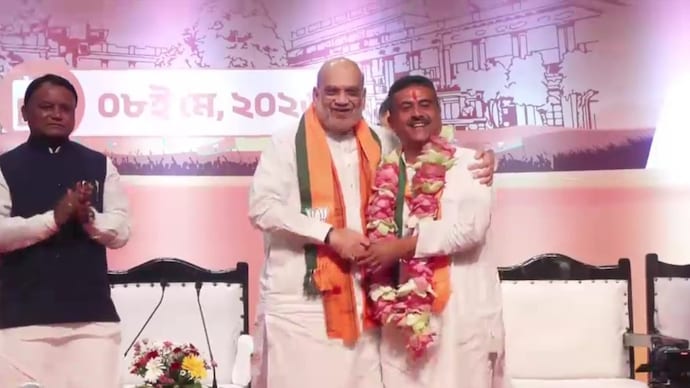
BJP leader Suvendu Adhikari is set to become the next Chief Minister of West Bengal, marking a historic moment as he becomes the first BJP leader to head a government in the state. Union Home Minister Amit Shah on Friday officially announced Adhikari as the elected leader of the BJP legislature party in West Bengal, confirming his elevation to the top post.
The announcement comes after a decisive electoral victory for the BJP, which won 207 of the 293 seats it contested in the 294-member Assembly. The result has been described as a major political shift in West Bengal, where regional forces and the Left had dominated politics for decades before the BJP’s rise.

The new government will be sworn in at Kolkata’s Brigade Parade Ground tomorrow in the presence of Prime Minister Narendra Modi, Union Home Minister Amit Shah, BJP national president Nitin Nabin, senior Union ministers, and chief ministers from BJP-ruled states. Preparations are already underway at Raj Bhavan, which is expected to play a central role in the government formation process.
Sources indicated that Adhikari will first arrive at Lok Bhavan around 6:30 pm before heading to Raj Bhavan, where he will formally present letters of support from BJP MLAs to stake claim to form the government.
Adhikari’s rise to the top post was widely anticipated. During the election campaign, BJP leaders repeatedly projected him as the “son of the soil” who reflects Bengal’s cultural and linguistic identity. His political career took a defining turn after he defeated outgoing Chief Minister Mamata Banerjee in Bhabanipur, a seat long considered her stronghold. He also retained Nandigram, a politically significant constituency tied to the 2007 anti-land acquisition movement.
Once a close aide of Banerjee in the Trinamool Congress, Adhikari played a key role in the Nandigram protests that contributed to the Left Front’s fall in 2011. His switch to the BJP ahead of the 2021 elections reshaped Bengal’s political landscape.
After the BJP’s victory, Adhikari called it the beginning of the “real change” in Bengal, expressing confidence that the party’s rule would have long-term stability in the state.