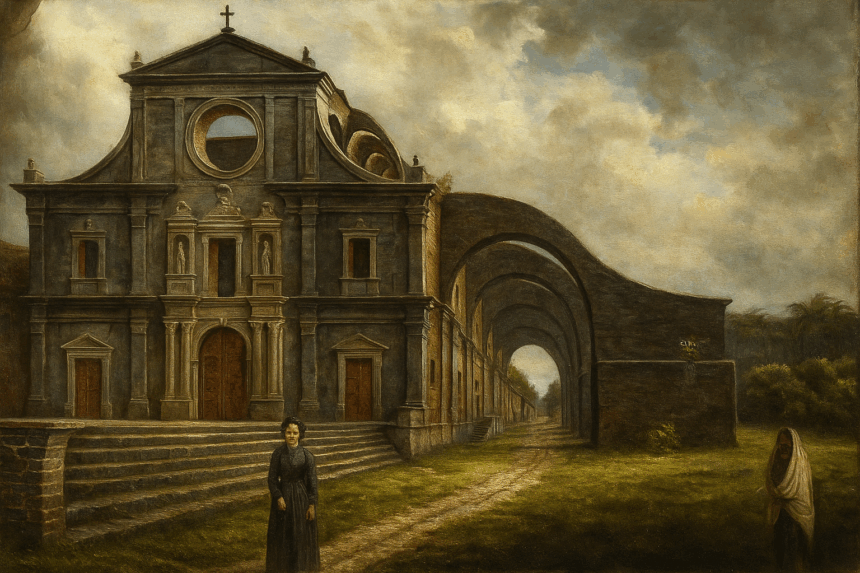
In 1560, the original church of St Paul was demolished due to its deteriorating condition, and on January 25 of the same year which is the Feast of the Conversion of St. Paul, the foundation stone for a larger church with three naves was laid. Around twenty years later, one of the walls of this new structure began to develop cracks. To reinforce it, three grand arched flying buttresses spanning the existing road were constructed under the supervision of the Jesuit João de Faria. Because of these supporting arches, the church came to be popularly known as S. Paulo dos Arcos or St. Paul of the Arches.
The design and construction of the new church were undertaken by Brother Antonio Dias, assisted by Brothers Cristovão de Araujo and Cosme Cardoso, both skilled masons. In 1556, Brother João Gonsalves assumed responsibility for continuing the construction. Later, in 1568, the Spanish architect Martin Ochoa took over the project and completed it by 1572, including the creation of the impressive main doorway.

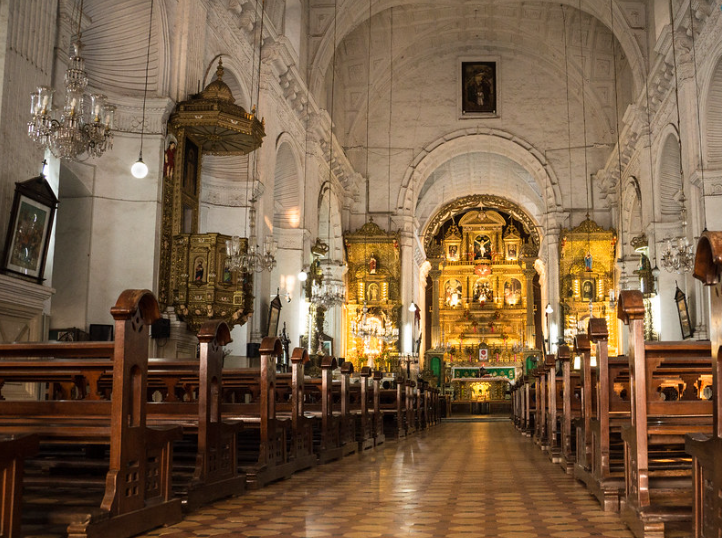
The Jesuits intended for this to be their most splendid church in Asia, a structure befitting what Alessandro Valignano described as “such a large and populated city.” The church followed the plain architectural style (architectura chã), similar to that of the Archiepiscopal Palace. It had no towers but featured three naves, measuring 50 meters in length and 25 meters in width, while the chancel measured 10.29 meters by 8.58 meters. Notably, coffered barrel vaults were used here for the first time.
The church had eight altars, with the main altar (altar-mor) dedicated to the Conversion of St. Paul. The Jesuits’ close association with this church led to them being popularly referred to as Paulistas (Paulists).
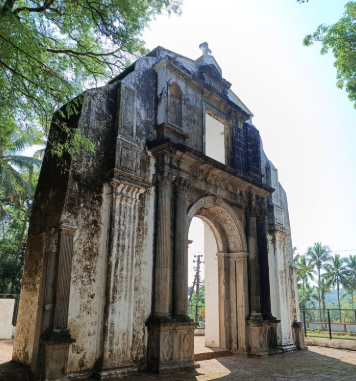
The remains of the five martyrs of Salçéte were later brought to this church. Following instructions from the Jesuit Father General Claudio Acquaviva, the Provincial Fr. Manuel da Veiga arranged in 1605 to build two niches in the chancel, one on the right for the body of St. Francis Xavier, and another on the left for the martyrs of Salçéte, both facing the altar.
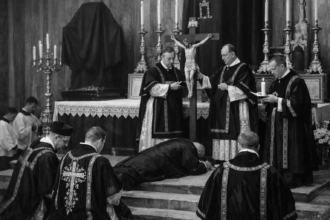
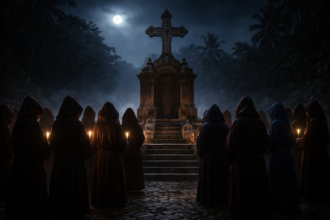
It was also in this institution that most likely the Santos Passos, a dramatic enactment of the Passion of Christ, was introduced in Asia for the first time. The penitential processions accompanying it were marked by acts of public self-flogging, and first-aid booths were set up at various points to assist participants. Additionally, the tradition of scattering flowers during the Feast of Our Lady of Mount originated here. The martyrs of Cuncolim were also buried within this church.
It is noteworthy that the pulpit at the Holy Spirit Church in Margão was a gift from the Jesuits and originally formed part of the Church of St. Paul, where it once adorned the walls.
In 1570, when an epidemic struck, the Jesuits acquired several houses belonging to Pedro de Faria on the hill of Nossa Senhora do Rosário in 1578 to serve as a convalescent home. This establishment came to be known as the Colégio de S. Roque, or College of St. Roque, and was sometimes referred to as College of St. Paul the New (S. Paulo o Novo), since all the departments and studies from the original College of St. Paul were transferred there.
The construction of this new building, however, met with strong opposition from the Augustinians and the nuns of Santa Monica. The Jesuits also faced hostility from other quarters, as the building was set on fire four times between 1591 and 1675.
Among its treasured relics was a surplice belonging to St. Francis Xavier, kept in a silver box, which was later moved to the Basilica of Bom Jesus.
The printing press from the old College of St. Paul was also relocated to the new college, where in 1654, the third edition of the “Purana” by Fr. Thomas Stephens was printed. Following the closure of the College, the Hospital Real (Royal Hospital) operated within the premises from 1760 to 1764.