Aman Verma
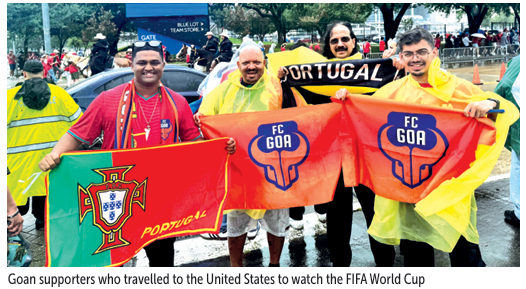
India’s absence from yet another FIFA World Cup is no longer just a sporting statistic; it reflects a deeper gap in the country’s footballing journey. While the world’s leading nations compete on the grandest stage and several Asian teams continue their steady rise, India remain on the outside, passionately following a tournament it has never qualified for.

For Goa Football Association (GFA) President Caetano Fernandes, the explanation lies not in talent, but in priorities, planning and support.
Speaking exclusively to O Heraldo from North America, where he is currently following the ongoing FIFA World Cup, Fernandes delivered a pointed critique of Indian football’s development model, arguing that the country’s stagnation stems from a lack of sustained commitment from policymakers.
“Why are we lacking in the World Cup? Because of lack of support from the Central government,” Fernandes said.
Across Asia, the contrast is becoming increasingly evident. Japan, South Korea, Saudi Arabia and Iran have established themselves as regular World Cup participants, while several other nations continue to make steady progress through long-term investment in grassroots football and youth development.
Fernandes believes India has failed to show a similar level of commitment.
“Central government only looks for medals in individual sports, but they don’t look at football as a universal game,” he said.
For him, football is far more than a sport. It is a global industry capable of generating economic opportunities, international visibility and national pride.
“Football is a big industry. Football and sports give a big name to the country. If we reach the World Cup, the entire world recognises us,” he said.
The contrast becomes even sharper when measured against India’s size and potential. Despite being home to more than 140 crore people and possessing strong football cultures in States such as Goa, Kerala and West Bengal, the country continues to struggle to consistently produce players capable of competing at Asia’s highest level.
“You tell me, we are 140 crore people. We cannot produce 40 players?” Fernandes asked.
At the heart of his argument is a simple distinction: talent exists, but the pathway beyond talent remains weak.
“We have talent. We have good players. What we require are good coaches and good mentorship.”
Fernandes believes India needs a focused and long-term player development programme rather than fragmented initiatives that fail to create continuity.
“Select 50 players, give them the best training and develop them properly,” he said.
Another major concern, according to Fernandes, is the lack of financial security for aspiring footballers — an issue that often forces talented players to abandon the sport.
“If they want to play, we should give them monetary support.”
“Give them salary also. Give them permanent jobs as well. Then they will be financially secure.”
Without that support system, he argues, sustaining commitment becomes increasingly difficult.
“Like anybody works in an organisation and puts their full effort, it is the same. We have to support them financially.”
Fernandes points to Japan as the clearest example of what long-term planning can achieve. He credits decades of strategic investment and structured development programmes for transforming Japan into a consistent World Cup nation.
“If you compare with Japan, they made a 30-year plan. That’s the reason today they are playing in the World Cup.”
Despite his criticism, Fernandes remains optimistic that India can eventually break through.
“India is lacking, but we will also come,” he said. “We will be in the World Cup in the coming years.”
He also believes Goa can play a significant role in that journey.
“Goa can produce a full team for India,” Fernandes said.
Fernandes argued that Goa’s footballing potential remains underutilised despite the State’s rich football heritage.
“Goa has the talent, the passion and the football culture to produce players capable of competing at the highest level, but without proper government support, infrastructure, quality coaching and financial security for players, that potential will continue to go to waste,” he said.
According to Fernandes, the issue is not a lack of ability but a lack of sustained investment and planning.
“We are a State known for football, yet many players still struggle for opportunities,” he said.
Fernandes said, “Goa could become the backbone of Indian football if governments treated the sport as a long-term priority rather than a secondary concern.”
“If the Pramod Sawant government and the Centre make football a priority and invest consistently over the next few years, there is no reason why Goa cannot become the backbone of an Indian team capable of reaching the World Cup,” he added.
Ultimately, Fernandes argues that India’s football problem is not about physicality, population or even passion, but about organisation, planning and long-term commitment.
The country’s relationship with the sport remains one of admiration without execution: India watches, celebrates and produces talent in pockets, but continues to fall short where it matters most — building a system capable of turning potential into consistent international performance.
As smaller nations continue to break through and Asia steadily expands its presence on football’s biggest stage, the gap is no longer about ability alone, but about structure and intent. Until that changes, India’s World Cup dream will remain permanently within reach, but never fully realised.