AJIT PETER JOHN
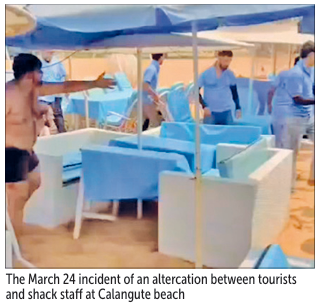
In the wake of a spate of violent clashes between tourists and lo cals, the Goa administra tion’s renewed emphasis on strict penal action against anyone ‘hurting tourists’ or damaging the State’s image has triggered sharp push back from those on the frontlines of its tourism economy. The official signalling — seen as part of a broad er attempt to safeguard Goa’s reputation as a safe destination — comes even as stakeholders warn that the State risks overlooking a growing pattern of unruly and en titled behaviour among visitors. At the heart of the de bate lies a deeper ques tion: Can Goa’s long-held ethos of ‘Atithi Devo Bha va’ coexist with increas ing impunity among sec tions of tourists? Recent incidents have underscored the vola tility of the situation. In one of the more serious cases, a group of 10-12 tourists from Karnataka allegedly assaulted a local man near the Mapusa taxi stand between March 27 following a minor rear end collision. Eyewitness accounts indicate that the group used abusive language before 5–6 in dividuals physically at tacked the victim in front of his family, triggering a wider confrontation when locals intervened. Seven tourists were sub sequently arrested. Another violent assault on March 24 involving tourists from Bengalu ru and shack owners occurred at Calangute, leading to the suspension of the shack’s licence. The allegedly inebriated tourists occupied beach beds without ordering anything and reportedly abused the staff, which then escalated into vio lence. The episode was not isolated. Earlier, on March 2, five tourists were ac cused of assaulting an India Reserve Battalion policeman in Mapusa fol lowing a vehicle accident.

On March 24, another altercation on the Candolim road escalated into violence after tourists rammed a local vehi cle and engaged in a heated dispute. Yet, even as such incidents accumulate, the State’s mes saging has remained focused on protecting tourists and preserving Goa’s image — an approach that many stake holders argue is skewed. Tourism operators say the problem is no longer sporad ic but systemic. “This is happening all over Goa. People come in groups, drink, relax on beach beds, and spend time at shacks. We welcome them, but it depends on how they treat shack owners and staff,” said Cruz Cardozo, president of the All Goa Shack Owners Association. While cautioning against blanket blame, Cardozo point ed to a pattern of confrontational behaviour. “A few local operators may behave badly, but you cannot blame every one. There are also tourists who eat and leave without paying. Who tracks them?” he asked. He also flagged the risks faced by frontline workers, calling for stronger enforcement. “Police need to be pres ent after 5 pm. Response time must improve. Our staff are at risk.” For many in the sector, the concern is not just about isolated violence but about a shift in tourist conduct — marked by intoxication, entitlement, and disregard for local norms. Shack operator S K Moses from Colva described an in creasingly difficult operating environment. “When tour ists come drunk or high, they become very demanding. It is difficult to say no because we are in the hospitality business,” he said. Disputes, he noted, often centre around billing. “When bills cross Rs 2,000–3,000, they start demanding dis counts or create a scene, sometimes claiming they are from the government.” Moses also highlighted behavioural concerns beyond fi nancial disputes. “Why take pictures of women in bikinis? It creates discomfort and looks very bad,” he said, pointing to a lack of basic personal boundaries. Even in relatively quieter belts, operators say they are forced to tolerate conduct that would otherwise be unac ceptable. “We get more budget customers and can some times filter out troublemakers, but we still have to tolerate certain behaviour,” he added. Authorities, meanwhile, acknowledge constraints in maintaining order across a sprawling and high-density tourism landscape. “We are doing whatever is possible, especially on busy stretches like Calangute. But we cannot be present every where,” said Superintendent of Tourism Police Pravin Ku mar Vast. “Every day, we have new tourists from different states. It is not possible to control each individual. Cooperation is essential,” he added. In Panjim’s Latin Quarter, where there are frequent alter cations between residents and tourists, the situation has reportedly improved. While the introduction of wardens has had some impact, gaps remain. “Wardens are present now, so tourists behave better. Earlier, many would create unnecessary nuisance,” said Aloo Gomes, even as he point ed out that disturbances continue to disrupt daily life. “We want to rest in the afternoon, but some tourists con tinue to behave badly. This is not the kind of tourism Goa needs,” he said. Residents argue that the current discourse risks creating an imbalance — where protecting tourists becomes synon ymous with overlooking misconduct. “It works both ways. Nobody should resort to violence. There is law and order that needs to be followed. If locals are harassed, they should call the police. Tourists should do the same,” said Lloyd Mascarenes from Parra. Others warned that failure to address the root issue could damage Goa’s image far more than isolated confron tations. “It gives a bad name to Goa. This could have been avoided with better understanding. Taking the law into one’s own hands only worsens the situation,” a resident said. Anil Figredo echoed the sentiment, calling the escalation of minor disputes into violence ‘unfortunate’. “Sometimes issues can be resolved quickly, but they escalate unneces sarily,” he said. For Goa’s tourism-dependent economy, the stakes are clear. Shack owners and locals alike stress that while vis itors remain central to livelihoods, discipline and mutual respect are non-negotiable. “Without tourists, there is no income. But without disci pline, there will be no tourism in the long run,” Cruz Car dozo warned. As the State doubles down on protecting its global image, the unfolding pushback suggests that the real challenge lies not in choosing between tourists and locals — but in enforcing a framework where neither is above the law. The message from the ground is increasingly unambig uous — Atithi Devo Bhava cannot be misread as uncondi tional tolerance.