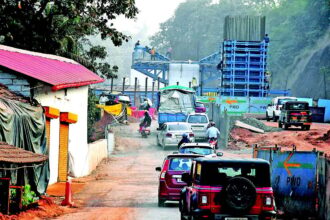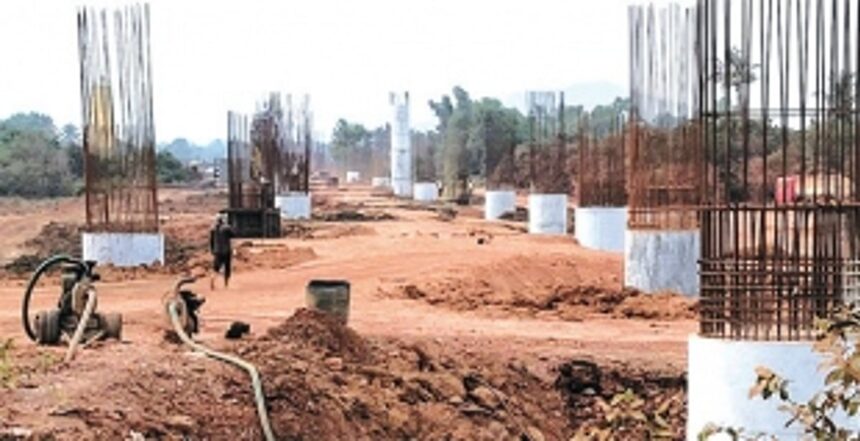
BENAULIM: There is anxiety building amongst residents of Benaulim as the work on the Western Bypass stretch passing through their village is being expedited, raising concerns if their collective and long-standing demand for the bypass to be built on stilts and not embankments, won’t be fulfilled. For the villagers, if the bypass is built on embankments, there will be widespread destruction to the fields, the biodiversity, and moreover, there will be flooding during the monsoon season.
Given that there have been floods for the last two consecutive years, which were followed by site inspections from various authorities, locals wonder why the government is failing to see reason and listen to their demands.

Even the Water Resources Department (WRD) in its inspection reports of the flooding of Tolleabandh area in July 2023 and July 2022, had warned against the construction of the bypass on stilts on the grounds that it would cause flooding.
Incidentally, Seraulim, where the bypass stretch is being constructed on stilts, witnessed flooding, causing damage to the farmers, who attributed the heavy waterlogging to the filling up of low-lying fields. The villagers’ demand too suffered a setback when an expert who had been commissioned by the Union Ministry of Surface Transport in New Delhi did not endorse the idea of constructing the bypass on elevated platforms through the Tolleabandh water catchment area in Benaulim. The expert, R K Pandey had been sent by Union Highway Minister Nitin Gadkari to assess the feasibility of constructing a bypass on stilts along the Tolleabandh stretch of the Western Bypass. During his evaluation of the Khareband-Benaulim segment of the Sal River, Pandey noted that even if the bypass was built on stilts, the Tolleabandh water body would still be prone to inundation during the monsoon due to slow drainage into the Sal River. Based on his inspection, Pandey concluded that a comprehensive solution is needed to address the issues, including actions such as river desilting and the construction and widening of culverts along the Margao-Varca road, connecting Tolleabandh to the Sal River.
Pandey however did provide alternative suggestions for improving the Sal River’s discharge capacity, emphasising the importance of actions like desilting and dredging. Furthermore, he highlighted the necessity of enhancing the drainage capabilities from Varca road to the Sal River, which could involve increasing culvert size or their numbers.
Pandey recommended avoiding the construction of reinforced earthen walls in flood-prone areas and conducting a review of the slope stability in high embankment regions with a 1:1 slope. However, according to locals, these recommendations have been ignored.
Moreover, the concerns long harboured by farmers tending to the fields near the Tolleaband catchment area in Benaulim have also unfortunately materialised. Last monsoon, these Tolleaband farmers experienced a decrease in yield as a significant portion of their fields were flooded. During the present season, the drainage issue has persisted casting a shadow over their efforts. With the raising if the earthen embankment for the Western Bypass by dumping truckloads of mud into the water body, the problem has worsened. Farmers have urged the PWD and WRD to address the drainage inadequacies.
Farmers lamented that the existing drainage infrastructure, including culverts installed by the PWD, has not effectively managed excess water since the construction of the embankment for the bypass. Some have even resorted to renting pumps to salvage their fields, emphasizing the insufficiency of the PWD’s drainage measures. Despite the PWD’s attempts to address the issue by increasing the number of culverts along the bypass stretch passing through the village, the farmers pointed
out that the water still fails to drain adequately. They added that the culverts are too small in width and have failed to prevent damage to their cultivated fields.